Faculty of Veterinary and Agricultural Sciences, University of Melbourne, Parkville, VIC 3010, Australia.
Rivalea Australia Pty Ltd., Corowa, NSW 2646, Australia.
Int J Mol Sci. 2021 Apr 16;22(8):4147. doi: 10.3390/ijms22084147.
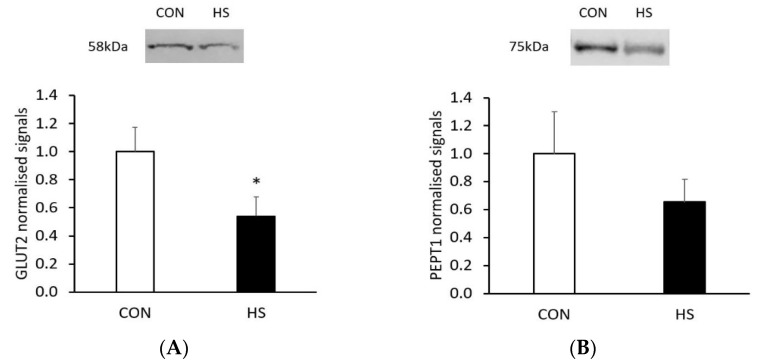
Placental insufficiency is a known consequence of maternal heat stress during gestation in farm animals. The molecular regulation of placentae during the stress response is little known in pigs. This study aims to identify differential gene expression in pig placentae caused by maternal heat exposure during early to mid-gestation. RNA sequencing (RNA-seq) was performed on female placental samples from pregnant pigs exposed to thermoneutral control (CON; constant 20 °C; = 5) or cyclic heat stress (HS; cyclic 28 to 33 °C; = 5) conditions between d40 and d60 of gestation. On d60 of gestation, placental efficiency (fetal/placental weight) was decreased ( = 0.023) by maternal HS. A total of 169 genes were differentially expressed (FDR ≤ 0.1) between CON and HS placentae of female fetuses, of which 35 genes were upregulated and 134 genes were downregulated by maternal HS. The current data revealed transport activity (FDR = 0.027), glycoprotein biosynthetic process (FDR = 0.044), and carbohydrate metabolic process (FDR = 0.049) among the terms enriched by the downregulated genes (HS vs. CON). In addition, solute carrier (SLC)-mediated transmembrane transport (FDR = 0.008) and glycosaminoglycan biosynthesis (FDR = 0.027), which modulates placental stroma synthesis, were identified among the pathways enriched by the downregulated genes. These findings provide evidence that heat-stress induced placental inefficiency may be underpinned by altered expression of genes associated with placental nutrient transport capacity and metabolism. A further understanding of the molecular mechanism contributes to the identification of placental gene signatures of summer infertility in pigs.
胎盘功能不全是家畜在妊娠期间母体受热应激的已知后果。在猪中,应激反应期间胎盘的分子调节知之甚少。本研究旨在鉴定因妊娠早期至中期母体受热暴露而导致的猪胎盘的差异基因表达。对暴露于热中性对照(CON;恒定 20°C;n = 5)或循环热应激(HS;循环 28 至 33°C;n = 5)条件下妊娠母猪的雌性胎盘样本进行 RNA 测序(RNA-seq)。在妊娠第 60 天,母体 HS 降低了胎盘效率(胎儿/胎盘重量)( = 0.023)。在 CON 和 HS 雌性胎儿胎盘之间共鉴定出 169 个差异表达基因(FDR ≤ 0.1),其中 35 个基因上调,134 个基因下调。母体 HS 。目前的数据揭示了转运活性(FDR = 0.027),糖蛋白生物合成过程(FDR = 0.044)和碳水化合物代谢过程(FDR = 0.049)是下调基因富集的术语(HS 与 CON)之一。此外,还鉴定了溶质载体(SLC)介导的跨膜转运(FDR = 0.008)和糖胺聚糖生物合成(FDR = 0.027),这调节胎盘基质合成,这些途径是下调基因富集的途径。这些发现为热应激引起的胎盘效率低下可能是与胎盘营养转运能力和代谢相关的基因表达改变所支撑提供了证据。进一步了解分子机制有助于鉴定猪夏季不育的胎盘基因特征。