Ortega-Barón Jéssica, González-Cabrera Joaquín, Machimbarrena Juan M, Montiel Irene
Faculty of Education, Universidad Internacional de la Rioja (UNIR), Avenida de la Paz, 137, 26006 Logroño, Spain.
Faculty of Psychology, Universidad del País Vasco (UPV/EHU), Avenida de Tolosa, 70, 20018 Donostia, Spain.
Int J Environ Res Public Health. 2021 Apr 16;18(8):4249. doi: 10.3390/ijerph18084249.
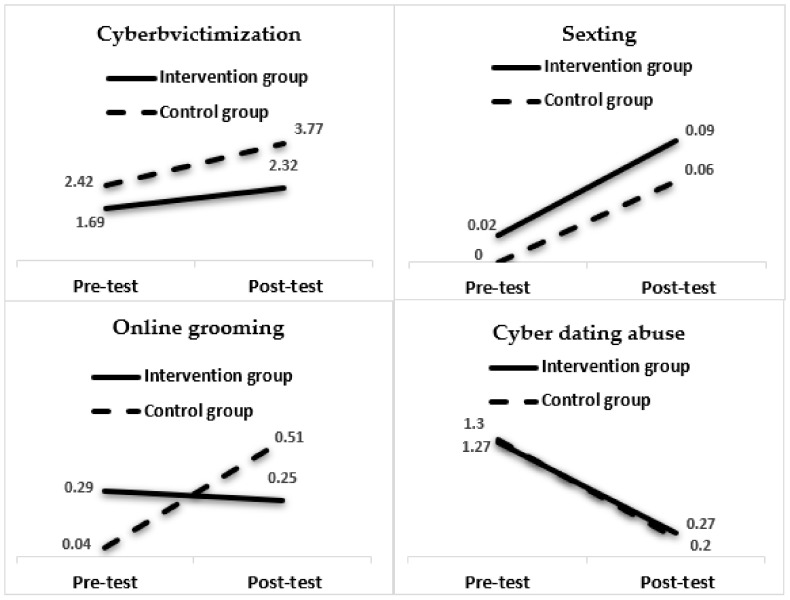
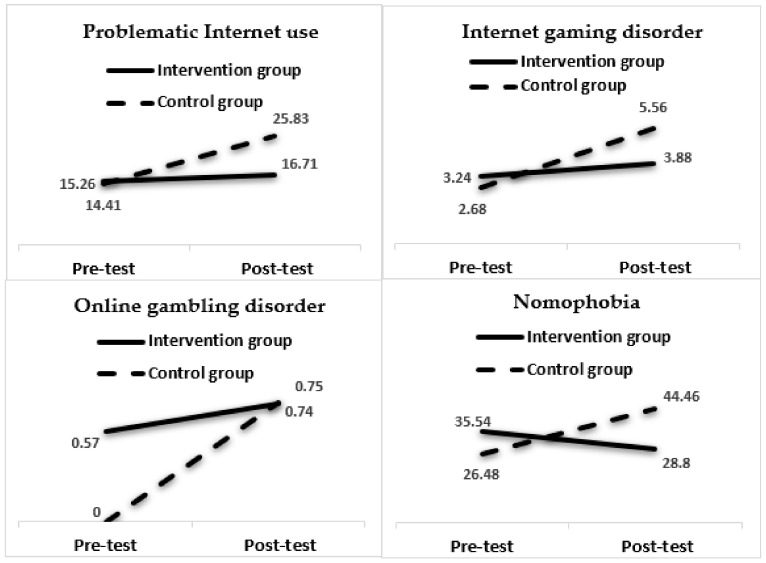
Many programs exist to prevent bullying and cyberbullying. Nevertheless, despite evidence of the numerous overlapping risks of the Internet, programs that jointly and adequately address large sets of risks are not presently described in the scientific literature. This study's main objective was to assess the effectiveness of the Safety.net program in a pilot sample. This program prevents eight Internet risks: cyberbullying, sexting, online grooming, cyber dating abuse, problematic Internet use, nomophobia, Internet gaming disorder, and online gambling disorder. The Safety.net program comprises 16 sessions and 4 modules (digital skills, relational risks, dysfunctional risks, and change of attitudes and cognitions). Each session lasts one hour, but the program has a networked instructional design to recall previous content in later sessions. For its assessment, a pre/post-test repeated measures design with a control group and an intervention group was used. The study sample was 165 adolescents between 11 and 14 years old (M = 12.11, SD = 0.89). The intervention group demonstrated improvements compared to the control group concerning online grooming, problematic Internet use, Internet gaming disorder, and nomophobia. These results suggest that the Safety.net program is effective in preventing the increase of most of the assessed risks and that it reduces some of them with a small number of sessions.
有许多项目致力于预防欺凌和网络欺凌。然而,尽管有证据表明互联网存在众多重叠风险,但科学文献中目前尚未描述能联合且充分应对大量风险的项目。本研究的主要目的是在一个试点样本中评估Safety.net项目的有效性。该项目可预防八种互联网风险:网络欺凌、发送色情短信、网络诱骗、网络约会虐待、网络使用问题、无手机恐惧症、网络游戏障碍和网络赌博障碍。Safety.net项目包括16节课程和4个模块(数字技能、关系风险、功能失调风险以及态度和认知改变)。每节课程持续一小时,但该项目采用网络化教学设计,以便在后续课程中回顾之前的内容。为了进行评估,采用了带有对照组和干预组的前后测重复测量设计。研究样本为165名11至14岁的青少年(M = 12.11,SD = 0.89)。与对照组相比,干预组在网络诱骗、网络使用问题、网络游戏障碍和无手机恐惧症方面有改善。这些结果表明,Safety.net项目在预防大多数评估风险的增加方面是有效的,并且通过少量课程就能减少其中一些风险。