Genome Damage and Stability Centre, School of Life Sciences, University of Sussex, Falmer, Brighton BN1 9RQ, UK.
Int J Mol Sci. 2021 Apr 13;22(8):3984. doi: 10.3390/ijms22083984.
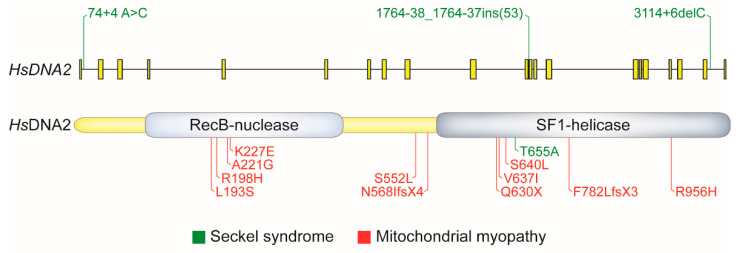
The conserved nuclease-helicase DNA2 has been linked to mitochondrial myopathy, Seckel syndrome, and cancer. Across species, the protein is indispensable for cell proliferation. On the molecular level, DNA2 has been implicated in DNA double-strand break (DSB) repair, checkpoint activation, Okazaki fragment processing (OFP), and telomere homeostasis. More recently, a critical contribution of DNA2 to the replication stress response and recovery of stalled DNA replication forks (RFs) has emerged. Here, we review the available functional and phenotypic data and propose that the major cellular defects associated with DNA2 dysfunction, and the links that exist with human disease, can be rationalized through the fundamental importance of DNA2-dependent RF recovery to genome duplication. Being a crucial player at stalled RFs, DNA2 is a promising target for anti-cancer therapy aimed at eliminating cancer cells by replication-stress overload.
保守的核酸酶-解旋酶 DNA2 与线粒体肌病、Seckel 综合征和癌症有关。在不同物种中,该蛋白对于细胞增殖是不可或缺的。在分子水平上,DNA2 已被牵连到 DNA 双链断裂 (DSB) 修复、检查点激活、冈崎片段加工 (OFP) 和端粒稳态。最近,DNA2 对复制应激反应和停滞 DNA 复制叉 (RF) 的恢复的关键贡献已经出现。在这里,我们回顾了现有的功能和表型数据,并提出与 DNA2 功能障碍相关的主要细胞缺陷,以及与人类疾病之间的联系,可以通过 DNA2 依赖性 RF 恢复对基因组复制的基本重要性来合理化。作为停滞 RF 中的关键参与者,DNA2 是一种有前途的抗癌治疗靶点,旨在通过复制压力过载消除癌细胞。