Department of Biology, Faculty of Science, Universiti Putra Malaysia, UPM, Serdang 43400, Malaysia.
Department of Biology, Faculty of Science, University of Tabuk, Tabuk 741, Saudi Arabia.
Int J Environ Res Public Health. 2021 Apr 28;18(9):4682. doi: 10.3390/ijerph18094682.
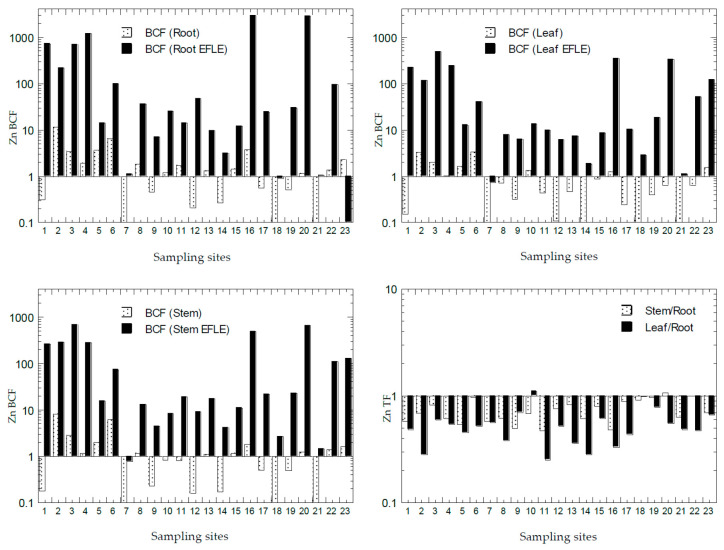
The invasive weed was investigated for its potential as a biomonitor and as a phytoremediator of potentially toxic metals (PTMs) (Cd, Cu, Ni, Pb, and Zn) in Peninsular Malaysia owing to its ecological resistance towards unfavourable environments. The biomonitoring potential of PTMs was determined based on the correlation analysis of the metals in the different parts of the plant (leaves, stems, and roots) and its habitat topsoils. In the roots, the concentrations (mg/kg dry weight) of Cd, Cu, Ni, Pb, and Zn ranged from 0.03 to 2.18, 9.22 to 139, 0.63 to 5.47, 2.43 to 10.5, and 50.7 to 300, respectively. In the leaves, the concentrations (mg/kg dry weight) of Cd, Cu, Ni, Pb, and Zn ranged from 0.03 to 1.16, 7.94 to 20.2, 0.03 to 6.13, 2.10 to 21.8, and 18.8 to 160, respectively. In the stems, the concentrations (mg/kg dry weight) of Cd, Cu, Ni, Pb, and Zn ranged from 0.03 to 1.25, 5.57 to 11.8, 0.23 to 3.69, 0.01 to 7.79, and 26.4 to 246, respectively. On the other hand, the phytoremediation potential of the five metals was estimated based on the bioconcentration factor (BCF) and the translocation factor (TF) values. Correlation analysis revealed that the roots and stems could be used as biomonitors of Cu, the stems as biomonitors of Ni, the roots and leaves as biomonitors of Pb, and all three parts of the plant as biomonitors of Zn. According to the BCF values, in the topsoil, the "easily, freely, leachable, or exchangeable" geochemical fractions of the five metals could be more easily transferred to the roots, leaves, and stems when compared with total concentrations. Based on the TF values of Cd, Ni, and Pb, the metal transfer to the stems (or leaves) from the roots was efficient (>1.0) at most sampling sites. The results of BCF and TF showed that was a good phytoextractor for Cd and Ni, and a good phytostabilizer for Cu, Pb, and Zn. Therefore, is a good candidate as a biomonitor and a phytoremediator of Ni, Pb, and Zn for sustainable contaminant remediation subject to suitable field management strategies.
由于其对不利环境的生态抗性,入侵杂草被调查为生物监测器和潜在有毒金属(PTM)(Cd、Cu、Ni、Pb 和 Zn)的植物修复剂,在马来西亚半岛。基于金属在植物不同部位(叶、茎和根)及其生境表土中的相关性分析,确定了 PTM 的生物监测潜力。在根部,Cd、Cu、Ni、Pb 和 Zn 的浓度(mg/kg 干重)分别为 0.03 至 2.18、9.22 至 139、0.63 至 5.47、2.43 至 10.5 和 50.7 至 300。在叶片中,Cd、Cu、Ni、Pb 和 Zn 的浓度(mg/kg 干重)分别为 0.03 至 1.16、7.94 至 20.2、0.03 至 6.13、2.10 至 21.8 和 18.8 至 160。在茎中,Cd、Cu、Ni、Pb 和 Zn 的浓度(mg/kg 干重)分别为 0.03 至 1.25、5.57 至 11.8、0.23 至 3.69、0.01 至 7.79 和 26.4 至 246。另一方面,根据生物浓缩因子(BCF)和迁移因子(TF)值,估算了这五种金属的植物修复潜力。相关分析表明,根和茎可作为 Cu 的生物监测器,茎可作为 Ni 的生物监测器,根和叶可作为 Pb 的生物监测器,植物的所有三个部分都可作为 Zn 的生物监测器。根据 BCF 值,在表土中,与总浓度相比,五种金属的“易、自由、可浸提或可交换”地球化学形态更容易转移到根、叶和茎中。根据 Cd、Ni 和 Pb 的 TF 值,在大多数采样点,金属从根部向茎(或叶)的转移效率(>1.0)较高。BCF 和 TF 的结果表明,对于 Cd 和 Ni, 是一种很好的植物提取剂,对于 Cu、Pb 和 Zn,是一种很好的植物稳定剂。因此, 是一种很好的生物监测器和 Ni、Pb 和 Zn 的植物修复剂,适用于可持续污染物修复,受适当的田间管理策略的影响。