Pandya Abhilash D, Iversen Tore-Geir, Moestue Siver, Grinde Maria T, Mørch Ýrr, Snipstad Sofie, Åslund Andreas K O, Øy Geir F, Kildal Wanja, Engebråten Olav, Sandvig Kirsten, Skotland Tore, Mælandsmo Gunhild M
Department of Tumor Biology, Institute for Cancer Research, Oslo University Hospital, The Norwegian Radium Hospital, 0379 Oslo, Norway.
Department of Molecular Cell Biology, Institute for Cancer Research, Oslo University Hospital, The Norwegian Radium Hospital, 0379 Oslo, Norway.
Nanomaterials (Basel). 2021 Apr 28;11(5):1140. doi: 10.3390/nano11051140.
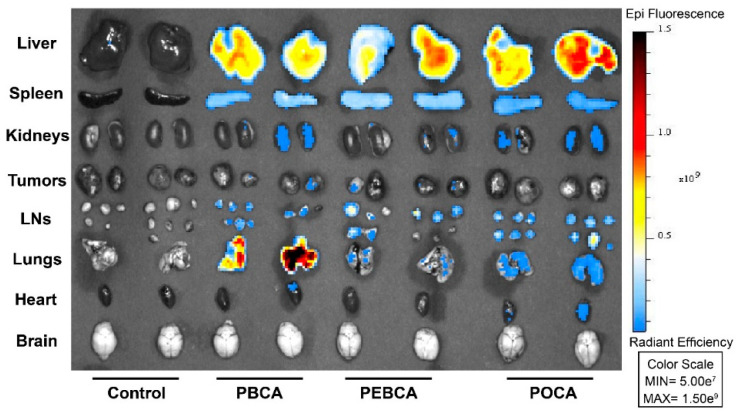
We have investigated the biodistribution and tumor macrophage infiltration after intravenous injection of the poly(alkyl cyanoacrylate) nanoparticles (NPs): PEBCA (poly(2-ethyl-butyl cyanoacrylate), PBCA (poly(n-butyl cyanoacrylate), and POCA (poly(octyl cyanoacrylate), in mice. These NPs are structurally similar, have similar PEGylation, and have previously been shown to give large variations in cellular responses in vitro. The PEBCA NPs had the highest uptake both in the patient-derived breast cancer xenograft MAS98.12 and in lymph nodes, and therefore, they are the most promising of these NPs for delivery of cancer drugs. High-resolution magic angle spinning magnetic resonance (HR MAS MR) spectroscopy did not reveal any differences in the metabolic profiles of tumors following injection of the NPs, but the PEBCA NPs resulted in higher tumor infiltration of the anti-tumorigenic M1 macrophages than obtained with the two other NPs. The PEBCA NPs also increased the ratio of M1/M2 (anti-tumorigenic/pro-tumorigenic) macrophages in the tumors, suggesting that these NPs might be used both as a vehicle for drug delivery and to modulate the immune response in favor of enhanced therapeutic effects.
我们研究了静脉注射聚(烷基氰基丙烯酸酯)纳米颗粒(NPs):聚(2-乙基丁基氰基丙烯酸酯)(PEBCA)、聚(正丁基氰基丙烯酸酯)(PBCA)和聚(辛基氰基丙烯酸酯)(POCA)后在小鼠体内的生物分布和肿瘤巨噬细胞浸润情况。这些纳米颗粒结构相似,聚乙二醇化程度相近,且此前已证明它们在体外细胞反应中表现出很大差异。PEBCA纳米颗粒在患者来源的乳腺癌异种移植瘤MAS98.12和淋巴结中的摄取量最高,因此,它们是这些纳米颗粒中最有希望用于递送癌症药物的。高分辨率魔角旋转磁共振(HR MAS MR)光谱未显示注射纳米颗粒后肿瘤代谢谱有任何差异,但与其他两种纳米颗粒相比,PEBCA纳米颗粒导致抗肿瘤的M1巨噬细胞在肿瘤中的浸润更高。PEBCA纳米颗粒还增加了肿瘤中M1/M2(抗肿瘤/促肿瘤)巨噬细胞的比例,这表明这些纳米颗粒既可以用作药物递送载体,又可以调节免疫反应以增强治疗效果。