Magnetic Resonance Center (CERM), University of Florence, 50019 Sesto Fiorentino, Italy.
Department of Chemistry "Ugo Schiff", University of Florence, 50019 Sesto Fiorentino, Italy.
Int J Mol Sci. 2021 Apr 28;22(9):4687. doi: 10.3390/ijms22094687.
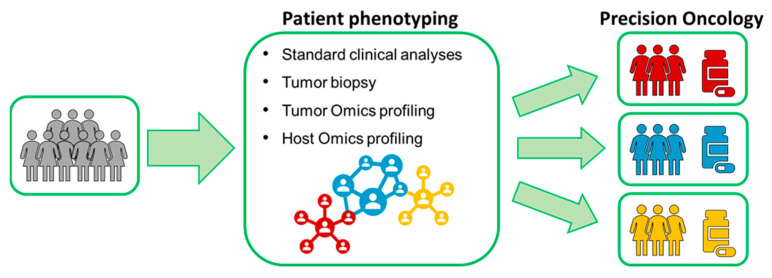
Precision oncology is an emerging approach in cancer care. It aims at selecting the optimal therapy for the right patient by considering each patient's unique disease and individual health status. In the last years, it has become evident that breast cancer is an extremely heterogeneous disease, and therefore, patients need to be appropriately stratified to maximize survival and quality of life. Gene-expression tools have already positively assisted clinical decision making by estimating the risk of recurrence and the potential benefit from adjuvant chemotherapy. However, these approaches need refinement to further reduce the proportion of patients potentially exposed to unnecessary chemotherapy. Nuclear magnetic resonance (NMR) metabolomics has demonstrated to be an optimal approach for cancer research and has provided significant results in BC, in particular for prognostic and stratification purposes. In this review, we give an update on the status of NMR-based metabolomic studies for the biochemical characterization and stratification of breast cancer patients using different biospecimens (breast tissue, blood serum/plasma, and urine).
精准肿瘤学是癌症治疗领域的一种新兴方法。它旨在通过考虑每个患者独特的疾病和个体健康状况,为合适的患者选择最佳的治疗方法。近年来,已经明显看出乳腺癌是一种极具异质性的疾病,因此,需要对患者进行适当的分层,以最大限度地提高生存率和生活质量。基因表达工具已经通过估计复发风险和辅助化疗的潜在获益,积极辅助临床决策。然而,这些方法需要进一步改进,以进一步减少潜在接受不必要化疗的患者比例。核磁共振(NMR)代谢组学已被证明是癌症研究的最佳方法,并在乳腺癌中提供了重要的结果,特别是在预后和分层方面。在这篇综述中,我们更新了基于 NMR 的代谢组学研究的现状,这些研究使用不同的生物样本(乳腺组织、血清/血浆和尿液)对乳腺癌患者进行生物化学特征分析和分层。