Carvalho Ângela, Ferreira Gabriela, Seixas Duarte, Guimarães-Teixeira Catarina, Henrique Rui, Monteiro Fernando J, Jerónimo Carmen
i3S-Instituto de Investigação e Inovação em Saúde, Universidade do Porto, Rua Alfredo Allen 208, 4200-135 Porto, Portugal.
INEB-Instituto de Engenharia Biomédica, Universidade do Porto, Rua Alfredo Allen 208, 4200-135 Porto, Portugal.
Cancers (Basel). 2021 Apr 27;13(9):2101. doi: 10.3390/cancers13092101.
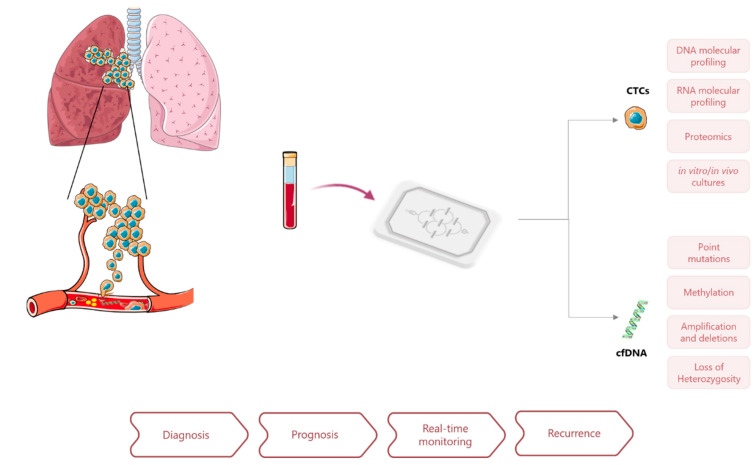
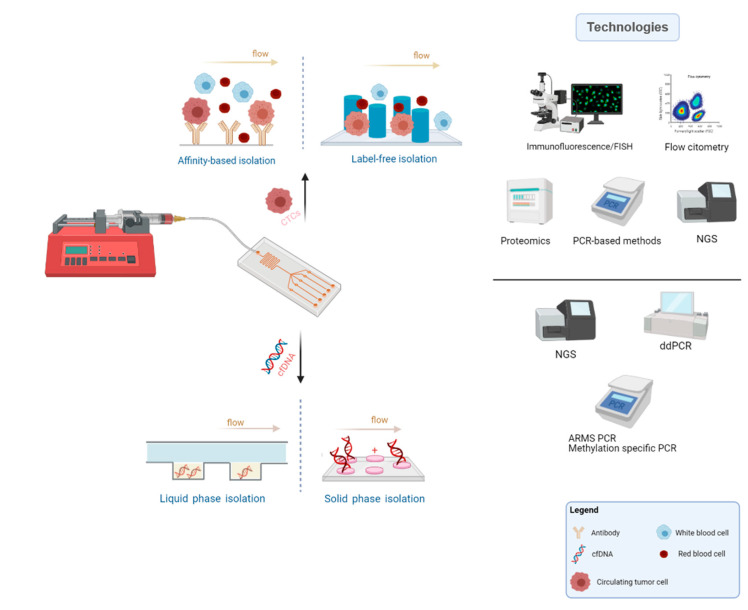
Despite the intensive efforts dedicated to cancer diagnosis and treatment, lung cancer (LCa) remains the leading cause of cancer-related mortality, worldwide. The poor survival rate among lung cancer patients commonly results from diagnosis at late-stage, limitations in characterizing tumor heterogeneity and the lack of non-invasive tools for detection of residual disease and early recurrence. Henceforth, research on liquid biopsies has been increasingly devoted to overcoming these major limitations and improving management of LCa patients. Liquid biopsy is an emerging field that has evolved significantly in recent years due its minimally invasive nature and potential to assess various disease biomarkers. Several strategies for characterization of circulating tumor cells (CTCs) and circulating tumor DNA (ctDNA) have been developed. With the aim of standardizing diagnostic and follow-up practices, microfluidic devices have been introduced to improve biomarkers isolation efficiency and specificity. Nonetheless, implementation of lab-on-a-chip platforms in clinical practice may face some challenges, considering its recent application to liquid biopsies. In this review, recent advances and strategies for the use of liquid biopsies in LCa management are discussed, focusing on high-throughput microfluidic devices applied for CTCs and ctDNA isolation and detection, current clinical validation studies and potential clinical utility.
尽管在癌症诊断和治疗方面付出了巨大努力,但肺癌(LCa)仍是全球癌症相关死亡的主要原因。肺癌患者生存率低通常是由于晚期诊断、表征肿瘤异质性的局限性以及缺乏用于检测残留疾病和早期复发的非侵入性工具。因此,液体活检的研究越来越致力于克服这些主要局限性并改善肺癌患者的管理。液体活检是一个新兴领域,近年来由于其微创性质和评估各种疾病生物标志物的潜力而有了显著发展。已经开发了几种表征循环肿瘤细胞(CTC)和循环肿瘤DNA(ctDNA)的策略。为了使诊断和随访实践标准化,已引入微流控设备以提高生物标志物的分离效率和特异性。然而,考虑到其最近在液体活检中的应用,芯片实验室平台在临床实践中的实施可能面临一些挑战。在这篇综述中,讨论了液体活检在肺癌管理中的最新进展和策略,重点是用于CTC和ctDNA分离与检测的高通量微流控设备、当前的临床验证研究以及潜在的临床应用。