Laboratoire Universitaire de Biodiversité et Écologie Microbienne, Université de Brest, EA 3882, F-29280 Plouzané, France.
Géoarchitecture Territoires, Urbanisation, Biodiversité, Environnement, Université de Brest, EA 7462, CS 93837, CEDEX 3, F-29238 Brest, France.
Toxins (Basel). 2021 Apr 27;13(5):312. doi: 10.3390/toxins13050312.
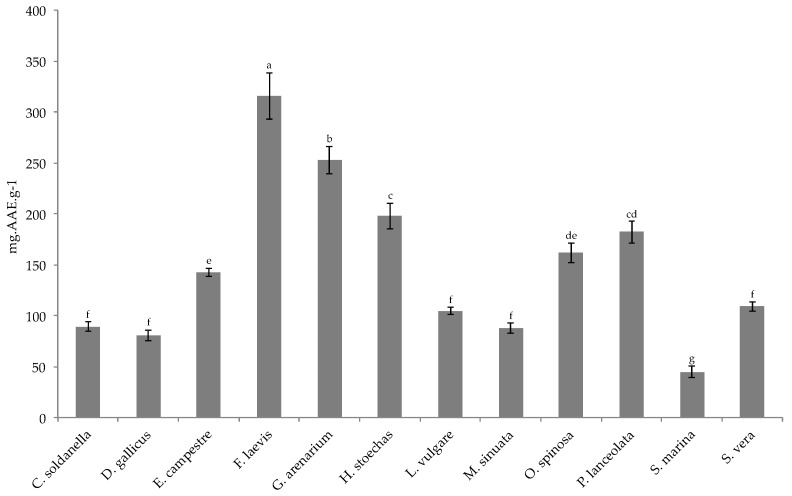
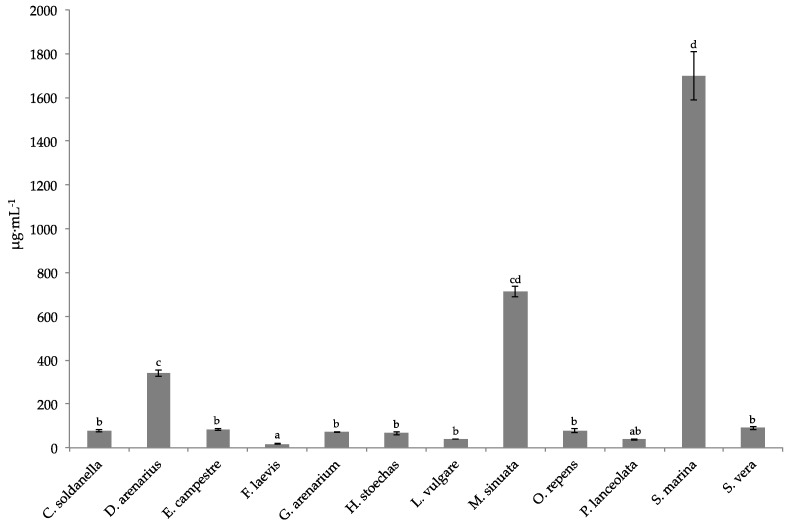
Twelve halophyte species belonging to different families, widely represented along French Atlantic shoreline and commonly used in traditional medicine, were screened for protective activities against mycotoxins, in order to set out new promising sources of natural ingredients for feed applications. Selected halophytic species from diverse natural habitats were examined for their in vitro anti-mycotoxin activities, through viability evaluation of Madin-Darby Bovine Kidney (MDBK) and intestinal porcine enterocyte (IPEC-J2) cell lines. Besides, the in vitro antioxidant activities of plant extracts were assessed (total antioxidant and 2,2-diphenyl-1-picrylhydrazyl (DPPH)-scavenging bioassays). Of the 12 species, , and exhibited the most protective action on MDBK and IPEC-J2 cells against zearalenone (ZEN) or T2 toxin contamination (restoring about 75% of cell viability at 10 μg·mL) without inflammation response. They also had strong antioxidant capacities (Inhibitory concentration of 50% (IC) < 100 μg·mL for DPPH radical and total antioxidant capacity (TAC) of 100 to 200 mg Ascorbic Acid Equivalent (AAE)·g Dry Weight), suggesting that cell protection against intoxication involves antioxidant action. A bio-guided study showed that fractions of extract protect MDBK cells against T2 or ZEN toxicity and several major compounds like chlorogenic acid and asperuloside could be involved in this protective effect. Overall, our results show that the halophytes , and should be considered further as new sources of ingredients for livestock feed with protective action against mycotoxin intoxication.
12 种属于不同科的盐生植物,广泛分布于法国大西洋沿岸,常用于传统医学,因其具有抗真菌毒素的活性,而被筛选用于保护动物,以寻找新的有前景的天然饲料成分来源。从不同的自然生境中选择的盐生植物物种,通过评估 Madin-Darby 牛肾 (MDBK) 和猪肠上皮细胞 (IPEC-J2) 细胞系的活力,检测其体外抗真菌毒素活性。此外,还评估了植物提取物的体外抗氧化活性 (总抗氧化和 2,2-二苯基-1-苦基肼 (DPPH)-清除生物测定)。在 12 种植物中, 、 和 对 MDBK 和 IPEC-J2 细胞具有最强的保护作用,可抵抗玉米赤霉烯酮 (ZEN) 或 T2 毒素污染 (在 10 μg·mL 时恢复约 75%的细胞活力),而没有炎症反应。它们还具有很强的抗氧化能力 (DPPH 自由基的 50%抑制浓度 (IC) < 100 μg·mL,总抗氧化能力 (TAC) 为 100 至 200 mg 抗坏血酸当量 (AAE)·g 干重),表明细胞保护免受中毒涉及抗氧化作用。一项生物导向研究表明, 提取物的馏分可保护 MDBK 细胞免受 T2 或 ZEN 的毒性,几种主要化合物,如绿原酸和asperuloside 可能参与这种保护作用。总的来说,我们的研究结果表明,盐生植物 、 和 应该被进一步考虑作为具有抗真菌毒素中毒保护作用的新型动物饲料成分来源。