PAPRSB Institute of Health Sciences, Universiti Brunei Darussalam, Tungku Link Road, Bandar Seri Begawan, BE1410, Brunei Darussalam.
School of Medicine, National University of Ireland Galway, University Road, Galway, H91 TK33, Ireland.
BMC Cancer. 2021 Apr 30;21(1):477. doi: 10.1186/s12885-021-08224-6.
Colorectal cancer (CRC) is a major cause of cancer-related mortality worldwide. It is the second leading cause of cancer death in men and women in Brunei Darussalam in 2017, posing a major burden on society.
This retrospective cohort study (n = 1035 patients diagnosed with CRC in Brunei Darussalam from 1st January 2002 until 31st December 2017) aims to compare the overall survival rates of CRC patients (2002-2017), to compare survival rates between two study periods (2002-2009 and 2010-2017) and to identify prognostic factors of CRC. Kaplan-Meier estimator and log-rank tests were performed to analyse the overall survival rates of CRC patients. Multiple Cox regression was performed to determine the prognostic factors of CRC with adjusted hazard ratios (Adj. HRs) reported.
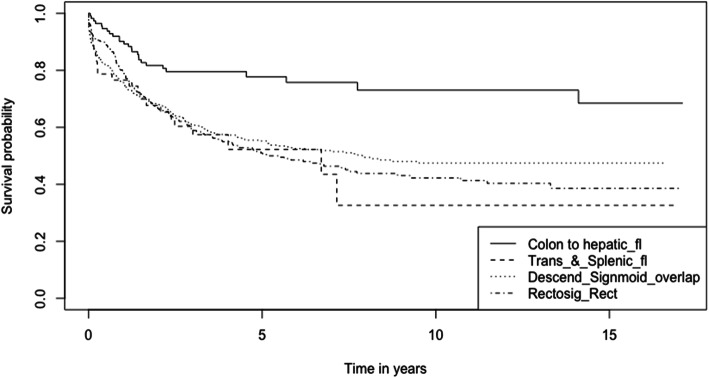
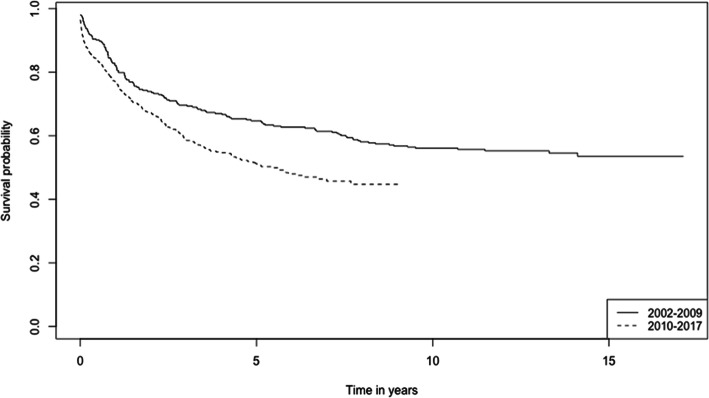
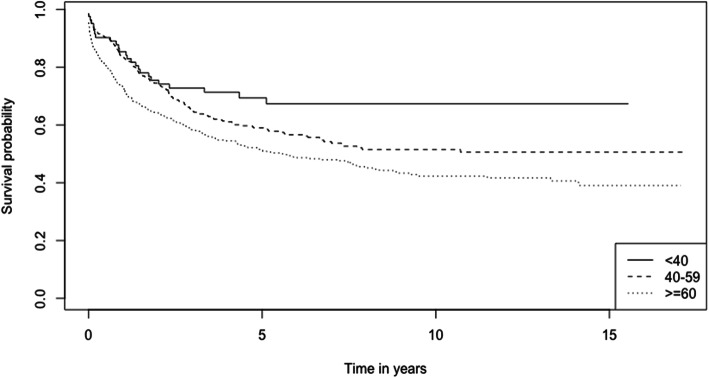
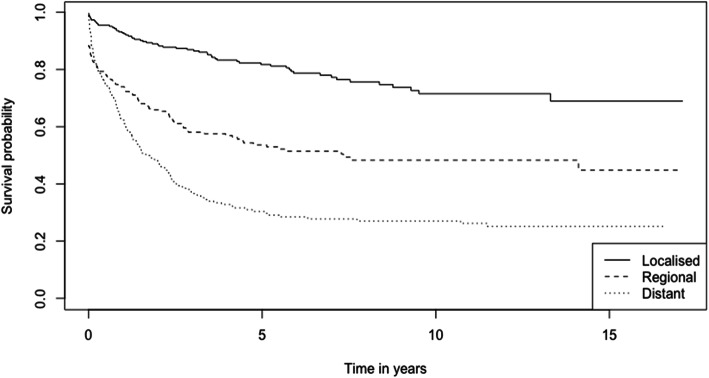
The 1-, 3- and 5-year survival rates of CRC patients are 78.6, 62.5, and 56.0% respectively from 2002 to 2017. The 1-, 3-, and 5-year survival rates of CRC patients for 2002-2009 are 82.2, 69.6, and 64.7%; 77.0, 59.1, and 51.3% for 2010-2017 respectively. A significant difference in CRC patients' survival rate was observed between the two study periods, age groups, ethnic groups, cancer stages, and sites of cancer (p < 0.05). The Adjusted Hazard Ratios (Adj. HRs) were significantly higher in the 2010-17 period (Adj. HR = 1.78, p < 0.001), older age group ( ≥ 60 years) (Adj. HR = 1.93, p = 0.005), distant cancer (Adj. HR = 4.69, p < 0.010), tumor at transverse colon and splenic flexure of colon (Adj. HR = 2.44, p = 0.009), and lower in the Chinese(Adj. HR = 0.63, p = 0.003).
This study highlights the lower survival rates of CRC patients in 2010-2017, Malays, older patients, distant cancer, and tumors located at the latter half of the proximal colon (transverse colon), and predominantly LCRC (splenic flexure, descending colon, sigmoid colon, overlapping lesion colon and colon (NOS), as well as the rectosigmoid junction and rectum (NOS)). Age, ethnicity, cancer stage, and tumor location are significant prognostic factors for CRC. These findings underscore the importance of public health policies and programmes to enhance awareness on CRC from screening to developing strategies for early detection and management, to reduce CRC-associated mortality.
结直肠癌(CRC)是全球癌症相关死亡的主要原因。2017 年,文莱达鲁萨兰国男性和女性因癌症死亡的第二大原因是结直肠癌,这给社会带来了重大负担。
本回顾性队列研究(n=1035 名在文莱达鲁萨兰国诊断为 CRC 的患者,从 2002 年 1 月 1 日至 2017 年 12 月 31 日)旨在比较 CRC 患者的总生存率(2002-2017 年),比较两个研究期(2002-2009 年和 2010-2017 年)之间的生存率,并确定 CRC 的预后因素。采用 Kaplan-Meier 估计器和对数秩检验分析 CRC 患者的总生存率。采用多 Cox 回归分析确定 CRC 的预后因素,并报告调整后的危险比(Adj. HR)。
2002 年至 2017 年 CRC 患者的 1、3 和 5 年生存率分别为 78.6%、62.5%和 56.0%。2002-2009 年 CRC 患者的 1、3 和 5 年生存率分别为 82.2%、69.6%和 64.7%;2010-2017 年分别为 77.0%、59.1%和 51.3%。两个研究期、年龄组、种族、癌症分期和癌症部位的 CRC 患者生存率存在显著差异(p<0.05)。2010-17 期间的调整后危险比(Adj. HR)显著升高(Adj. HR=1.78,p<0.001),年龄较大组(≥60 岁)(Adj. HR=1.93,p=0.005),远处癌症(Adj. HR=4.69,p<0.010),横结肠和结肠脾曲的肿瘤(Adj. HR=2.44,p=0.009),而中国人较低(Adj. HR=0.63,p=0.003)。
本研究强调了 2010-2017 年 CRC 患者生存率较低、马来人、年龄较大的患者、远处癌症以及近端结肠后半部(横结肠)的肿瘤,主要是 LCRC(脾曲、降结肠、乙状结肠、重叠病变结肠和结肠(NOS),以及直肠乙状结肠交界处和直肠(NOS))。年龄、种族、癌症分期和肿瘤位置是 CRC 的重要预后因素。这些发现强调了公共卫生政策和计划的重要性,以提高对 CRC 的认识,从筛查到制定早期发现和管理策略,以降低 CRC 相关死亡率。