Zhang Lei, Wu Meng Ting, Guo Lei, Zhu Zhuo Ying, Peng Su Fang, Li Wei, Chen Han, Fan Juan, Chen Jue
Shanghai Mental Health Center, Shanghai Jiao Tong University School of Medicine, 600 WanPing South Road, Shanghai, 200030, China.
J Eat Disord. 2021 Apr 29;9(1):58. doi: 10.1186/s40337-021-00405-9.
The Coronavirus Disease 2019 (COVID-19) is a global pandemic and posed serious challenges in many countries. A number of studies before the COVID-19 pandemic have shown that the primary caregivers of the ED patients are subjected to great burden, psychological pressure, and serious emotional problems. This study aimed to investigate the psychological distress level of the primary caregivers of ED offspring during the COVID-19 pandemic.
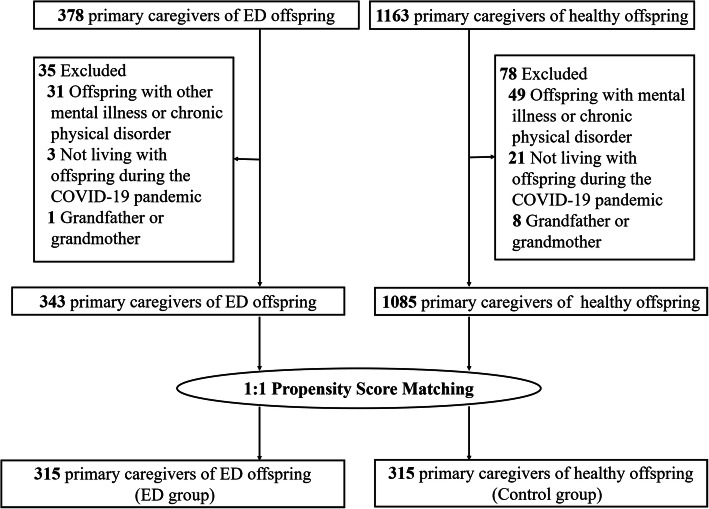
From March 6 to April 20, 2020, 378 questionnaires for primary caregivers of ED offspring and 1163 questionnaires for primary caregivers of healthy offspring were collected through an online crowdsourcing platform in mainland China. Valid questionnaires that met the criteria included 343 (90.74%) primary caregivers of ED offspring and 1085 (93.29%) primary caregivers of healthy offspring. Using Propensity Score Matching (PSM), 315 (83.33%) primary caregivers of ED offspring and 315 matched primary caregivers of healthy offspring were included in the statistical analysis. Depression, anxiety, perceived stress and social support were measured by Patient Health Questionnaire-9, Generalized Anxiety Disorder-7, Perceived Stress Scale-10 and Social Support Rating Scale, respectively.
The rates of depression and anxiety of the primary caregivers of ED offspring were 20.6 and 16.5%, which were significantly higher than those of primary caregivers of healthy offspring (4.1 and 2.2%), all P < 0.001. Regression analysis found that perceived stress, social support, previous or present mental illness, family conflicts during the COVID-19 pandemic had a significant impact on the severity of depression (P < 0.001, P = 0.002, P = 0.041, P = 0.014); Perceived stress, social support, family conflicts during the COVID-19 pandemic and years of education had a significant impact on the severity of anxiety (P < 0.001, P = 0.002, P = 0.002, P = 0.003).
During the COVID-19 pandemic, primary caregivers of ED offspring experienced more psychological distress than that of primary caregivers of healthy offspring. ED caregivers with high perceived stress may have higher levels of depression and anxiety. ED caregivers with high social support, no mental illness and no family conflicts may have lower levels of depression. ED caregivers with high social support, no family conflicts, and high years of education may have lower levels of anxiety.
2019年冠状病毒病(COVID-19)是一场全球大流行疾病,在许多国家都带来了严峻挑战。COVID-19大流行之前的一些研究表明,急诊科患者的主要照顾者承受着巨大负担、心理压力和严重的情绪问题。本研究旨在调查COVID-19大流行期间急诊科患者后代主要照顾者的心理困扰水平。
2020年3月6日至4月20日,通过中国大陆的一个在线众包平台收集了378份急诊科患者后代主要照顾者的问卷和1163份健康后代主要照顾者的问卷。符合标准的有效问卷包括343份(90.74%)急诊科患者后代主要照顾者和1085份(93.29%)健康后代主要照顾者。采用倾向得分匹配法(PSM),将315份(83.33%)急诊科患者后代主要照顾者和315名匹配的健康后代主要照顾者纳入统计分析。分别采用患者健康问卷-9、广泛性焦虑障碍量表-7、感知压力量表-10和社会支持评定量表测量抑郁、焦虑、感知压力和社会支持情况。
急诊科患者后代主要照顾者的抑郁和焦虑发生率分别为20.6%和16.5%,显著高于健康后代主要照顾者(4.1%和2.2%),所有P<0.001。回归分析发现,感知压力、社会支持、既往或目前的精神疾病、COVID-19大流行期间的家庭冲突对抑郁严重程度有显著影响(P<0.001,P = 0.002,P = 0.041,P = 0.014);感知压力、社会支持、COVID-19大流行期间的家庭冲突和受教育年限对焦虑严重程度有显著影响(P<0.001,P = 0.002,P = 0.002,P = 0.003)。
在COVID-19大流行期间,急诊科患者后代的主要照顾者比健康后代的主要照顾者经历了更多的心理困扰。感知压力高的急诊科照顾者可能有更高水平的抑郁和焦虑。社会支持高、无精神疾病且无家庭冲突的急诊科照顾者可能抑郁水平较低。社会支持高、无家庭冲突且受教育年限高的急诊科照顾者可能焦虑水平较低。