Pratt Arthur G, Siebert Stefan, Cole Michael, Stocken Deborah D, Yap Christina, Kelly Stephen, Shaikh Muddassir, Cranston Amy, Morton Miranda, Walker Jenn, Frame Sheelagh, Ng Wan-Fai, Buckley Christopher D, McInnes Iain B, Filer Andrew, Isaacs John D
Translational and Clinical Research Institute, Newcastle University, Newcastle upon Tyne, UK.
Newcastle upon Tyne Hospitals NHS Foundation Trust, Newcastle upon Tyne, UK.
Lancet Rheumatol. 2021 Mar 9;3(5):e337-e346. doi: 10.1016/S2665-9913(21)00061-8. eCollection 2021 May.
Current rheumatoid arthritis therapies target immune inflammation and are subject to ceiling effects. Seliciclib is an orally available cyclin-dependent kinase inhibitor that suppresses proliferation of synovial fibroblasts-cells not yet targeted in rheumatoid arthritis. Part 1 of this phase 1b/2a trial aimed to establish the maximum tolerated dose of seliciclib in patients with active rheumatoid arthritis despite ongoing treatment with TNF inhibitors, and to evaluate safety and pharmacokinetics.
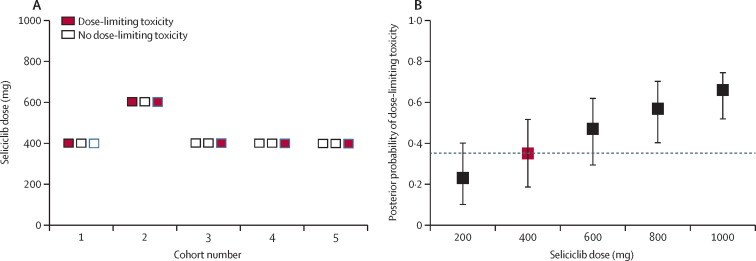
Phase 1b of the TRAFIC study was a non-randomised, open-label, dose-finding trial done in rheumatology departments in five UK National Health Service hospitals. Eligible patients (aged ≥18 years) fulfilled the 1987 American College of Rheumatology (ACR) or the 2010 ACR-European League Against Rheumatism classification criteria for rheumatoid arthritis and had moderate to severe disease activity (a Disease Activity Score for 28 joints [DAS28] of ≥3·2) despite stable treatment with anti-TNF therapy for at least 3 months before enrolment. Participants were recruited sequentially to a maximum of seven cohorts of three participants each, designated to receive seliciclib 200 mg, 400 mg, 600 mg, 800 mg, or 1000 mg administered in 200 mg oral capsules. Sequential cohorts received doses determined by a restricted, one-stage Bayesian continual reassessment model, which determined the maximum tolerated dose (the primary outcome) based on a target dose-limiting toxicity rate of 35%. Seliciclib maximum concentration (C) and area under the plasma concentration time curve 0-6 h (AUC) were measured. This study is registered with ISRCTN, ISRCTN36667085.
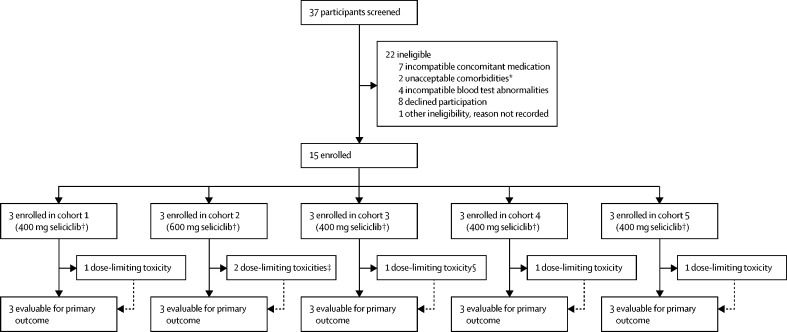
Between Oct 8, 2015, and Aug 15, 2017, 37 patients were screened and 15 were enrolled to five cohorts and received seliciclib, after which the trial steering committee and the data monitoring committee determined that the maximum tolerated dose could be defined. In addition to a TNF inhibitor, ten (67%) enrolled patients were taking conventional synthetic disease modifying antirheumatic drugs. The maximum tolerated dose of seliciclib was 400 mg, with an estimated dose-limiting toxicity probability of 0·35 (90% posterior probability interval 0·18-0·52). Two serious adverse events occurred (one acute kidney injury in a patient receiving the 600 mg dose and one drug-induced liver injury in a patient receiving the 400 mg dose), both considered to be related to seliciclib and consistent with its known safety profile. 65 non-serious adverse events occurred during the trial, 50 of which were considered to be treatment related. Most treatment-related adverse events were mild; 20 of the treatment-related non-serious adverse events contributed to dose-limiting toxicities. There were no deaths. Average C and AUC were two-times higher in participants developing dose-limiting toxicities.
The maximum tolerated dose of seliciclib has been defined for rheumatoid arthritis refractory to TNF blockade. No unexpected safety concerns were identified to preclude ongoing clinical evaluation in a formal efficacy trial.
UK Medical Research Council, Cyclacel, Research into Inflammatory Arthritis Centre (Versus Arthritis), and the National Institute of Health Research Newcastle and Birmingham Biomedical Research Centres and Clinical Research Facilities.
目前类风湿关节炎的治疗方法主要针对免疫炎症,且存在疗效天花板效应。塞利西利布是一种口服的细胞周期蛋白依赖性激酶抑制剂,可抑制类风湿关节炎中尚未被靶向的滑膜成纤维细胞的增殖。这项1b/2a期试验的第1部分旨在确定在使用肿瘤坏死因子(TNF)抑制剂治疗的情况下,活动性类风湿关节炎患者中塞利西利布的最大耐受剂量,并评估其安全性和药代动力学。
TRAFIC研究的1b期是一项在英国国民健康服务体系的5家医院的风湿科进行的非随机、开放标签、剂量探索试验。符合条件的患者(年龄≥18岁)符合1987年美国风湿病学会(ACR)或2010年ACR-欧洲抗风湿病联盟类风湿关节炎分类标准,且尽管在入组前至少3个月接受抗TNF治疗病情稳定,但仍有中度至重度疾病活动(28个关节疾病活动评分[DAS28]≥3.2)。参与者按顺序被招募到最多7个队列,每个队列3名参与者,分别接受200mg、400mg、600mg、800mg或1000mg塞利西利布口服胶囊给药。后续队列接受由受限的单阶段贝叶斯连续重新评估模型确定的剂量,该模型基于35%的目标剂量限制性毒性率确定最大耐受剂量(主要结局)。测量塞利西利布的最大浓度(C)和血浆浓度-时间曲线下0至6小时的面积(AUC)。本研究已在国际标准随机对照试验编号注册库(ISRCTN)注册,编号为ISRCTN36667085。
在2015年10月8日至2017年8月15日期间,37名患者接受筛查,15名患者入组5个队列并接受塞利西利布治疗,之后试验指导委员会和数据监测委员会确定可以定义最大耐受剂量。除TNF抑制剂外,10名(67%)入组患者正在服用传统合成改善病情抗风湿药物。塞利西利布的最大耐受剂量为400mg,估计剂量限制性毒性概率为0.35(后验概率90%区间0.18-0.52)。发生了2起严重不良事件(接受600mg剂量的1名患者出现急性肾损伤,接受400mg剂量的1名患者出现药物性肝损伤),均被认为与塞利西利布有关,且与其已知的安全性特征相符。试验期间发生了65起非严重不良事件,其中50起被认为与治疗有关。大多数与治疗相关的不良事件为轻度;20起与治疗相关的非严重不良事件导致了剂量限制性毒性。无死亡病例。发生剂量限制性毒性的参与者的平均C和AUC高出两倍。
已确定塞利西利布在对TNF阻断治疗难治的类风湿关节炎中的最大耐受剂量。未发现意外的安全问题,无需在正式的疗效试验中停止正在进行的临床评估。
英国医学研究理事会、Cyclacel公司、炎症性关节炎研究中心(对抗关节炎组织)以及英国国家卫生研究院纽卡斯尔和伯明翰生物医学研究中心及临床研究设施。