Shu Mengjun, Gao Feng, Zeng Min, Yu Chulang, Wang Xue, Huang Renhua, Yang Jianhua, Su Yanjie, Hu Nantao, Zhou Zhihua, Liu Ke, Yang Zhi, Tan Hongtao, Xu Lin
Key Laboratory of Thin Film and Microfabrication (Ministry of Education), Department of Micro/Nano Electronics, School of Electronic Information and Electrical Engineering, Shanghai Jiao Tong University, Shanghai, 200240, People's Republic of China.
State Key Laboratory for Managing Biotic and Chemical Threats To the Quality and Safety of Agro-Products, Key Laboratory of Biotechnology in Plant Protection of MOA and Zhejiang Province, Institute of Plant Virology, Ningbo University, Ningbo, 315211, People's Republic of China.
Nanoscale Res Lett. 2021 Apr 30;16(1):75. doi: 10.1186/s11671-021-03525-y.
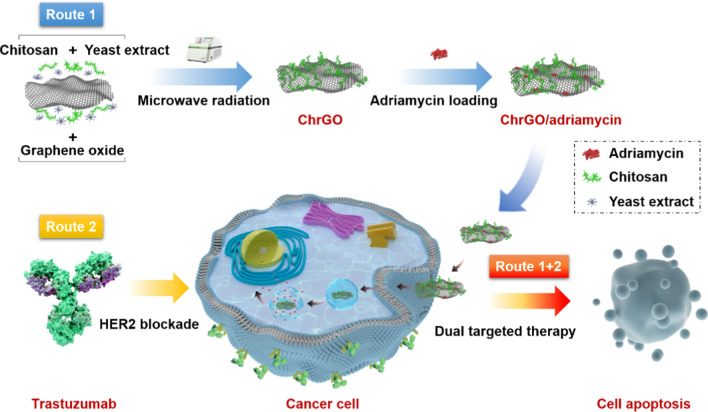
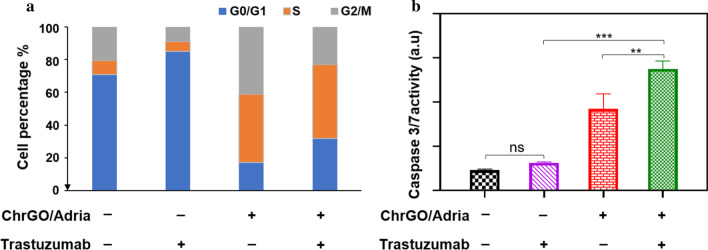
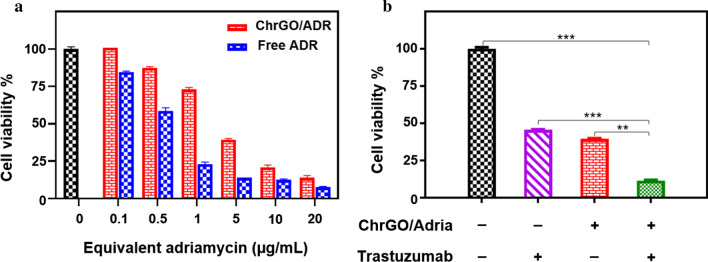
To achieve better antitumour efficacy, it is urgent to improve anticancer drug delivery efficiency in targeting cancer cells. In this work, chitosan-functionalized graphene oxide (ChrGO) nanosheets were fabricated via microwave-assisted reduction, which were employed to the intracellular delivery nanosystem for anticancer drug agent in breast cancer cells. Drug loading and release research indicated that adriamycin can be efficiently loaded on and released from the ChrGO nanosheets. Less drug release during delivery and better biocompatibility of ChrGO/adriamycin significantly improve its safety and therapeutic efficacy in HER2-overexpressing BT-474 cells. Furthermore, ChrGO/adriamycin in combination with trastuzumab exhibited synergistic antitumour activity in BT-474 cells, which demonstrated superior therapeutic efficacy compared with each drug alone. Cells treated with trastuzumab (5 μg/mL) or equivalent ChrGO/adriamycin (5 μg/mL) each elicited 54.5% and 59.5% cell death, respectively, while the combination treatment with trastuzumab and ChrGO/adriamycin resulted in a dramatic 88.5% cell death. The dual-targeted therapy displayed higher apoptosis, indicating superior therapeutic efficacy due to the presence of different mechanisms of action. The combined treatment of ChrGO/adriamycin and trastuzumab in BT-474 cells induced cell cycle arrest and apoptosis, which ultimately led to the death of augmented cancer cells. This work has provided a facile microwave-assisted fabrication of ChrGO as a controlled and targeted intracellular drug delivery nanosystem, which is expected to be a novel promising therapy for treating HER2-overexpressing breast cancer cells.
为了获得更好的抗肿瘤疗效,提高抗癌药物靶向癌细胞的递送效率迫在眉睫。在这项工作中,通过微波辅助还原制备了壳聚糖功能化氧化石墨烯(ChrGO)纳米片,并将其用于乳腺癌细胞中抗癌药物的细胞内递送纳米系统。药物负载和释放研究表明,阿霉素可以有效地负载在ChrGO纳米片上并从其上释放。在递送过程中较少的药物释放以及ChrGO/阿霉素更好的生物相容性显著提高了其在HER2过表达的BT-474细胞中的安全性和治疗效果。此外,ChrGO/阿霉素与曲妥珠单抗联合在BT-474细胞中表现出协同抗肿瘤活性,与单独使用每种药物相比,其治疗效果更优。用曲妥珠单抗(5μg/mL)或等效的ChrGO/阿霉素(5μg/mL)处理的细胞分别引起54.5%和59.5%的细胞死亡,而曲妥珠单抗和ChrGO/阿霉素联合治疗导致显著的88.5%的细胞死亡。双靶向治疗显示出更高的细胞凋亡率,表明由于存在不同的作用机制而具有更优的治疗效果。ChrGO/阿霉素和曲妥珠单抗在BT-474细胞中的联合治疗诱导细胞周期停滞和凋亡,最终导致更多癌细胞死亡。这项工作提供了一种简便的微波辅助制备ChrGO的方法,作为一种可控的靶向细胞内药物递送纳米系统,有望成为治疗HER2过表达乳腺癌细胞的一种新型有前景的疗法。