Leitão Miguel M, Alves Cátia G, de Melo-Diogo Duarte, Lima-Sousa Rita, Moreira André F, Correia Ilídio J
CICS-UBI - Centro de Investigação em Ciências da Saúde, Universidade da Beira Interior 6200-506 Covilhã Portugal
CIEPQPF - Departamento de Engenharia Química, Universidade de Coimbra 3030-790 Coimbra Portugal.
RSC Adv. 2020 Oct 20;10(63):38621-38630. doi: 10.1039/d0ra07508f. eCollection 2020 Oct 15.
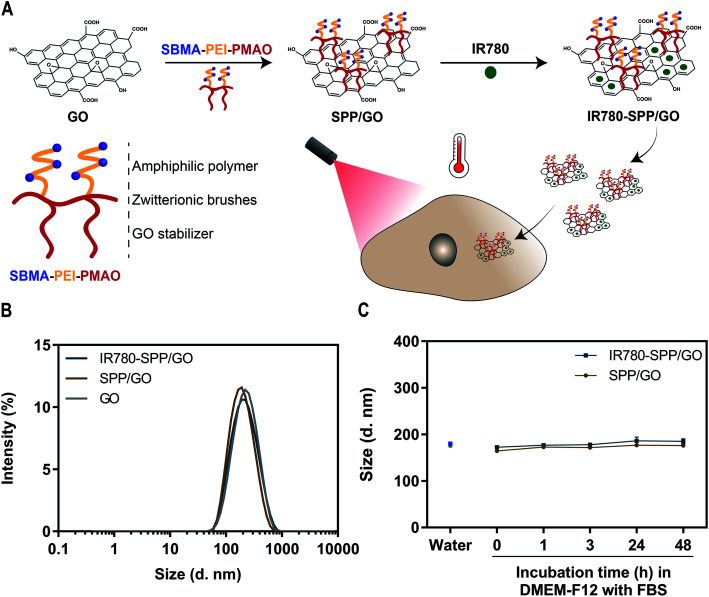
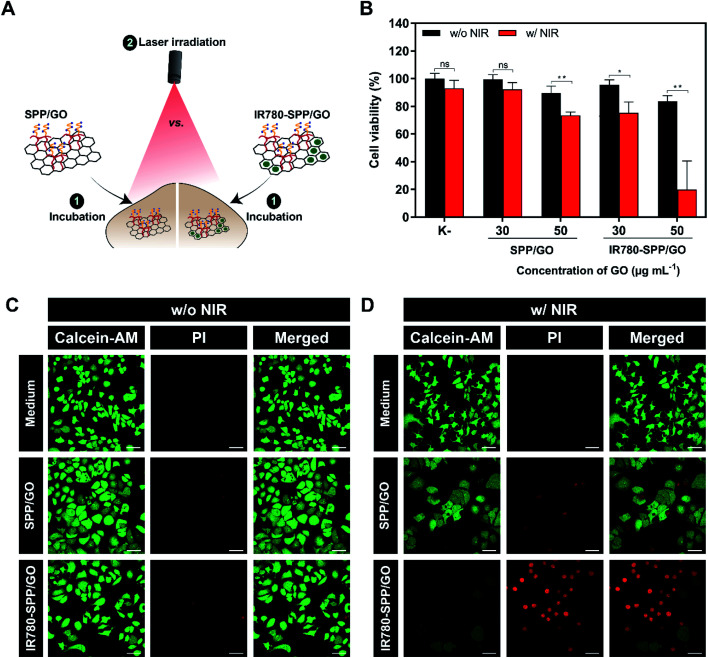
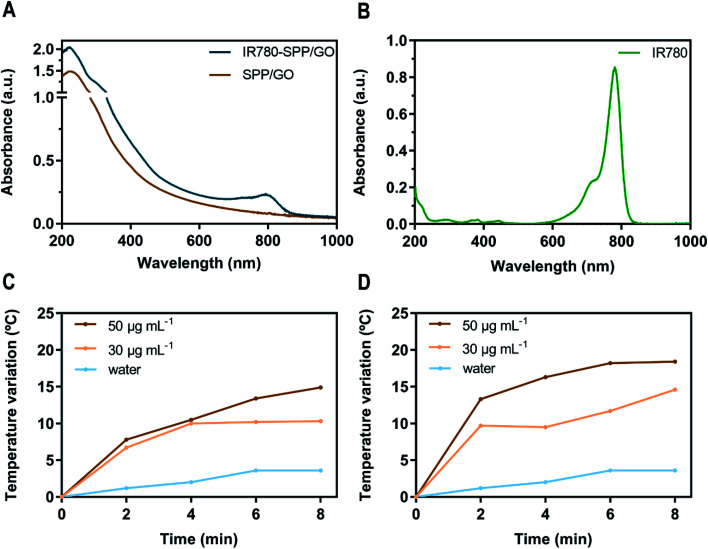
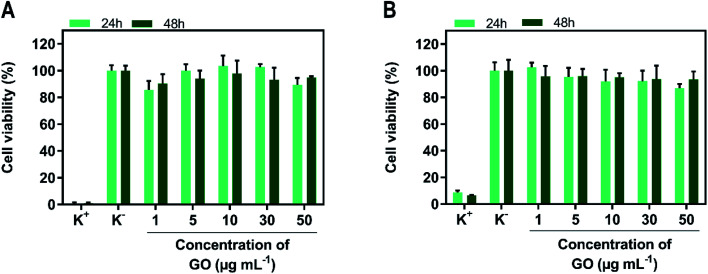
The application of Graphene Oxide (GO) in cancer photothermal therapy is hindered by its lack of colloidal stability in biologically relevant media and modest Near Infrared (NIR) absorption. In this regard, the colloidal stability of GO has been improved by functionalizing its surface with poly(ethylene glycol) (PEG), which may not be optimal due to the recent reports on PEG immunogenicity. On the other hand, the chemical reduction of GO using hydrazine hydrate has been applied to enhance its photothermal capacity, despite decreasing its cytocompatibility. In this work GO was functionalized with an amphiphilic polymer containing [2-(methacryloyloxy)ethyl]dimethyl-(3-sulfopropyl)ammonium hydroxide (SBMA) brushes and was loaded with IR780, for the first time, aiming to improve its colloidal stability and phototherapeutic capacity. The attained results revealed that the SBMA-functionalized GO displays a suitable size distribution, neutral surface charge and adequate cytocompatibility. Furthermore, the SBMA-functionalized GO exhibited an improved colloidal stability in biologically relevant media, while its non-SBMA functionalized equivalent promptly precipitated under the same conditions. By loading IR780 into the SBMA-functionalized GO, its NIR absorption increased by 2.7-fold, leading to a 1.2 times higher photothermal heating. In cell studies, the combination of SBMA-functionalized GO with NIR light only reduced breast cancer cells' viability to 73%. In stark contrast, by combining IR780 loaded SBMA-functionalized GO and NIR radiation, the cancer cells' viability decreased to 20%, hence confirming the potential of this nanomaterial for cancer photothermal therapy.
氧化石墨烯(GO)在癌症光热治疗中的应用受到其在生物相关介质中缺乏胶体稳定性以及近红外(NIR)吸收能力有限的阻碍。在这方面,通过用聚乙二醇(PEG)对其表面进行功能化处理提高了GO的胶体稳定性,但由于最近有关PEG免疫原性的报道,这种方法可能并非最佳选择。另一方面,尽管使用水合肼对GO进行化学还原会降低其细胞相容性,但已被用于增强其光热能力。在这项工作中,首次用含有[2-(甲基丙烯酰氧基)乙基]二甲基-(3-磺丙基)氢氧化铵(SBMA)刷的两亲性聚合物对GO进行功能化处理,并负载IR780,旨在提高其胶体稳定性和光治疗能力。所获得的结果表明,SBMA功能化的GO具有合适的尺寸分布、中性表面电荷和足够的细胞相容性。此外,SBMA功能化的GO在生物相关介质中表现出改善的胶体稳定性,而其未进行SBMA功能化的类似物在相同条件下迅速沉淀。通过将IR780负载到SBMA功能化的GO中,其近红外吸收增加了2.7倍,导致光热加热提高了1.2倍。在细胞研究中,仅将SBMA功能化的GO与近红外光结合使用时,乳腺癌细胞的活力仅降低到73%。与之形成鲜明对比的是,通过将负载IR780的SBMA功能化的GO与近红外辐射相结合,癌细胞的活力降低到20%,从而证实了这种纳米材料在癌症光热治疗中的潜力。