Kotwani Anita, Joshi Jyoti, Kaloni Deeksha
Department of Pharmacology, Vallabhbhai Patel Chest Institute (VPCI), University of Delhi, Delhi, 110007, India.
Amity Institute of Public Health, Amity University, & Center for Disease Dynamics, Economics and Policy (CDDEP), New Delhi, India.
Environ Sci Pollut Res Int. 2021 Apr 30;28(25):32111-24. doi: 10.1007/s11356-021-14178-w.
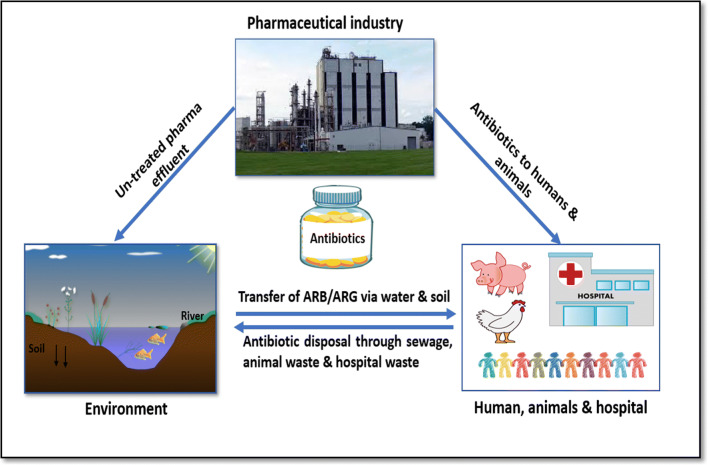
Antimicrobial resistance (AMR) is a complex global health issue and will push twenty-four million people into extreme poverty by 2030, risking the sustainable development goals (SDGs) 2, 3, 6, 9, 12, and 17 if not addressed immediately. Humans, animals, and the environment are the reservoirs that contribute and allow AMR to propagate in interconnected ecosystems. The emergence of antibiotic-resistant bacteria and antibiotic-resistant genes in the water environment has become an important environmental health issue. One of the major influencers from environment sector is the pharmaceutical industry which is growing globally to meet the ever-increasing demand of antibiotics, especially in low- and middle-income countries. The pharmaceutical effluent has a mix of large concentrations of antibiotics and antibiotic resistance genes, and these sites act as hotspots for environmental contamination and the spread of AMR. Inadequate treatment of the effluent and its irresponsible disposal leads to unprecedented antibiotic contamination in the environment and their persistent presence in the environment significantly modulates the bacterial genomes' expression that is responsible for increase and spread of AMR. However, not much interventions are suggested in the National Action Plan developed on AMR by many countries. There are no regulations across the globe till date for the level of antibiotic residues in pharmaceutical effluent for the growing pharmaceutical industry. This review put together the work done showing several detrimental effects of the antimicrobial residues in the pharmaceutical effluent which leads to rise in development of AMR. The environment risk approach and need to have indicators to measure environment risk is a way forward for all countries engage in antibiotic manufacturing. Overall, efforts to address the problem are isolated and fragmented. Policymakers, regulators, manufacturers, researchers, civil society, and the community need to collaborate so that antibiotics are produced sustainably and continue to stay effective in treating bacterial infections.
抗菌药物耐药性(AMR)是一个复杂的全球健康问题,到2030年将使2400万人陷入极端贫困,如果不立即加以解决,可持续发展目标2、3、6、9、12和17都将面临风险。人类、动物和环境是导致抗菌药物耐药性产生并使其在相互关联的生态系统中传播的源头。水环境中抗生素耐药细菌和抗生素耐药基因的出现已成为一个重要的环境卫生问题。环境领域的一个主要影响因素是制药行业,该行业在全球范围内不断发展,以满足对抗生素日益增长的需求,尤其是在低收入和中等收入国家。制药废水含有高浓度的抗生素和抗生素耐药基因,这些场所成为环境污染和抗菌药物耐药性传播的热点。废水处理不当及其不负责任的排放导致环境中出现前所未有的抗生素污染,它们在环境中的持续存在显著调节了负责抗菌药物耐药性增加和传播的细菌基因组的表达。然而,许多国家制定的关于抗菌药物耐药性的国家行动计划中提出的干预措施并不多。迄今为止,全球尚未对不断发展的制药行业的制药废水中抗生素残留水平制定相关规定。本综述汇总了已开展的工作,展示了制药废水中抗菌药物残留的若干有害影响,这些影响导致抗菌药物耐药性的发展增加。环境风险方法以及需要有衡量环境风险的指标是所有从事抗生素生产的国家的前进方向。总体而言,解决该问题的努力是孤立和分散的。政策制定者、监管机构、制造商、研究人员、民间社会和社区需要合作,以便可持续地生产抗生素,并使其在治疗细菌感染方面继续保持有效。