Fang Xinyu, Hu Jianli, Peng Zhihang, Dai Qigang, Liu Wendong, Liang Shuyi, Li Zhifeng, Zhang Nan, Bao Changjun
Jiangsu Provincial Center for Disease Control and Prevention (Jiangsu institution of Public health), Nanjing, China.
School of Public Health, Nanjing Medical University, Nanjing, China.
PLoS Negl Trop Dis. 2021 Apr 30;15(4):e0009037. doi: 10.1371/journal.pntd.0009037. eCollection 2021 Apr.
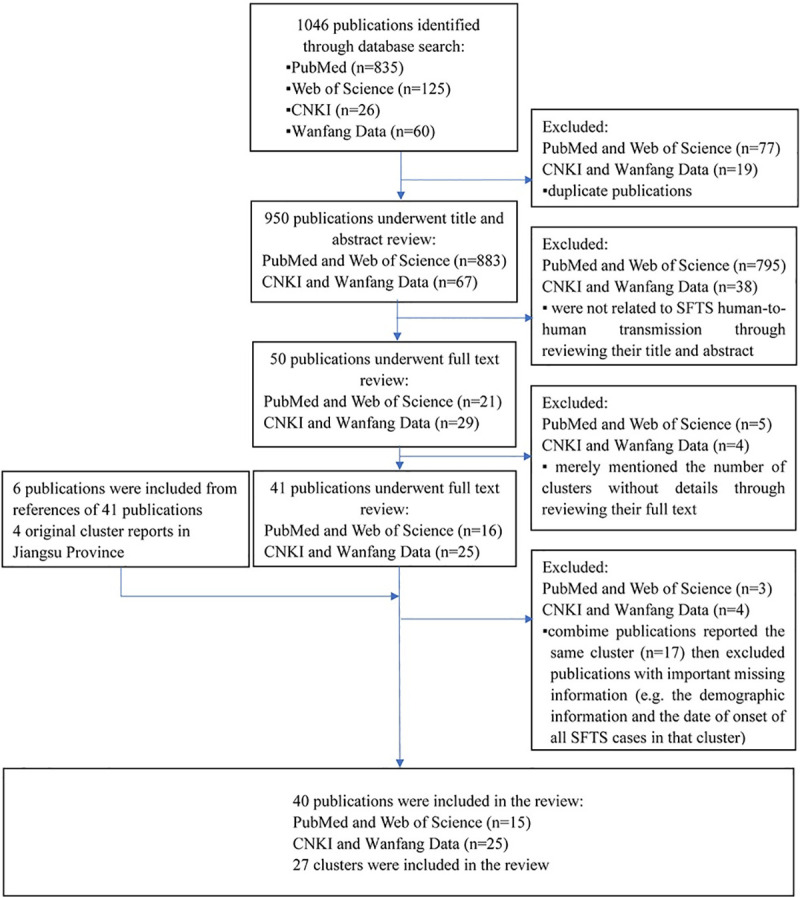
Severe fever with thrombocytopenia syndrome (SFTS) was listed as one of the most severe infectious disease by world health organization in 2017. It can mostly be transmitted by tick bite, while human-to-human transmission has occurred on multiple occasions. This study aimed to explore the epidemiological and clinical characteristics and make risk analysis of SFTS human-to-human transmission.
Descriptive and spatial methods were employed to illustrate the epidemiological and clinical characteristics of SFTS human-to-human transmission. The risk of SFTS human-to-human transmission was accessed through secondary attack rate (SAR) and basic reproductive number (R0). Logistic regression analysis was used to identify the associated risk factors.
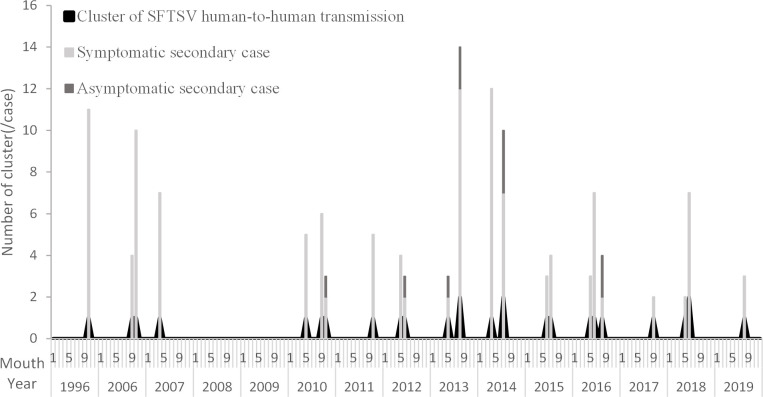
A total of 27 clusters of SFTS human-to-human transmission were reported in China and South Korea during 1996-2019. It mainly occurred among elder people in May, June and October in central and eastern China. The secondary cases developed milder clinical manifestation and better outcome than the index cases. The incubation period was 10.0 days (IQR:8.0-12.0), SAR was 1.72%-55.00%, and the average R0 to be 0.13 (95%CI:0.11-0.16). Being blood relatives of the index case, direct blood/bloody secretion contact and bloody droplet contact had more risk of infection (OR = 6.35(95%CI:3.26-12.37), 38.01 (95%CI,19.73-73.23), 2.27 (95%CI,1.01-5.19)).
SFTS human-to-human transmission in China and South Korea during 1996-2019 had obvious spatio-temporal distinction. Ongoing assessment of this transmission risk is crucial for public health authorities though it continues to be low now.
严重发热伴血小板减少综合征(SFTS)在2017年被世界卫生组织列为最严重的传染病之一。它主要通过蜱叮咬传播,不过人际传播也多次发生。本研究旨在探讨SFTS人际传播的流行病学和临床特征,并进行风险分析。
采用描述性和空间方法来说明SFTS人际传播的流行病学和临床特征。通过二代发病率(SAR)和基本繁殖数(R0)评估SFTS人际传播的风险。采用逻辑回归分析确定相关风险因素。
1996年至2019年期间,中国和韩国共报告了27起SFTS人际传播聚集性病例。主要发生在中国中部和东部地区5月、6月和10月的老年人中。二代病例的临床表现比首例病例更轻,预后更好。潜伏期为10.0天(四分位间距:8.0 - 12.0),SAR为1.72% - 55.00%,平均R0为0.13(95%置信区间:0.11 - 0.16)。与首例病例有血缘关系、直接血液/血性分泌物接触和血性飞沫接触感染风险更高(比值比 = 6.35(95%置信区间:3.26 - 12.37),38.01(95%置信区间,19.73 - 73.23),2.27(95%置信区间,1.01 - 5.19))。
1996年至2019年期间中国和韩国的SFTS人际传播具有明显的时空差异。尽管目前传播风险仍然较低,但对这种传播风险进行持续评估对公共卫生当局至关重要。