Interdisciplinary Department of Medicine - Section of Occupational Medicine, University of Bari, Bari, Italy.
Department of Earth and Geo-environmental Sciences, University of Bari, Bari, Italy.
Environ Res. 2021 Jul;198:111197. doi: 10.1016/j.envres.2021.111197. Epub 2021 Apr 27.
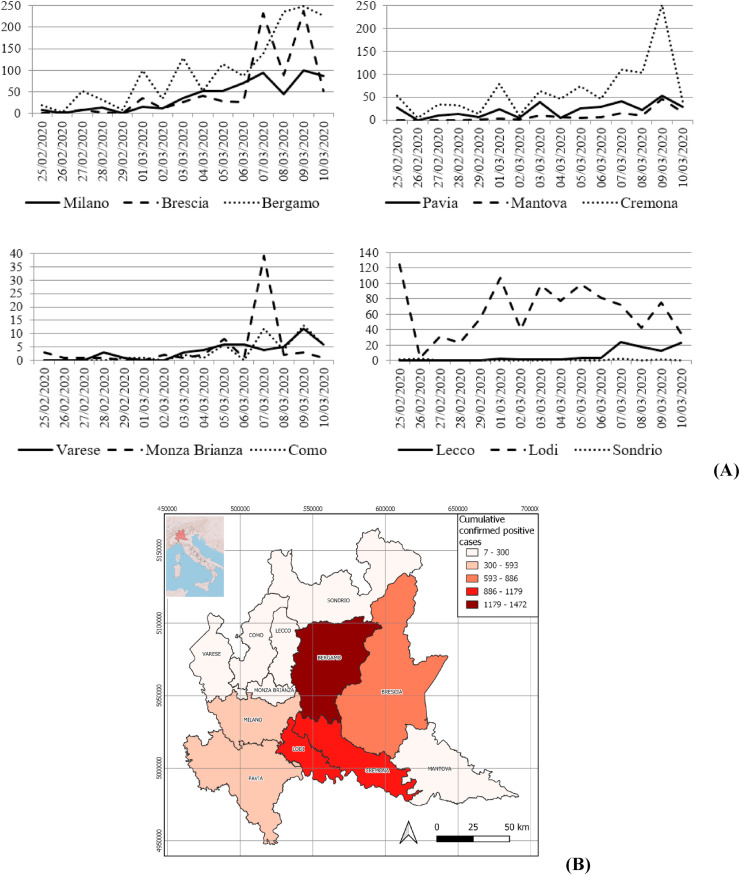
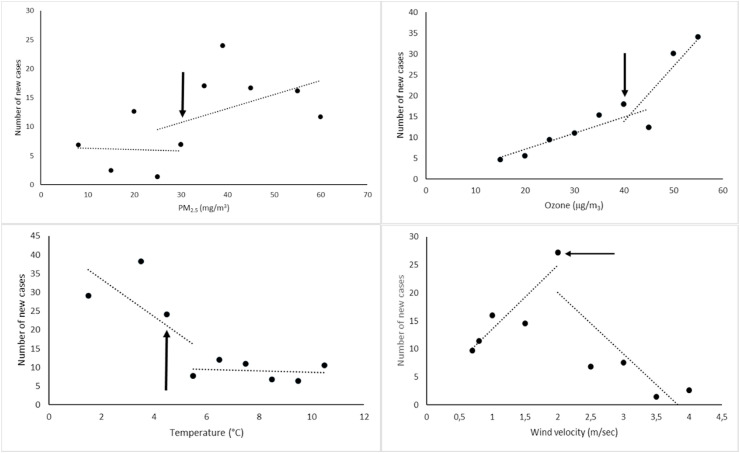
Short-term exposure to air pollution, as well as to climate variables have been linked to a higher incidence of respiratory viral diseases. The study aims to assess the short-term influence of air pollution and climate on COVID19 incidence in Lombardy (Italy), during the early stage of the outbreak, before the implementation of the lockdown measures. The daily number of COVID19 cases in Lombardy from February 25th to March 10th 2020, and the daily average concentrations up to 15 days before the study period of particulate matter (PM, PM), O, SO and NO together with climate variables (temperature, relative humidity - RH%, wind speed, precipitation), were analyzed. A univariable mixed model with a logarithm transformation as link function was applied for each day, from 15 days (lag15) to one day (lag1) before the day of detected cases, to evaluate the effect of each variable. Additionally, change points (Break Points-BP) in the relationship between incident cases and air pollution or climatic factors were estimated. The results did not show a univocal relationship between air quality or climate factors and COVID19 incidence. PM, PM and O concentrations in the last lags seem to be related to an increased COVID19 incidence, probably due to an increased susceptibility of the host. In addition, low temperature and low wind speed in some lags resulted associated with increased daily COVID19 incidence. The findings observed suggest that these factors, in particular conditions and lags, may increase individual susceptibility to the development of viral infections such as SARS-CoV-2.
短期暴露于空气污染以及气候变量与呼吸道病毒疾病的发病率升高有关。本研究旨在评估在意大利伦巴第大区(Lombardy)爆发初期,即封锁措施实施之前,空气污染和气候对 COVID19 发病率的短期影响。从 2020 年 2 月 25 日至 3 月 10 日,分析了 COVID19 在伦巴第大区的每日病例数以及在研究期间前 15 天的每日平均浓度,包括颗粒物(PM、PM)、O、SO 和 NO 以及气候变量(温度、相对湿度 - RH%、风速、降水)。应用具有对数变换作为链接函数的单变量混合模型,分析了从 15 天(lag15)到检测病例前一天(lag1)的每一天,以评估每个变量的影响。此外,还估计了与空气污染或气候因素相关的发病病例之间的关系的转折点(Break Points-BP)。结果表明,空气质量或气候因素与 COVID19 发病率之间没有明确的关系。最后几个滞后的 PM、PM 和 O 浓度似乎与 COVID19 发病率的增加有关,这可能是由于宿主的易感性增加。此外,在某些滞后期,低温和低风速与每日 COVID19 发病率的增加有关。观察到的结果表明,这些因素,特别是在特定条件和滞后期下,可能会增加个体对 SARS-CoV-2 等病毒感染的易感性。