Ferretti Agata, Ienca Marcello, Sheehan Mark, Blasimme Alessandro, Dove Edward S, Farsides Bobbie, Friesen Phoebe, Kahn Jeff, Karlen Walter, Kleist Peter, Liao S Matthew, Nebeker Camille, Samuel Gabrielle, Shabani Mahsa, Rivas Velarde Minerva, Vayena Effy
Health Ethics and Policy Lab, Department of Health Sciences and Technology, ETH Zürich, Hottingerstrasse 10 (HOA), 8092, Zürich, Switzerland.
The Ethox Centre, Department of Population Health, University of Oxford, Oxford, UK.
BMC Med Ethics. 2021 Apr 30;22(1):51. doi: 10.1186/s12910-021-00616-4.
Ethics review is the process of assessing the ethics of research involving humans. The Ethics Review Committee (ERC) is the key oversight mechanism designated to ensure ethics review. Whether or not this governance mechanism is still fit for purpose in the data-driven research context remains a debated issue among research ethics experts.
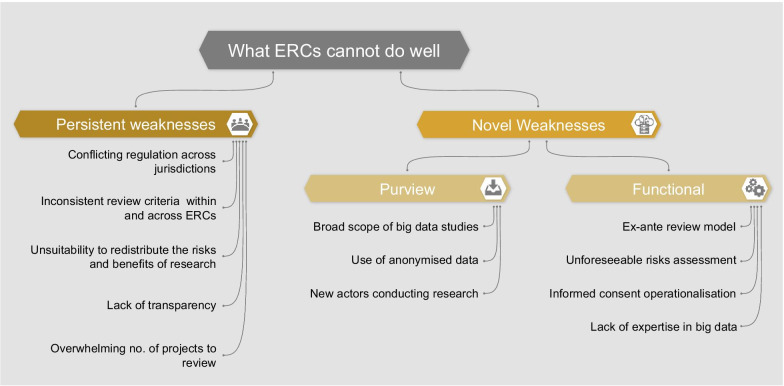
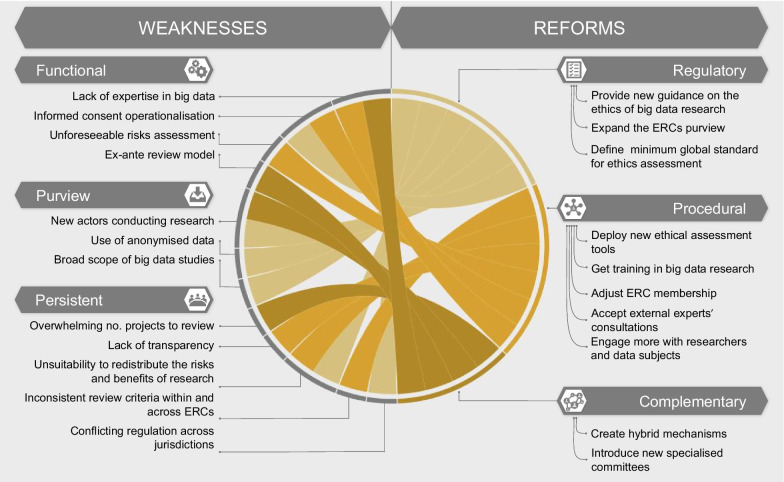
In this article, we seek to address this issue in a twofold manner. First, we review the strengths and weaknesses of ERCs in ensuring ethical oversight. Second, we map these strengths and weaknesses onto specific challenges raised by big data research. We distinguish two categories of potential weakness. The first category concerns persistent weaknesses, i.e., those which are not specific to big data research, but may be exacerbated by it. The second category concerns novel weaknesses, i.e., those which are created by and inherent to big data projects. Within this second category, we further distinguish between purview weaknesses related to the ERC's scope (e.g., how big data projects may evade ERC review) and functional weaknesses, related to the ERC's way of operating. Based on this analysis, we propose reforms aimed at improving the oversight capacity of ERCs in the era of big data science.
We believe the oversight mechanism could benefit from these reforms because they will help to overcome data-intensive research challenges and consequently benefit research at large.
伦理审查是评估涉及人类研究的伦理道德的过程。伦理审查委员会(ERC)是指定用于确保伦理审查的关键监督机制。在数据驱动的研究背景下,这种治理机制是否仍然适用,仍是研究伦理专家们争论的问题。
在本文中,我们试图从两个方面解决这个问题。首先,我们审视伦理审查委员会在确保伦理监督方面的优点和缺点。其次,我们将这些优缺点与大数据研究提出的具体挑战进行对应分析。我们区分了两类潜在的弱点。第一类是持续存在的弱点,即那些并非大数据研究特有的,但可能因大数据研究而加剧的弱点。第二类是新出现的弱点,即那些由大数据项目产生并固有的弱点。在第二类中,我们进一步区分了与伦理审查委员会范围相关的权限弱点(例如大数据项目如何规避伦理审查委员会的审查)和与伦理审查委员会运作方式相关的功能弱点。基于这一分析,我们提出了旨在提高大数据科学时代伦理审查委员会监督能力的改革建议。
我们认为,这些改革将使监督机制受益,因为它们将有助于克服数据密集型研究的挑战,从而使整个研究受益。