Facultad de Ciencias Médicas, Universidad Central del Ecuador, Quito, Pichincha, Ecuador.
Universitat de Barcelona, Barcelona, Spain.
BMJ Open Respir Res. 2021 Apr;8(1). doi: 10.1136/bmjresp-2020-000773.
Although asthma has emerged as an important public health problem over recent decades in Latin America, there are limited published data on national hospital admission and mortality rates for asthma from countries in the region.
To analyse trends in asthma hospitalisation and mortality rates in Ecuador over a 19-year period from 2000 to 2018.
Hospital discharge and death certificates listing asthma, as defined in the International Classification of Diseases 10th Revision codes (J45 and J46), were used to analyse time trends in rates of hospital admissions and mortality for asthma. The data were obtained from the Ecuadorian National Institute of Statistics and Census. Crude and age-standardised rates were estimated for the entire population. Additionally, specific rates by sex, age and region were estimated. We used joinpoint analysis to identify national trends.
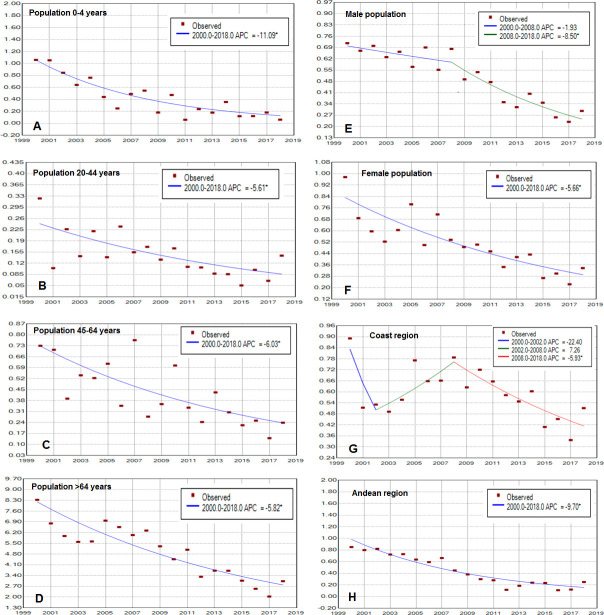
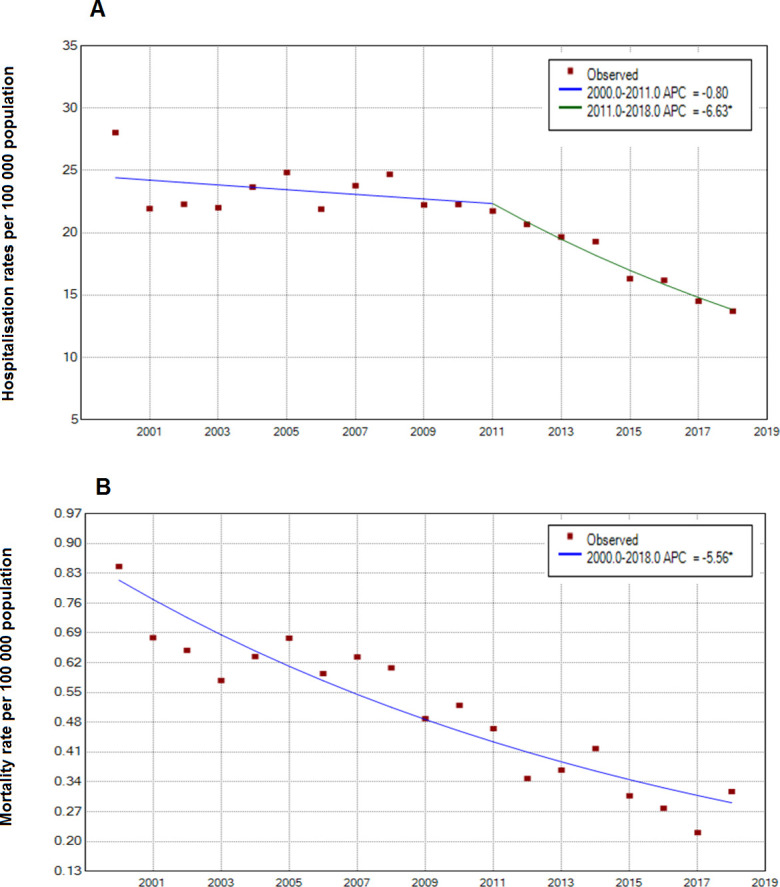
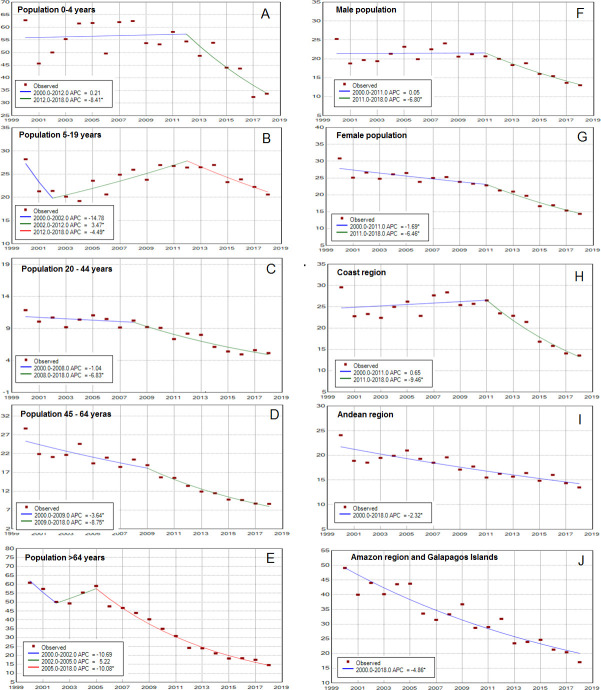
During 2000-2018, a total of 58 250 hospitalisations and 1328 deaths due to asthma were identified. The average annual rates for hospitalisation and mortality attributed to asthma were estimated to be 21 (95% CI 19.3 to 22.8) and 5.2 (95% CI 4.4 to 6.0) per 100 000 population, respectively, over this period. Asthma hospital admissions decreased from 28 to 13.7 per 100 000 population between 2000 and 2018, and asthma mortality decreased from 0.8 to 0.3 per 100 000 population over the same period. Based on jointpoint analysis, two temporal trends were identified for hospital admissions. Between 2000 and 2011, hospital admissions decreased 0.8% per year and between 2011 and 2018 decreased 6.6% per year (p<0.05). On average, hospitalisation rates decreased 3.1% per year (p<0.05) over the entire study period. Mortality rate decreased 5.6% per year (p<0.05) over the 19-year period. Hospitalisation rates were higher among females, those aged 5 to 19 years and those living in the Coast region.
Our analysis shows a temporal trend of reduction in rates of hospitalisations and deaths attributed to asthma between 2000 and 2018 in Ecuador, consistent with similar trends elsewhere in the Latin American region. Health registration systems in Latin America need to be improved to provide reliable data for future between and within country comparisons of trends in asthma hospitalisations and deaths.
尽管哮喘在拉丁美洲近几十年来已成为一个重要的公共卫生问题,但该地区国家的哮喘住院和死亡率的全国性数据有限。
分析 2000 年至 2018 年厄瓜多尔哮喘住院和死亡率的 19 年趋势。
使用国际疾病分类第 10 版代码(J45 和 J46)列出的哮喘住院和死亡证明,分析哮喘住院和死亡率的时间趋势。数据来自厄瓜多尔国家统计和人口普查研究所。对整个人群估算了住院和死亡率的粗率和年龄标准化率。此外,还按性别、年龄和地区估算了特定的比率。我们使用连接点分析来确定国家趋势。
2000-2018 年期间,共发现 58250 例哮喘住院和 1328 例哮喘死亡。在此期间,哮喘住院和死亡率的平均年估计值分别为 21(95%CI 19.3-22.8)和 5.2(95%CI 4.4-6.0)每 10 万人。哮喘住院人数从 2000 年的 28 人降至 2018 年的 13.7 人,同期哮喘死亡率从 0.8 人降至 0.3 人。基于连接点分析,发现了住院人数的两个时间趋势。2000 年至 2011 年期间,每年下降 0.8%,2011 年至 2018 年期间每年下降 6.6%(p<0.05)。平均而言,整个研究期间,住院率每年下降 3.1%(p<0.05)。19 年间,死亡率每年下降 5.6%(p<0.05)。女性、5 至 19 岁和沿海地区的住院率较高。
我们的分析显示,2000 年至 2018 年期间,厄瓜多尔哮喘住院和死亡率呈下降趋势,与拉丁美洲其他地区的趋势一致。拉丁美洲的卫生登记系统需要改进,以便为未来各国之间和各国内部哮喘住院和死亡趋势的比较提供可靠的数据。