Operation Wallacea, Wallace House, Old Bolingbroke, Spilsby, Lincolnshire, PE23 4EX, UK.
School of Environment, Earth and Ecosystem Sciences, The Open University, Walton Hall, Milton Keynes, MK7 6AA, UK.
Sci Rep. 2021 Apr 30;11(1):9382. doi: 10.1038/s41598-021-87232-9.
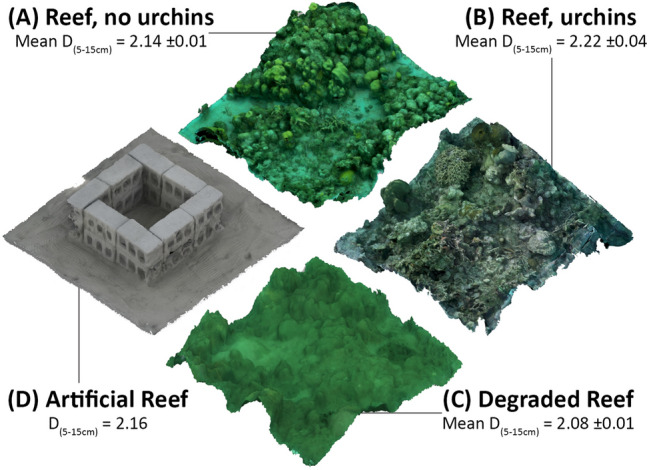
When Caribbean long-spined sea urchins, Diadema antillarum, are stable at high population densities, their grazing facilitates scleractinian coral dominance. Today, populations remain suppressed after a mass mortality in 1983-1984 caused a loss of their ecosystem functions, and led to widespread declines in ecosystem health. This study provides three lines of evidence to support the assertion that a lack of habitat complexity on Caribbean coral reefs contributes to their recovery failure. Firstly, we extracted fractal dimension (D) measurements, used as a proxy for habitat complexity, from 3D models to demonstrate that urchins preferentially inhabit areas of above average complexity at ecologically relevant spatial scales. Secondly, controlled behaviour experiments showed that an energetically expensive predator avoidance behaviour is reduced by 52% in complex habitats, potentially enabling increased resource allocation to reproduction. Thirdly, we deployed a network of simple and cost-effective artificial structures on a heavily degraded reef system in Honduras. Over a 24-month period the adult D. antillarum population around the artificial reefs increased by 320% from 0.05 ± 0.01 to 0.21 ± 0.04 m and the juvenile D. antillarum population increased by 750% from 0.08 ± 0.02 to 0.68 ± 0.07 m. This study emphasises the important role of habitat structure in the ecology of D. antillarum and as a barrier to its widespread recovery.
当加勒比长刺海胆(Diadema antillarum)在高密度种群中稳定时,它们的摄食促进了石珊瑚的优势地位。如今,在 1983-1984 年大规模死亡导致其生态系统功能丧失,并导致生态系统健康广泛下降后,这些种群的数量仍然受到抑制。本研究提供了三条证据支持以下观点:加勒比珊瑚礁缺乏栖息地复杂性是其恢复失败的原因之一。首先,我们从 3D 模型中提取分形维数(D)测量值,用作栖息地复杂性的代理,以证明海胆优先栖息在生态相关空间尺度上具有平均以上复杂性的区域。其次,受控行为实验表明,在复杂栖息地中,一种能量消耗高的捕食者回避行为减少了 52%,这可能使更多的资源分配给繁殖。第三,我们在洪都拉斯一个严重退化的珊瑚礁系统上部署了一个简单且具有成本效益的人工结构网络。在 24 个月的时间里,人工礁石周围的成年加勒比长刺海胆(Diadema antillarum)种群数量增加了 320%,从 0.05±0.01 增加到 0.21±0.04 m,而幼年加勒比长刺海胆(Diadema antillarum)种群数量增加了 750%,从 0.08±0.02 增加到 0.68±0.07 m。本研究强调了栖息地结构在加勒比长刺海胆生态学中的重要作用,以及它作为其广泛恢复的障碍的重要作用。