Naturalis Biodiversity Center, Leiden, 2332 AA, the Netherlands.
Institute of Biology, Leiden University, Leiden, 2333 BE, the Netherlands.
New Phytol. 2021 Jul;231(2):791-800. doi: 10.1111/nph.17414. Epub 2021 Jun 1.
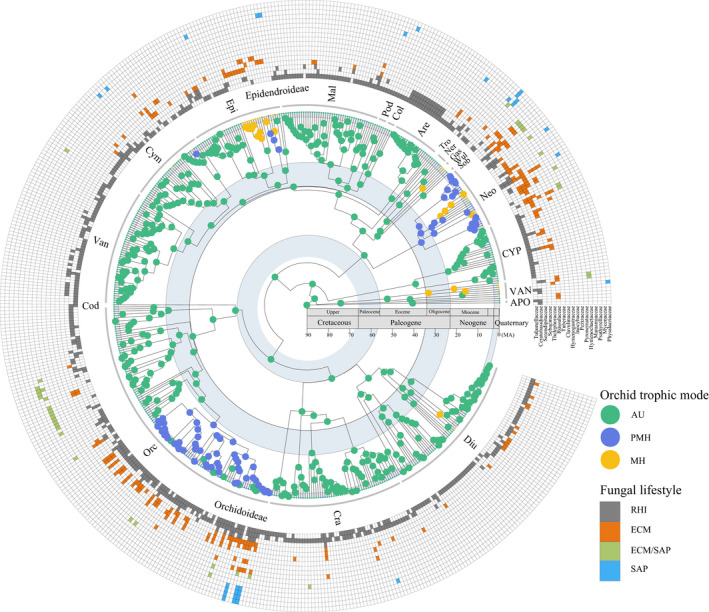
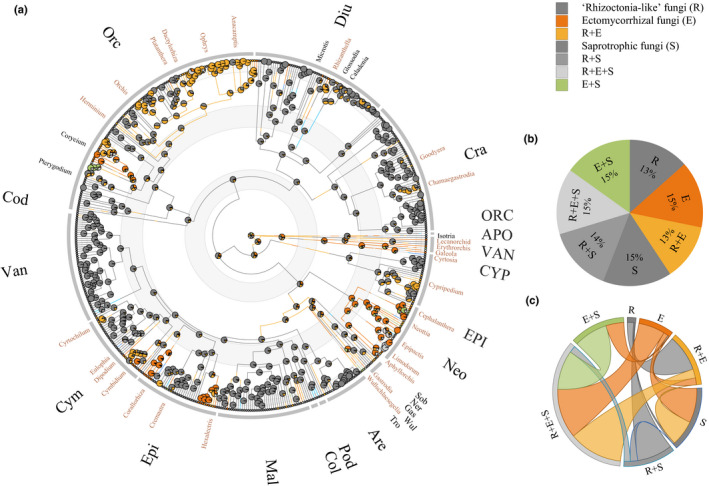
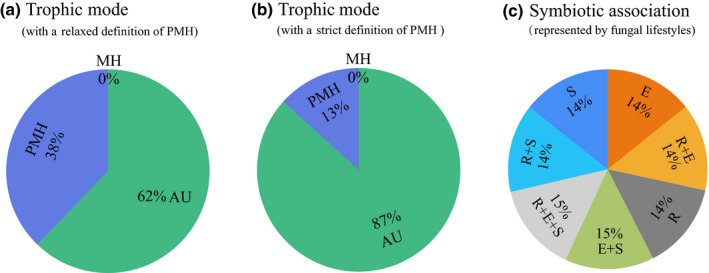
Mycorrhizal fungi are central to the biology of land plants. However, to what extent mycorrhizal shifts - broad evolutionary transitions in root-associated fungal symbionts - are related to changes in plant trophic modes remains poorly understood. We built a comprehensive DNA dataset of Orchidaceae fungal symbionts and a dated plant molecular phylogeny to test the hypothesis that shifts in orchid trophic modes follow a stepwise pattern, from autotrophy over partial mycoheterotrophy (mixotrophy) to full mycoheterotrophy, and that these shifts are accompanied by switches in fungal symbionts. We estimate that at least 17 independent shifts from autotrophy towards full mycoheterotrophy occurred in orchids, mostly through an intermediate state of partial mycoheterotrophy. A wide range of fungal partners was inferred to occur in the roots of the common ancestor of this family, including 'rhizoctonias', ectomycorrhizal, and wood- or litter-decaying saprotrophic fungi. Phylogenetic hypothesis tests further show that associations with ectomycorrhizal or saprotrophic fungi were most likely a prerequisite for evolutionary shifts towards full mycoheterotrophy. We show that shifts in trophic mode often coincided with switches in fungal symbionts, suggesting that the loss of photosynthesis selects for different fungal communities in orchids. We conclude that changes in symbiotic associations and ecophysiological traits are tightly correlated throughout the diversification of orchids.
菌根真菌是陆生植物生物学的核心。然而,菌根转移(根系共生真菌的广泛进化转变)在多大程度上与植物营养方式的变化有关,仍知之甚少。我们构建了一个全面的兰科真菌共生体 DNA 数据集和一个经过时间校准的植物分子系统发育树,以检验以下假设:兰花营养方式的转变遵循逐步模式,从自养到部分菌根异养(混养)再到完全菌根异养,并且这些转变伴随着真菌共生体的转变。我们估计,兰花至少发生了 17 次从自养向完全菌根异养的独立转变,大多数是通过部分菌根异养的中间状态。在这个科的共同祖先的根部中,推断出存在广泛的真菌伙伴,包括“立枯丝核菌”、外生菌根真菌和木质或腐叶分解真菌。系统发育假设检验进一步表明,与外生菌根或腐生真菌的关联最有可能是向完全菌根异养进化转变的先决条件。我们表明,营养方式的转变通常与真菌共生体的转变同时发生,这表明光合作用的丧失选择了兰花中不同的真菌群落。我们的结论是,在兰花多样化的过程中,共生关系和生理特征的变化是紧密相关的。