Department of Internal Medicine, Morehouse School of Medicine, 720 Westview Drive, Atlanta, GA, 30310, USA.
Program in Physical Therapy and Department of Medicine, Washington University School of Medicine, St. Louis, MO, 63108, USA.
BMC Med Genomics. 2021 May 1;14(1):118. doi: 10.1186/s12920-021-00961-8.
Associations have been observed among genetic variants, dietary patterns, and metabolic syndrome (MetS). A gap in knowledge is whether a genetic risk score (GRS) and dietary patterns interact to increase MetS risk among African Americans. We investigated whether MetS risk was influenced by interaction between a GRS and dietary patterns among Whites and African Americans. A secondary aim examined if molecular genetic clusterings differed by racial ancestry.
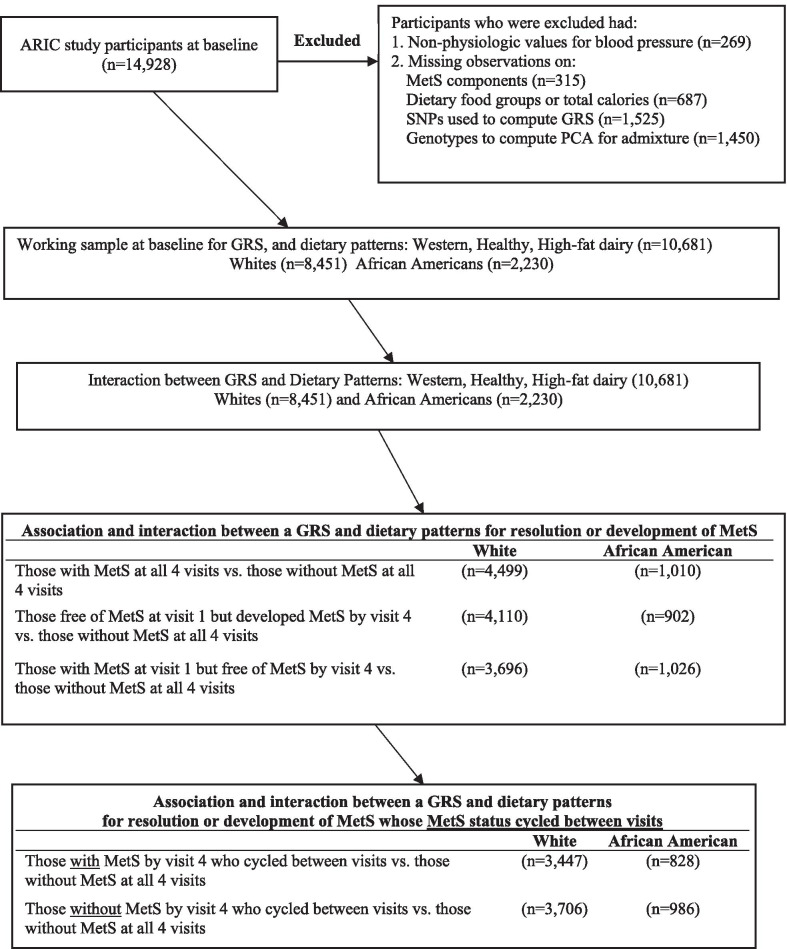
We used longitudinal data over 4-visits (1987-1998) that included 10,681 participants aged 45-64y at baseline from the Atherosclerosis Risk in Communities study (8451 Whites and 2230 African Americans). We constructed a simple-count GRS as the linear weighted sum of high-risk alleles (0, 1, 2) from cardiovascular disease polymorphisms from the genome-wide association studies catalog associated with MetS risk. Three dietary patterns were determined by factor analysis of food frequency questionnaire data: Western, healthy, and high-fat dairy. MetS was defined according to the 2016 National Cholesterol Education Program Adult Treatment Panel III criteria but used 2017 American Heart Association/American College of Cardiology criteria for elevated blood pressure. Analyses included generalized linear model risk ratios (RR), 95% confidence intervals (CI), and Bonferroni correction for multiple testing.
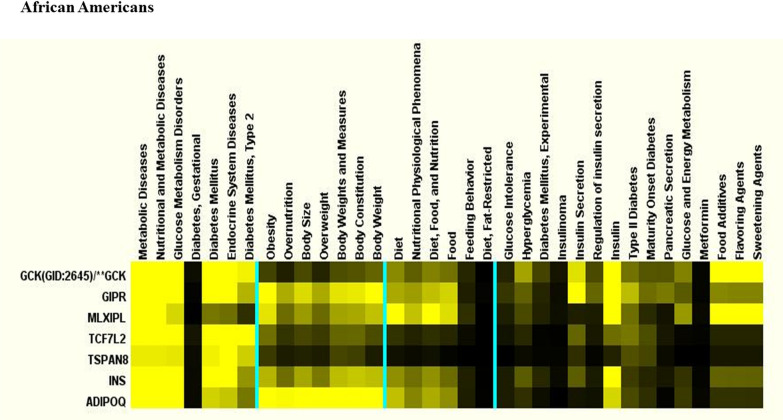
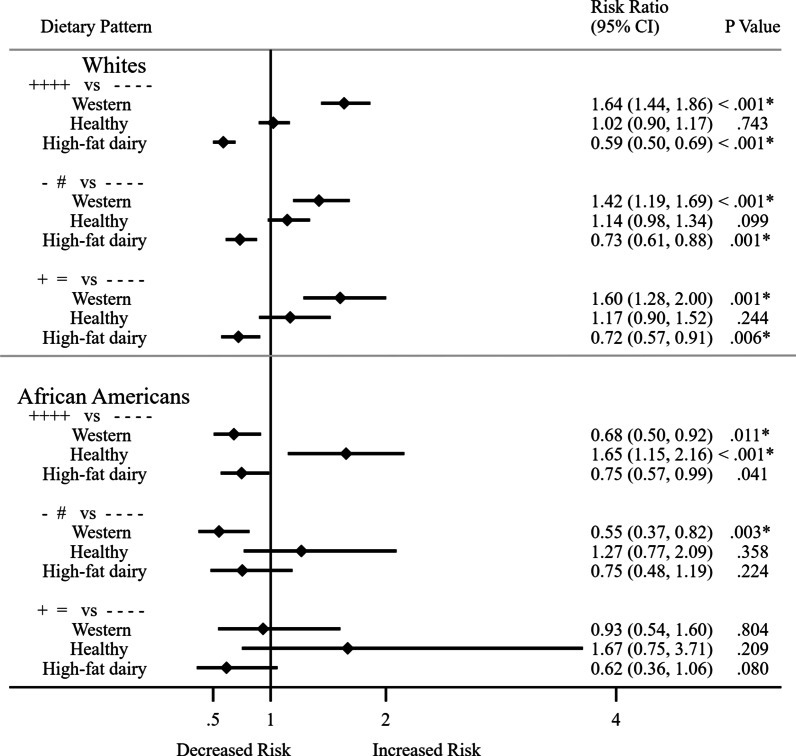
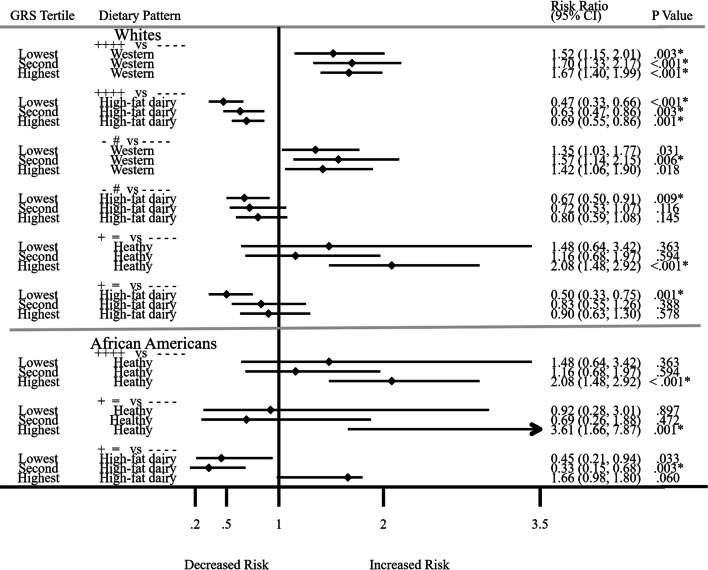
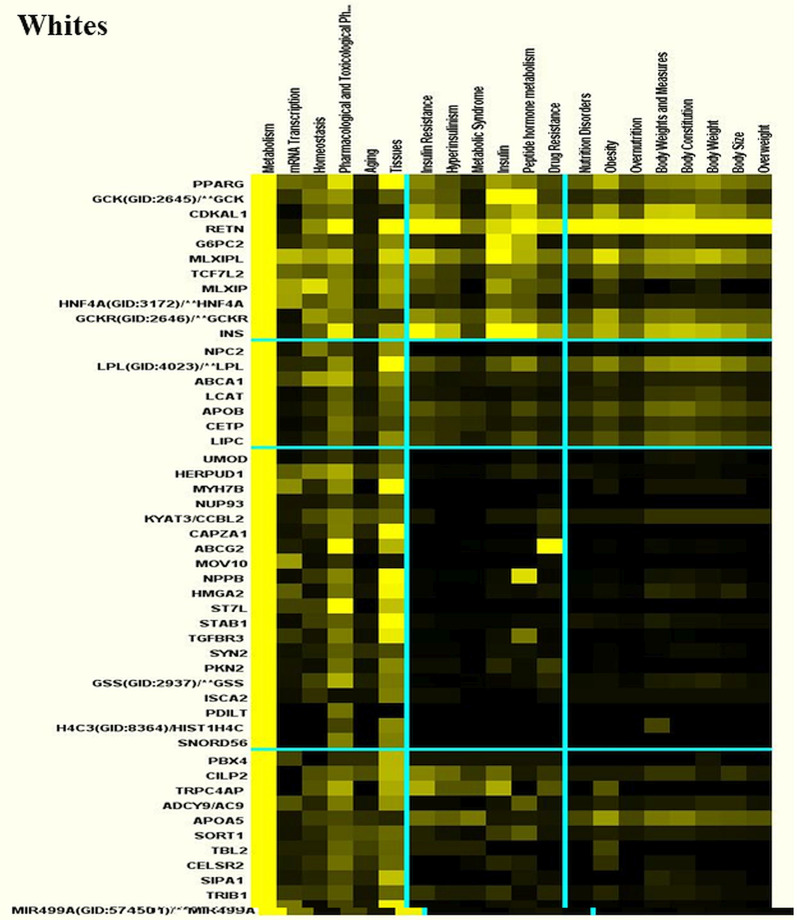
The Western dietary pattern was associated with higher risk for MetS across increasing GRS tertiles among Whites (p < 0.017). The high-fat dairy pattern was protective against MetS, but its impact was most effective in the lowest GRS tertile in Whites (RR = 0.62; CI: 0.52-0.74) and African Americans (RR = 0.67; CI: 0.49-0.91). Among each racial group within GRS tertiles, the Western dietary pattern was associated with development and cycling of MetS status between visits, and the high-fat dairy pattern with being free from MetS (p < 0.017). The healthy dietary pattern was associated with higher risk of MetS among African Americans which may be explained by higher sucrose intake (p < 0.0001). Fewer genes, but more metabolic pathways for obesity, body fat distribution, and lipid and carbohydrate metabolism were identified in African Americans than Whites. Some polymorphisms were linked to the Western and high-fat dairy patterns.
The influence of dietary patterns on MetS risk appears to differ by genetic predisposition and racial ancestry.
遗传变异、饮食模式和代谢综合征(MetS)之间存在关联。知识上的一个空白是,遗传风险评分(GRS)和饮食模式是否会相互作用,增加非裔美国人患 MetS 的风险。我们研究了 GRS 和饮食模式之间的相互作用是否会影响白人和非裔美国人的 MetS 风险。次要目的是检查分子遗传聚类是否因种族起源不同而不同。
我们使用了来自社区动脉粥样硬化风险研究(Atherosclerosis Risk in Communities study)的纵向数据,该研究包括来自 1987 年至 1998 年的 4 次访视的 10681 名年龄在 45-64 岁的参与者(8451 名白人,2230 名非裔美国人)。我们构建了一个简单计数的 GRS,作为与 MetS 风险相关的来自全基因组关联研究目录的心血管疾病多态性的高风险等位基因(0、1、2)的线性加权和。通过对食物频率问卷数据的因子分析确定了三种饮食模式:西方模式、健康模式和高脂肪乳制品模式。根据 2016 年国家胆固醇教育计划成人治疗专家组 III 标准定义代谢综合征,但使用 2017 年美国心脏协会/美国心脏病学会标准定义高血压。分析包括广义线性模型风险比(RR)、95%置信区间(CI)和多重检验的 Bonferroni 校正。
在白人中,随着 GRS 三分位数的增加,西方饮食模式与更高的 MetS 风险相关(p < 0.017)。高脂肪乳制品模式可预防 MetS,但在白人最低 GRS 三分位数时,其影响最为显著(RR = 0.62;CI:0.52-0.74)和非裔美国人(RR = 0.67;CI:0.49-0.91)。在 GRS 三分位数内的每个种族群体中,西方饮食模式与访视之间 MetS 状态的发展和循环有关,而高脂肪乳制品模式与无 MetS 状态有关(p < 0.017)。健康饮食模式与非裔美国人患 MetS 的风险增加有关,这可能与蔗糖摄入量较高有关(p < 0.0001)。与肥胖、体脂肪分布以及脂质和碳水化合物代谢相关的基因较少,但代谢途径在非裔美国人中比在白人中更多。一些多态性与西方和高脂肪乳制品模式有关。
饮食模式对 MetS 风险的影响似乎因遗传易感性和种族起源而异。