Qi Zhan, Hu Yuanping, Qiu Rong, Li Juan, Li Yuekao, He Ming, Wang Yuxiang
Department of thoracic surgery, Fourth Hospital of Hebei Medical University, Shijiazhuang, 050011, China.
Department of Radiation Oncology, Fourth Hospital of Hebei Medical University, No.12, Jiankang road, Shijiazhuang, 050011, China.
J Cardiothorac Surg. 2021 May 1;16(1):121. doi: 10.1186/s13019-021-01503-0.
The overall survival (OS) remains unsatisfactory in patients with esophageal squamous cell carcinoma (ESCC) after extended esophagectomy with two-field lymphadenectomy. Therefore, this retrospective study aimed to identify the risk factors that contribute to the low survival of patients with pTNM ESCC.
Patients with pTNM ESCC who only underwent R0 esophagectomy with two-field lymphadenectomy in our department from January 2008 to December 2012 were retrospectively enrolled in this study and medical records were reviewed. Postoperative OS, disease-free survival (DFS), recurrence-free survival (RFS), and locoregional recurrence-free survival (LRFS) were analyzed sequentially.
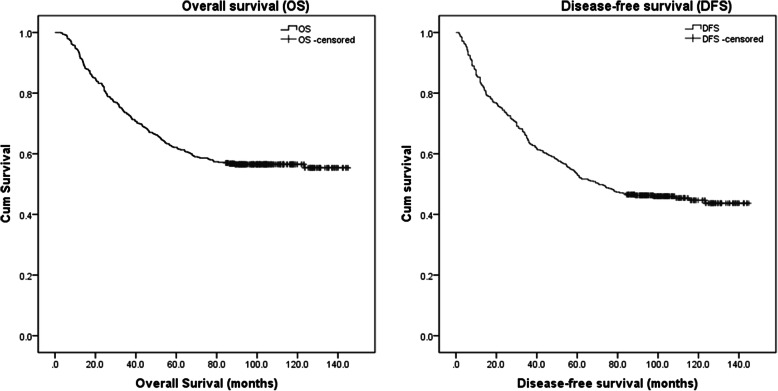
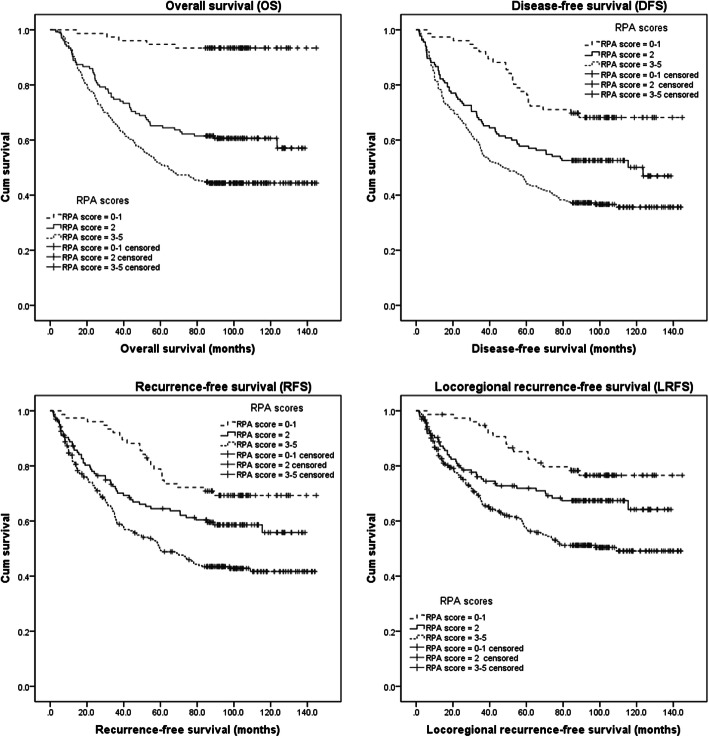
This study recruited a total of 488 patients, whose follow-up visits were completed at the end of December 2019. The five-year OS, DFS, RFS and LRFS rates were 62.1, 53.1, 58.3 and 65.6%, respectively. Multivariate Cox analysis identified patient age, site of the lesion, small mediastinal lymph nodes in CT imaging (SLNs in CT), dissected lymph nodes (LNs), and stage of esophageal malignancy as independent risk factors for OS of the patients. Of these factors, the site of the lesion, SLNs in CT and stage of the cancer were determined to be independent factors for DFS, RFS and LRFS. Based on all five factors, the recursive partitioning analysis (RPA) score system was developed to stratify the patients into low-, medium- and high-risk groups, which were found to possess significantly different rates of OS, DFS, RFS and LRFS (p < 0.001).
Several factors were associated with the survival of patients with pT NM ESCC who underwent extended esophagectomy with two-field lymphadenectomy. These factors contributed to the RPA scoring system, which could stratify the risk of postoperative survival and may expedite the initiation of postoperative adjuvant therapy.
在接受扩大食管切除术加两野淋巴结清扫术的食管鳞状细胞癌(ESCC)患者中,总生存期(OS)仍不尽人意。因此,本回顾性研究旨在确定导致pTNM期ESCC患者生存率低的危险因素。
回顾性纳入2008年1月至2012年12月期间在我科仅接受R0食管切除术加两野淋巴结清扫术的pTNM期ESCC患者,并查阅病历。依次分析术后总生存期(OS)、无病生存期(DFS)、无复发生存期(RFS)和区域无复发生存期(LRFS)。
本研究共纳入488例患者,其随访于2019年12月底完成。五年OS、DFS、RFS和LRFS率分别为62.1%、53.1%、58.3%和65.6%。多因素Cox分析确定患者年龄、病变部位、CT影像中的小纵隔淋巴结(CT中的SLN)、清扫淋巴结(LN)和食管恶性肿瘤分期为患者OS的独立危险因素。在这些因素中,病变部位、CT中的SLN和癌症分期被确定为DFS、RFS和LRFS的独立因素。基于所有五个因素,开发了递归划分分析(RPA)评分系统,将患者分为低、中、高风险组,发现这些组的OS、DFS、RFS和LRFS率有显著差异(p<0.001)。
几个因素与接受扩大食管切除术加两野淋巴结清扫术的pTNM期ESCC患者的生存相关。这些因素促成了RPA评分系统,该系统可以对术后生存风险进行分层,并可能加快术后辅助治疗的启动。