Robinson Thomas N, Matheson Donna, Wilson Darrell M, Weintraub Dana L, Banda Jorge A, McClain Arianna, Sanders Lee M, Haskell William L, Haydel K Farish, Kapphahn Kristopher I, Pratt Charlotte, Truesdale Kimberly P, Stevens June, Desai Manisha
Stanford Solutions Science Lab, Department of Pediatrics, Stanford University, Stanford, CA, USA; Division of General Pediatrics, Department of Pediatrics, Stanford University, Stanford, CA, USA; Prevention Research Center, Stanford University, Stanford, CA, USA; Department of Medicine, Department of Epidemiology and Population Health, Stanford University, Stanford, CA, USA.
Stanford Solutions Science Lab, Department of Pediatrics, Stanford University, Stanford, CA, USA; Division of General Pediatrics, Department of Pediatrics, Stanford University, Stanford, CA, USA.
Lancet Diabetes Endocrinol. 2021 Jun;9(6):336-349. doi: 10.1016/S2213-8587(21)00084-X. Epub 2021 Apr 29.
There are few long-term studies of interventions to reduce in low socioeconomic status children with overweight or obesity. The Stanford GOALS trial evaluated a 3-year, community-based, multi-level, multi-setting, multi-component (MMM) systems intervention, to reduce weight gain among low socioeconomic status, Latinx children with overweight or obesity.
We did a two-arm, parallel group, randomised, open-label, active placebo-controlled trial with masked assessment over 3 years. Families from low-income, primarily Latinx communities in Northern California, CA, USA, with 7-11-year-old children with overweight or obesity were randomly assigned to a MMM intervention or a Health Education (HE) comparison intervention. The MMM intervention included home environment changes and behavioural counselling, community after school team sports, and reports to primary health-care providers. The primary outcome was child BMI trajectory over three years. Secondary outcomes included one- and two-year changes in BMI. This trial is registered with ClinicalTrials.govNCT01642836.
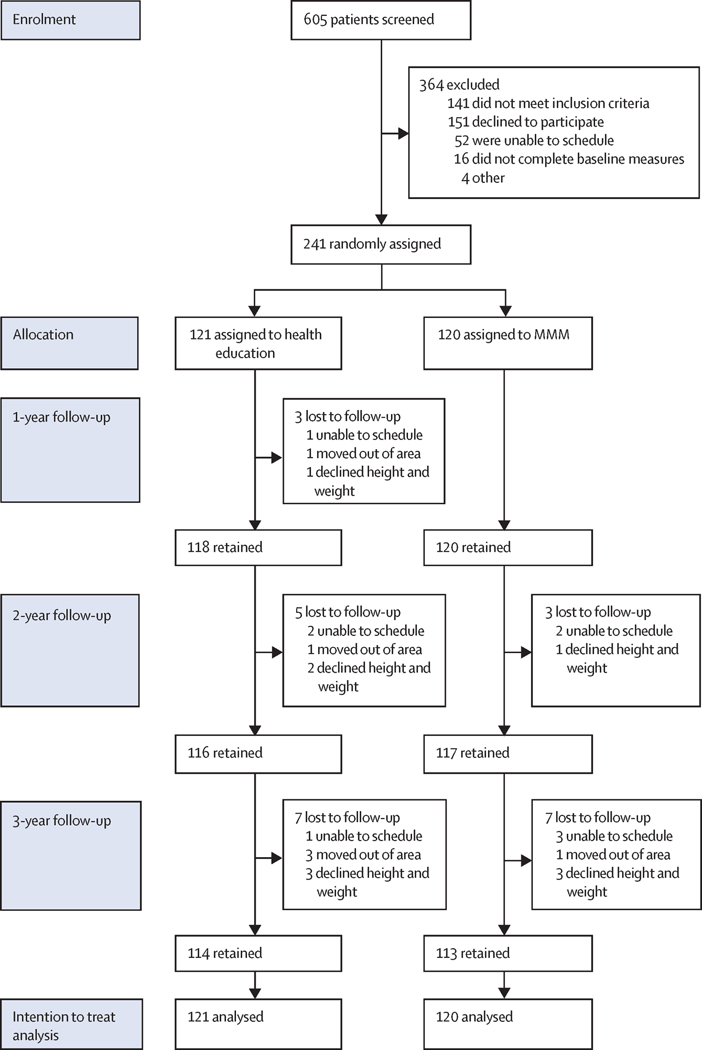
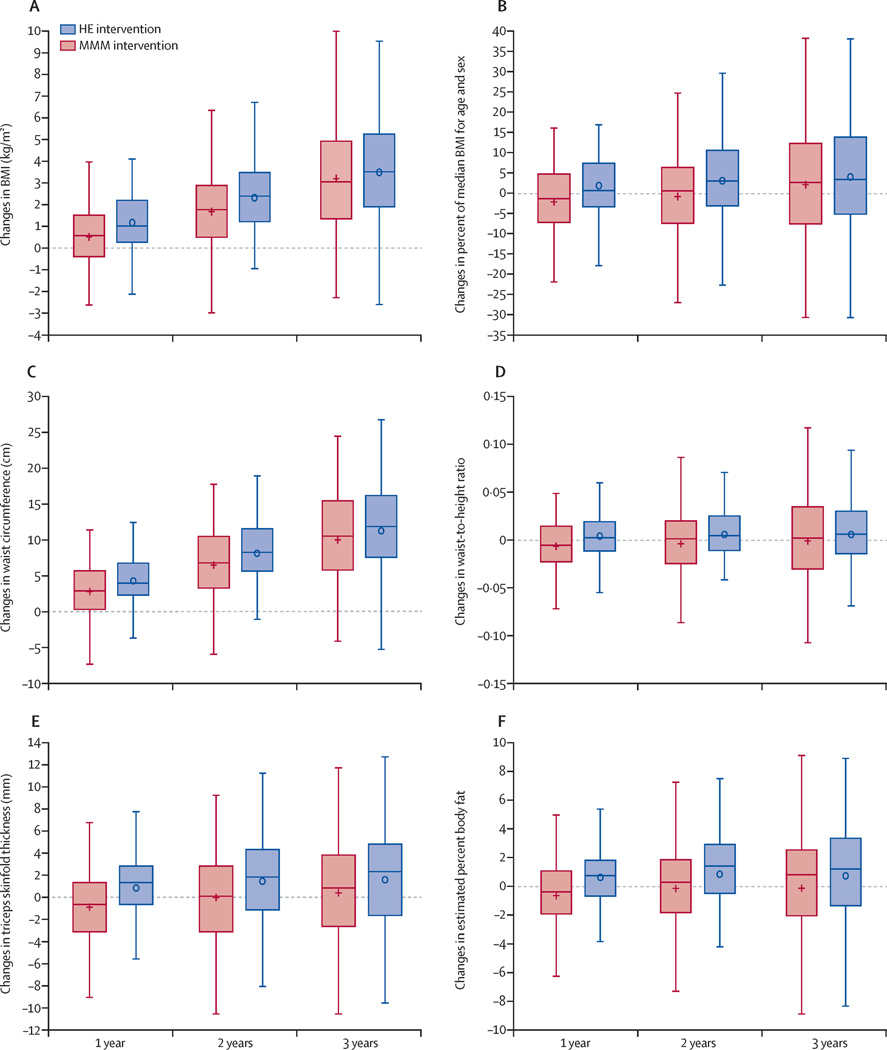
Between July 13, 2012, and Oct 3, 2013, 241 families were recruited and randomly assigned to MMM (n=120) or HE (n=121). Children's mean age was 9·5 (SD 1·4) years, 134 (56%) were female and 107 (44%) were male, and 236 (98%) were Latinx. 238 (99%) children participated in year 1, 233 (97%) in year 2, and 227 (94%) in year 3 of follow-up assessments. In intention-to-treat analysis, over 3 years, the difference between intervention groups in BMI trajectory was not significant (mean adjusted difference -0·25 [95% CI -0·90 to 0·40] kg/m; Cohen's d=0.10; p=0·45). Children in the MMM intervention group gained less BMI over 1 year than did children in the HE intervention group (-0·73 [-1·07 to -0·39] kg/m, d=0.55); the same was true over 2 years (-0·63 [-1·13 to -0·14] kg/m; d =0.33). No differential adverse events were observed.
The MMM intervention did not reduce BMI gain versus HE over 3 years but the effects over 1 and 2 years in this rigorous trial show the promise of this systems intervention approach for reducing weight gain and cardiometabolic risk factors in low socioeconomic status communities.
US National Institutes of Health.
针对降低社会经济地位较低的超重或肥胖儿童体重的干预措施,长期研究较少。斯坦福目标试验评估了一项为期3年、基于社区、多层次、多场所、多组分(MMM)的系统干预措施,以减少社会经济地位较低的超重或肥胖拉丁裔儿童的体重增加。
我们进行了一项双臂、平行组、随机、开放标签、活性安慰剂对照试验,为期3年,采用盲法评估。来自美国加利福尼亚州北部低收入、主要为拉丁裔社区的家庭,其7至11岁的孩子超重或肥胖,被随机分配到MMM干预组或健康教育(HE)对照干预组。MMM干预包括家庭环境改变和行为咨询、社区课后团队运动,以及向初级卫生保健提供者汇报。主要结局是儿童三年的BMI轨迹。次要结局包括BMI在1年和2年的变化。本试验已在ClinicalTrials.gov注册,注册号为NCT01642836。
在2012年7月13日至2013年10月3日期间,招募了241个家庭,并随机分配到MMM组(n = 120)或HE组(n = 121)。儿童的平均年龄为9.5(标准差1.4)岁,134名(56%)为女性,107名(44%)为男性,236名(98%)为拉丁裔。238名(99%)儿童参与了第1年的随访评估,233名(97%)参与了第2年,227名(94%)参与了第3年。在意向性分析中,3年期间,干预组之间的BMI轨迹差异不显著(平均调整差异-0.25 [95%置信区间-0.90至0.40] kg/m;科恩d值 = 0.10;p = 0.45)。MMM干预组儿童在1年内的BMI增加量低于HE干预组儿童(-0.73 [-1.07至-0.39] kg/m,d = 0.55);2年时情况相同(-0.63 [-1.13至-0.14] kg/m;d = 0.33)。未观察到有差异的不良事件。
与健康教育相比,MMM干预在3年内并未降低BMI增加量,但在这项严格试验中,其在1年和2年的效果显示出这种系统干预方法在降低社会经济地位较低社区的体重增加和心血管代谢危险因素方面的前景。
美国国立卫生研究院。