Network Aging Research, Heidelberg University, Heidelberg, Germany.
Division of Clinical Epidemiology and Aging Research, German Cancer Research Center, Heidelberg, Germany.
Transl Psychiatry. 2021 May 1;11(1):261. doi: 10.1038/s41398-021-01380-0.
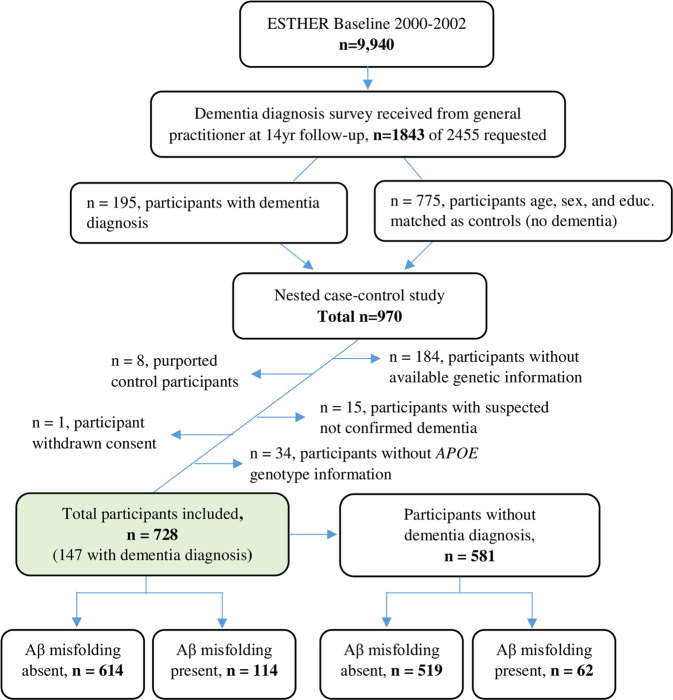
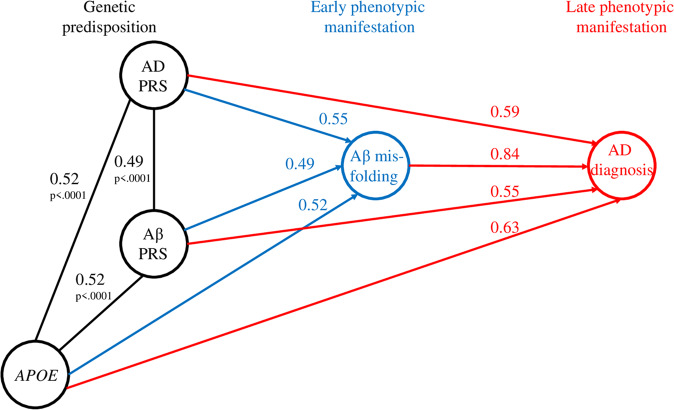
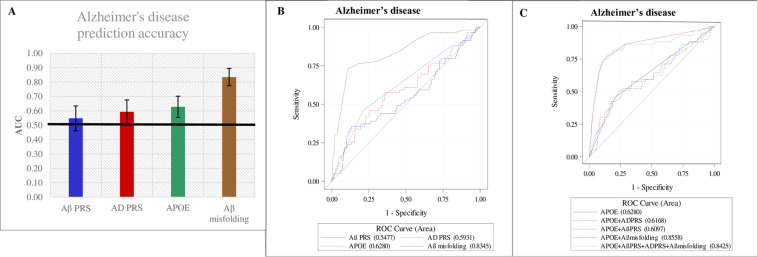
Alzheimer's disease is highly heritable and characterized by amyloid plaques and tau tangles in the brain. The aim of this study was to investigate the association between genetic predisposition, Aβ misfolding in blood plasma, a unique marker of Alzheimer associated neuropathological changes, and Alzheimer's disease occurrence within 14 years. Within a German community-based cohort, two polygenic risk scores (clinical Alzheimer's disease and Aβ based) were calculated, APOE genotype was determined, and Aβ misfolding in blood plasma was measured by immuno-infrared sensor in 59 participants diagnosed with Alzheimer's disease during 14 years of follow-up and 581 participants without dementia diagnosis. Associations between each genetic marker and Aβ misfolding were assessed through logistic regression and the ability of each genetic marker and Aβ misfolding to predict Alzheimer's disease was determined. The Alzheimer's disease polygenic risk score and APOE ε4 presence were associated to Aβ misfolding (odds ratio, 95% confidence interval: per standard deviation increase of score: 1.25, 1.03-1.51; APOE ε4 presence: 1.61, 1.04-2.49). No association was evident for the Aβ polygenic risk score. All genetic markers were predictive of Alzheimer's disease diagnosis albeit much less so than Aβ misfolding (areas under the curve: Aβ polygenic risk score: 0.55; AD polygenic risk score: 0.59; APOE ε4: 0.63; Aβ misfolding: 0.84). Clinical Alzheimer's genetic risk was associated to early pathological changes (Aβ misfolding) measured in blood, however, predicted Alzheimer's disease less accurately than Aβ misfolding itself. Genetic predisposition may provide information regarding disease initiation, while Aβ misfolding could be important in clinical risk prediction.
阿尔茨海默病的遗传性很高,其特征是大脑中有淀粉样斑块和 tau 缠结。本研究旨在探讨遗传易感性、血浆中 Aβ 错误折叠(阿尔茨海默病相关神经病理变化的独特标志物)与 14 年内发生阿尔茨海默病之间的关系。在德国社区为基础的队列中,计算了两个多基因风险评分(基于临床阿尔茨海默病和 Aβ 的评分),确定了 APOE 基因型,并通过免疫红外传感器测量了 59 名在 14 年随访期间被诊断为阿尔茨海默病的参与者和 581 名无痴呆诊断的参与者的血浆中 Aβ 错误折叠。通过逻辑回归评估了每个遗传标记与 Aβ 错误折叠之间的关联,并确定了每个遗传标记和 Aβ 错误折叠预测阿尔茨海默病的能力。阿尔茨海默病多基因风险评分和 APOE ε4 存在与 Aβ 错误折叠相关(优势比,95%置信区间:每增加一个评分标准偏差:1.25,1.03-1.51;APOE ε4 存在:1.61,1.04-2.49)。Aβ 多基因风险评分没有关联。所有遗传标记都可以预测阿尔茨海默病的诊断,尽管其预测能力远不如 Aβ 错误折叠(曲线下面积:Aβ 多基因风险评分:0.55;AD 多基因风险评分:0.59;APOE ε4:0.63;Aβ 错误折叠:0.84)。临床阿尔茨海默病的遗传风险与血液中测量的早期病理变化(Aβ 错误折叠)相关,但不如 Aβ 错误折叠本身准确地预测阿尔茨海默病。遗传易感性可能提供有关疾病起始的信息,而 Aβ 错误折叠可能在临床风险预测中很重要。