Department of Neuropsychology and Psychopharmacology, University of Maastricht, Universiteitssingel 40, 6229, Maastricht, The Netherlands.
Department of Neuropsychology, Max Planck Institute for Human Cognitive and Brain Sciences, Leipzig, Germany.
Brain Struct Funct. 2021 Jul;226(6):1659-1676. doi: 10.1007/s00429-021-02284-x. Epub 2021 May 2.
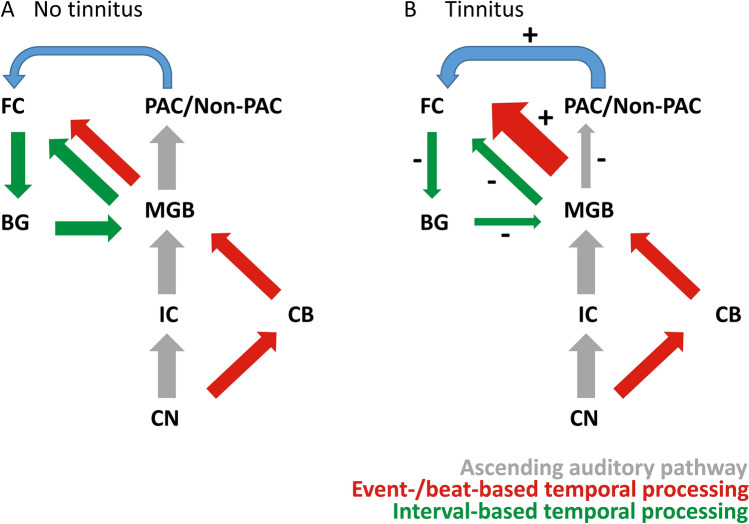
Tinnitus is the perception of a 'ringing' sound without an acoustic source. It is generally accepted that tinnitus develops after peripheral hearing loss and is associated with altered auditory processing. The thalamus is a crucial relay in the underlying pathways that actively shapes processing of auditory signals before the respective information reaches the cerebral cortex. Here, we review animal and human evidence to define thalamic function in tinnitus. Overall increased spontaneous firing patterns and altered coherence between the thalamic medial geniculate body (MGB) and auditory cortices is observed in animal models of tinnitus. It is likely that the functional connectivity between the MGB and primary and secondary auditory cortices is reduced in humans. Conversely, there are indications for increased connectivity between the MGB and several areas in the cingulate cortex and posterior cerebellar regions, as well as variability in connectivity between the MGB and frontal areas regarding laterality and orientation in the inferior, medial and superior frontal gyrus. We suggest that these changes affect adaptive sensory gating of temporal and spectral sound features along the auditory pathway, reflecting dysfunction in an extensive thalamo-cortical network implicated in predictive temporal adaptation to the auditory environment. Modulation of temporal characteristics of input signals might hence factor into a thalamo-cortical dysrhythmia profile of tinnitus, but could ultimately also establish new directions for treatment options for persons with tinnitus.
耳鸣是指在没有声源的情况下感知到“嗡嗡”声。一般认为,耳鸣是在听力损失后发展起来的,与听觉处理改变有关。丘脑是潜在通路中的关键中继站,在听觉信号到达大脑皮层之前,积极地对其进行处理。在这里,我们回顾了动物和人类的证据,以确定丘脑在耳鸣中的功能。在耳鸣的动物模型中,观察到丘脑内侧膝状体(MGB)和听觉皮层之间自发放电模式增加和相干性改变。在人类中,MGB 与初级和次级听觉皮层之间的功能连接可能减少。相反,有迹象表明 MGB 与扣带回皮层和后小脑区域的几个区域之间的连接增加,以及 MGB 与额叶区域之间的连接的可变性,关于额下回、额中回和额上回的侧性和方位。我们认为这些变化会影响听觉通路上的时间和频谱声音特征的适应性感觉门控,反映出与预测性听觉环境适应有关的广泛丘脑-皮层网络的功能障碍。输入信号的时间特征的调制可能因此成为耳鸣的丘脑-皮层节律紊乱的一个因素,但最终也可能为耳鸣患者的治疗选择开辟新的方向。