Department of Anesthesiology, Duke University, Durham, NC.
Critical Care and Perioperative Population Health Research (CAPER) Unit, Department of Anesthesiology, Duke University. Durham, NC.
Crit Care Med. 2021 Oct 1;49(10):1769-1778. doi: 10.1097/CCM.0000000000005055.
Traumatic brain injury is a leading cause of death and disability in the United States. While the impact of early multiple organ dysfunction syndrome has been studied in many critical care paradigms, the clinical impact of early multiple organ dysfunction syndrome in traumatic brain injury is poorly understood. We examined the incidence and impact of early multiple organ dysfunction syndrome on clinical, functional, and disability outcomes over the year following traumatic brain injury.
Retrospective cohort study.
Patients enrolled in the Transforming Clinical Research and Knowledge in Traumatic Brain Injury study, an 18-center prospective cohort study of traumatic brain injury patients evaluated in participating level 1 trauma centers.
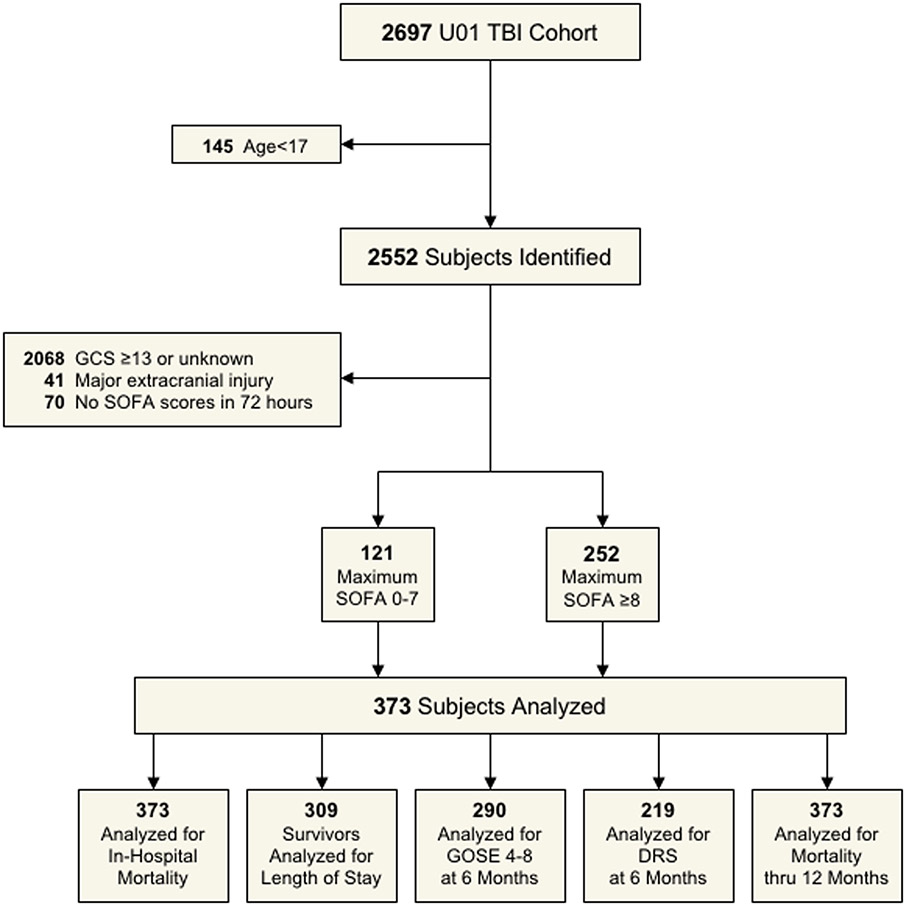
Adult (age > 17 yr) patients with moderate-severe traumatic brain injury (Glasgow Coma Scale < 13). We excluded patients with major extracranial injury (Abbreviated Injury Scale score ≥ 3).
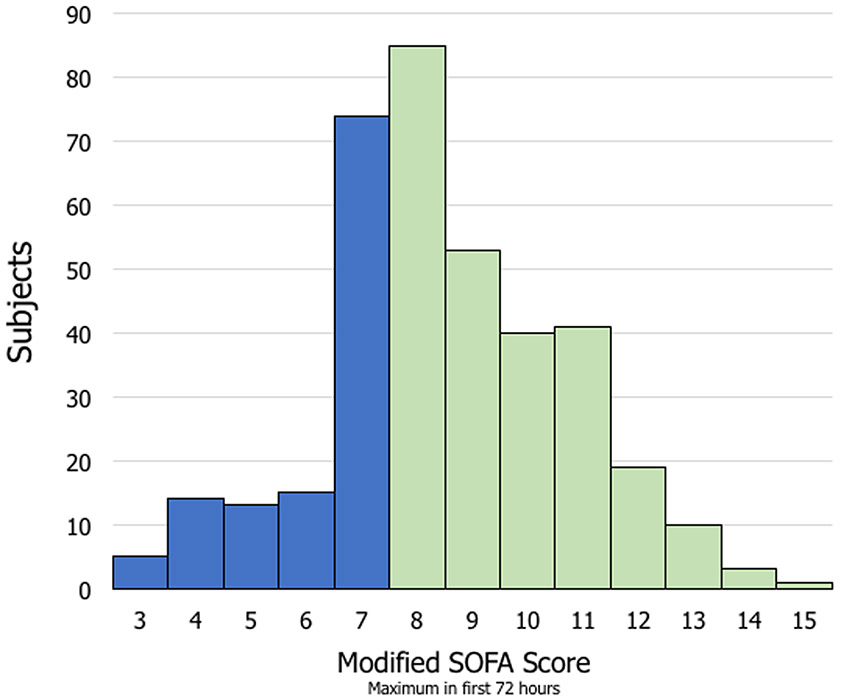
Development of early multiple organ dysfunction syndrome, defined as a maximum modified Sequential Organ Failure Assessment score greater than 7 during the initial 72 hours following admission.
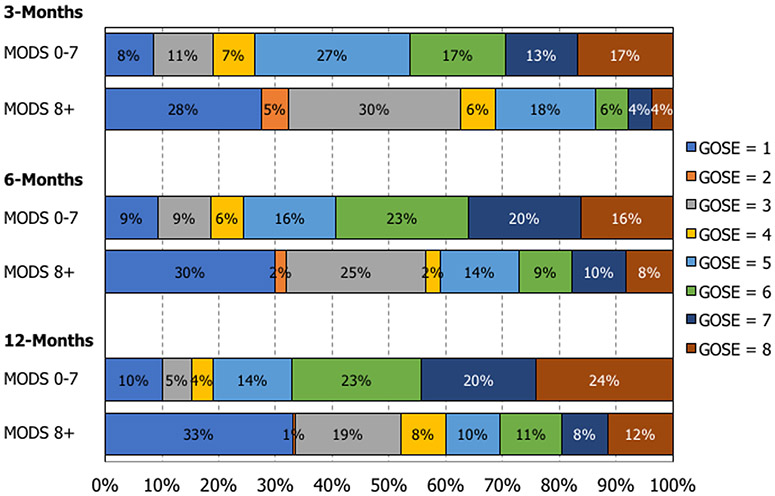
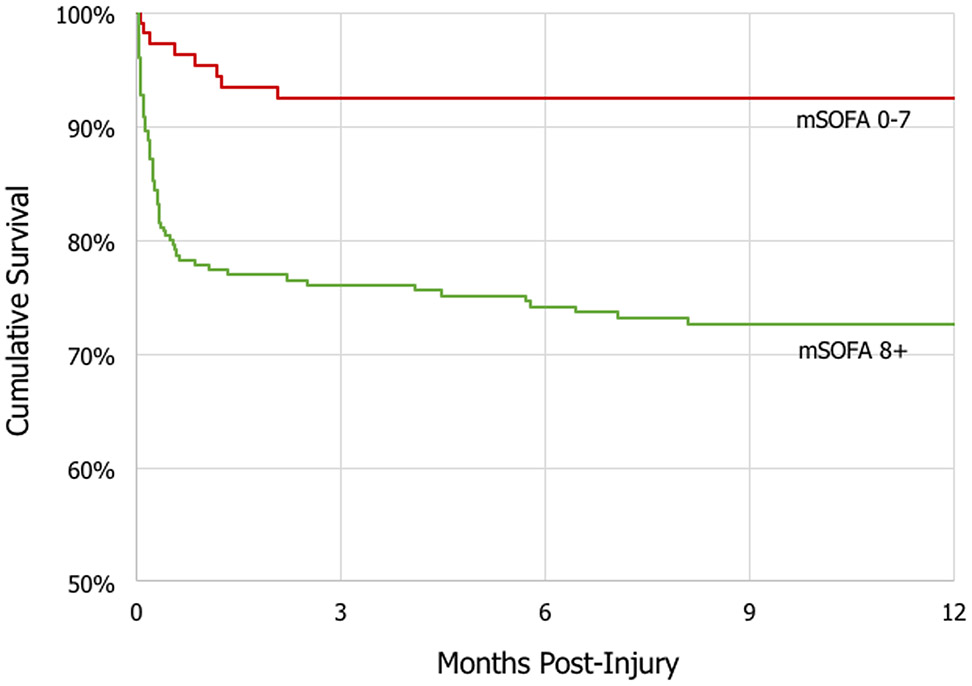
The main outcomes were: hospital mortality, length of stay, 6-month functional and disability domains (Glasgow Outcome Scale-Extended and Disability Rating Scale), and 1-year mortality. Secondary outcomes included: ICU length of stay, 3-month Glasgow Outcome Scale-Extended, 3-month Disability Rating Scale, 1-year Glasgow Outcome Scale-Extended, and 1-year Disability Rating Scale. We examined 373 subjects with moderate-severe traumatic brain injury. The mean (sd) Glasgow Coma Scale in the emergency department was 5.8 (3.2), with 280 subjects (75%) classified as severe traumatic brain injury (Glasgow Coma Scale 3-8). Among subjects with moderate-severe traumatic brain injury, 252 (68%) developed early multiple organ dysfunction syndrome. Subjects that developed early multiple organ dysfunction syndrome had a 75% decreased odds of a favorable outcome (Glasgow Outcome Scale-Extended 5-8) at 6 months (adjusted odds ratio, 0.25; 95% CI, 0.12-0.51) and increased disability (higher Disability Rating Scale score) at 6 months (adjusted mean difference, 2.04; 95% CI, 0.92-3.17). Subjects that developed early multiple organ dysfunction syndrome experienced an increased hospital length of stay (adjusted mean difference, 11.4 d; 95% CI, 7.1-15.8), with a nonsignificantly decreased survival to hospital discharge (odds ratio, 0.47; 95% CI, 0.18-1.2).
Early multiple organ dysfunction following moderate-severe traumatic brain injury is common and independently impacts multiple domains (mortality, function, and disability) over the year following injury. Further research is necessary to understand underlying mechanisms, improve early recognition, and optimize management strategies.
颅脑损伤是美国导致死亡和残疾的主要原因。虽然在许多重症监护模式中已经研究了早期多器官功能障碍综合征的影响,但颅脑损伤中早期多器官功能障碍综合征的临床影响仍知之甚少。我们研究了早期多器官功能障碍综合征对颅脑损伤后 1 年内临床、功能和残疾结局的发生率和影响。
回顾性队列研究。
参与转化临床研究和颅脑损伤知识研究的患者,这是一项在参与的 1 级创伤中心对颅脑损伤患者进行的 18 个中心前瞻性队列研究。
年龄>17 岁的中重度颅脑损伤(格拉斯哥昏迷量表<13)的成年患者。我们排除了有重大外损伤(损伤严重程度评分≥3)的患者。
在入院后最初 72 小时内,最大改良序贯器官衰竭评估评分>7,定义为早期多器官功能障碍综合征。
主要结局为:医院死亡率、住院时间、6 个月的功能和残疾域(格拉斯哥结局量表扩展版和残疾评定量表)和 1 年死亡率。次要结局包括:重症监护病房住院时间、3 个月格拉斯哥结局量表扩展版、3 个月残疾评定量表、1 年格拉斯哥结局量表扩展版和 1 年残疾评定量表。我们研究了 373 例中重度颅脑损伤患者。急诊科格拉斯哥昏迷量表的平均值(标准差)为 5.8(3.2),280 例患者(75%)被归类为严重颅脑损伤(格拉斯哥昏迷量表 3-8)。在中重度颅脑损伤患者中,252 例(68%)发生早期多器官功能障碍综合征。发生早期多器官功能障碍综合征的患者,其 6 个月时良好结局(格拉斯哥结局量表 5-8)的可能性降低 75%(调整后优势比,0.25;95%置信区间,0.12-0.51),6 个月时残疾程度增加(残疾评定量表评分较高)(调整后平均差异,2.04;95%置信区间,0.92-3.17)。发生早期多器官功能障碍综合征的患者住院时间延长(调整后平均差异,11.4d;95%置信区间,7.1-15.8),但出院时的生存率无显著下降(优势比,0.47;95%置信区间,0.18-1.2)。
中重度颅脑损伤后早期多器官功能障碍较为常见,并在损伤后 1 年内独立影响多个域(死亡率、功能和残疾)。需要进一步研究以了解潜在机制,提高早期识别能力,并优化管理策略。