Flora Darcy R, Carlson Katherine B, Fuehrer David C, Cadieux Benoit, Boike Guy, Schenfeld Jennifer, Lowe Kimberly A
GRYT Health Inc., Rochester, NY, USA.
Center for Observational Research, Amgen Inc., Thousand Oaks, CA, USA.
Cancer Manag Res. 2021 Apr 23;13:3529-3537. doi: 10.2147/CMAR.S300063. eCollection 2021.
Cancer patients with bone metastasis (BM) from solid tumors or multiple myeloma (MM) have an increased risk of painful skeletal-related events (SREs), which can decrease quality of life and increase mortality. Bone targeting agents (BTAs) can help delay or prevent SREs; however, a significant portion of eligible patients are not receiving BTA therapy. This study was conducted to understand patient awareness of cancer-related bone health and to identify opportunities to improve bone health education in cancer patients at risk of SREs.
The online BonE heAlth eduCatiOn Needs assessment (BEACON) survey included questions about patient demographics, cancer diagnosis and treatments (including BTA usage), and extent and satisfaction with bone health education received. Direct-to-patient outreach was used to recruit patients. Eligible patients were US adults with a diagnosis of self-reported MM or BM from a solid tumor (breast, lung, or prostate cancer) within the past three years.
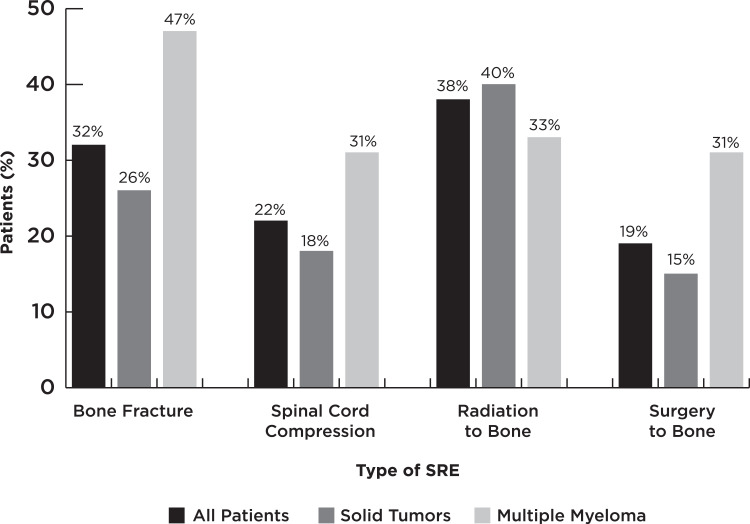
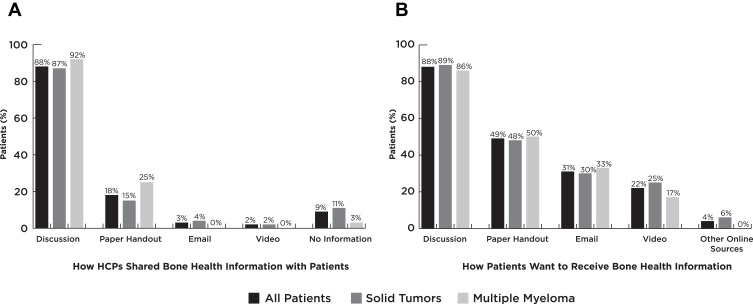
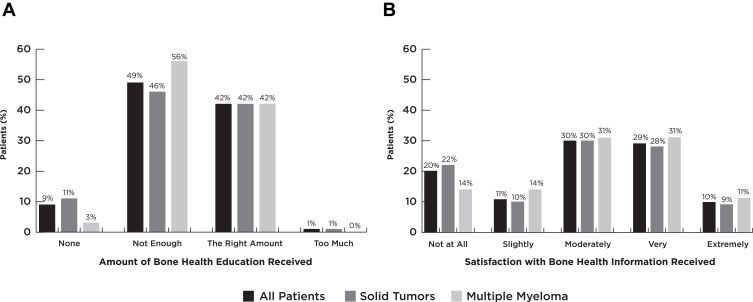
Of 125 patients, 71% were diagnosed with solid tumors with BM and 29% with MM. At least one prior SRE was experienced by 57% of patients (38% radiation to bone, 32% bone fracture, 22% spinal cord compression, and 19% surgery to bone), and 74% were currently receiving BTA therapy. Awareness of cancer bone health, protection strategies, and screening tests was low to moderate; patients were least informed of the impact of lifestyle changes (38%) and specific cancer treatments (≤35%) on bone health. Sixty-two percent of patients were not completely satisfied with the bone health education received. Patients generally wanted more information (58%) and to receive information by more than one mode of communication.
Notable gaps in bone health education were observed in cancer patients at risk for SREs indicating an important need for improved communication and education strategies to promote better health outcomes.
实体瘤或多发性骨髓瘤(MM)骨转移(BM)的癌症患者发生疼痛性骨相关事件(SRE)的风险增加,这会降低生活质量并增加死亡率。骨靶向药物(BTA)有助于延迟或预防SRE;然而,相当一部分符合条件的患者未接受BTA治疗。本研究旨在了解患者对癌症相关骨骼健康的认知,并确定改善有SRE风险的癌症患者骨骼健康教育的机会。
在线骨骼健康教育需求评估(BEACON)调查包括有关患者人口统计学、癌症诊断和治疗(包括BTA使用情况)以及所接受的骨骼健康教育的程度和满意度的问题。采用直接面向患者的宣传方式招募患者。符合条件的患者为过去三年内自我报告诊断为MM或实体瘤(乳腺癌、肺癌或前列腺癌)BM的美国成年人。
125例患者中,71%被诊断为实体瘤伴BM,29%为MM。57%的患者至少经历过一次既往SRE(38%为骨放疗,32%为骨折,22%为脊髓压迫,19%为骨手术),74%的患者目前正在接受BTA治疗。对癌症骨骼健康、保护策略和筛查测试的认知程度低至中等;患者对生活方式改变(38%)和特定癌症治疗(≤35%)对骨骼健康的影响了解最少。62%的患者对所接受的骨骼健康教育不完全满意。患者普遍希望获得更多信息(58%),并通过多种沟通方式获取信息。
在有SRE风险的癌症患者中观察到骨骼健康教育存在显著差距,这表明迫切需要改进沟通和教育策略,以促进更好的健康结果。