McGrath Leah J, Overman Robert A, Reams Diane, Cetin Karynsa, Liede Alexander, Narod Steven A, Brookhart M Alan, Hernandez Rohini K
NoviSci, LLC, Durham, NC, USA,
Amgen Inc, Thousand Oaks, CA, USA.
Clin Epidemiol. 2018 Sep 26;10:1349-1358. doi: 10.2147/CLEP.S175063. eCollection 2018.
Bone-modifying agents (BMAs) are recommended for women with bone metastasis from breast cancer to prevent skeletal-related events. We examined the usage patterns and identified the factors associated with the use of BMAs (denosumab and intravenous bisphosphonates) among women in the US.
Electronic health records from oncology clinics were used to identify women diagnosed with bone metastasis from breast cancer between 2013 and 2014. Patients were excluded if they had recently used a BMA or had concurrent cancer at an additional primary site. The incidence of BMA initiation, interruption, and reinitiation were estimated using competing risk regression models. A generalized linear model was used to estimate risk factors for treatment initiation and interruption.
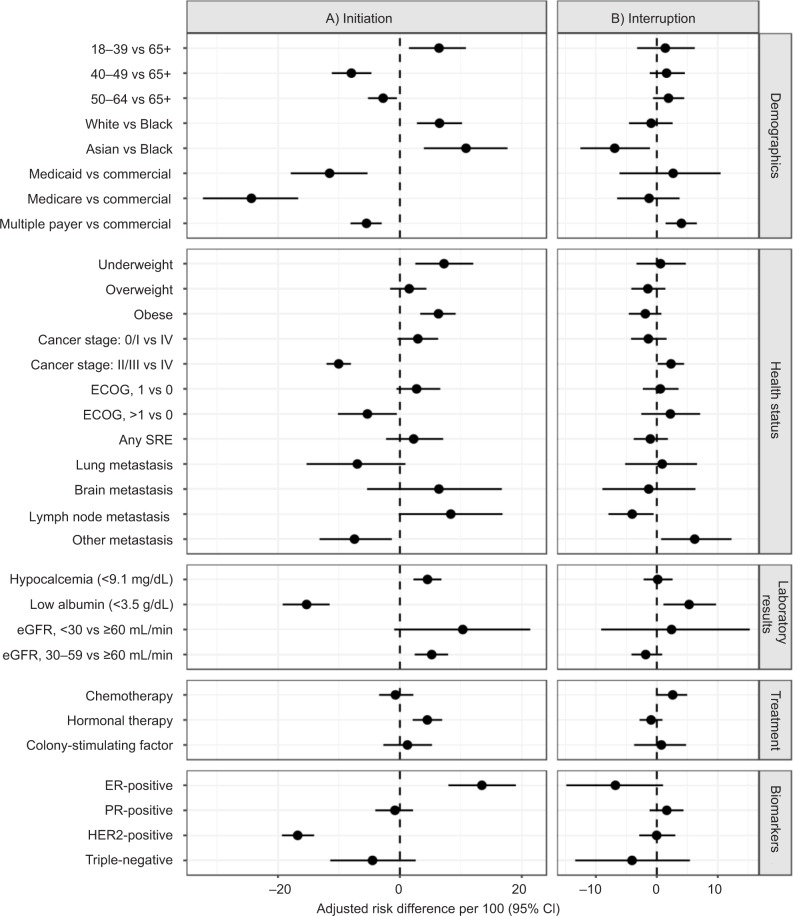
There were 589 women diagnosed with bone metastasis from breast cancer. By 1 year, 68% of these patients (95% CI: 64%, 71%) had initiated treatment with a BMA. Denosumab and zoledronic acid were the most commonly used agents, whereas pamidronate was used infrequently. Young women were more likely to initiate a BMA than older women (adjusted risk difference: 6.4 [95% CI: 1.5, 10.9]). Of the 412 patients who initiated a BMA, 46% (95% CI: 41%, 51%) experienced an interruption within 1 year. Seventy-four percent (95% CI: 68%, 79%) of patients who interrupted their treatment had reinitiated therapy within 1 year of interruption.
The majority of women diagnosed with bone metastasis from breast cancer initiate a BMA within 1 year of diagnosis, but a large proportion, particularly among the elderly, do not use these therapies.
对于患有乳腺癌骨转移的女性,推荐使用骨改良药物(BMAs)以预防骨相关事件。我们研究了美国女性中BMAs(地诺单抗和静脉注射双膦酸盐)的使用模式,并确定了与使用BMAs相关的因素。
利用肿瘤诊所的电子健康记录来识别2013年至2014年间被诊断为乳腺癌骨转移的女性。如果患者近期使用过BMA或在其他原发部位患有并发癌症,则将其排除。使用竞争风险回归模型估计BMA起始、中断和重新起始的发生率。采用广义线性模型估计治疗起始和中断的危险因素。
共有589名女性被诊断为乳腺癌骨转移。到1年时,这些患者中有68%(95%可信区间:64%,71%)开始使用BMA进行治疗。地诺单抗和唑来膦酸是最常用的药物,而帕米膦酸使用较少。年轻女性比老年女性更有可能开始使用BMA(调整后的风险差异:6.4[95%可信区间:1.5,10.9])。在开始使用BMA的412名患者中,46%(95%可信区间:41%,51%)在1年内经历了治疗中断。中断治疗的患者中有74%(95%可信区间:68%,79%)在中断治疗后1年内重新开始治疗。
大多数被诊断为乳腺癌骨转移的女性在诊断后1年内开始使用BMA,但很大一部分患者,尤其是老年人,未使用这些治疗方法。