Praxisklinik Am Rosengarten, Augustaanlage 7-11, 68165, Mannheim, Germany.
Paracelsus Medizinische Privatuniversität, Salzburg, Austria.
Support Care Cancer. 2022 Nov;30(11):9267-9278. doi: 10.1007/s00520-022-07333-7. Epub 2022 Sep 6.
To describe (non)adherence with denosumab among patients with solid tumors and bone metastases.
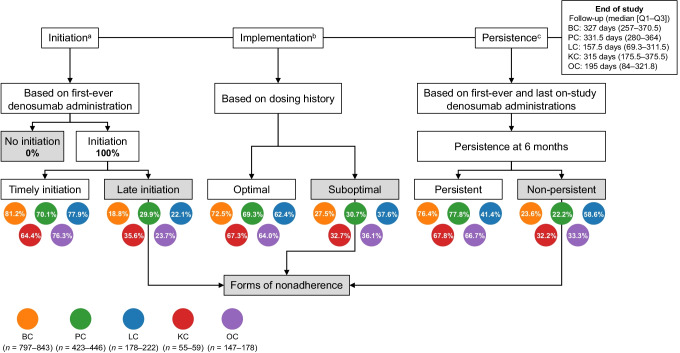
This retrospective, observational study pooled data from two completed prospective, multicenter cohort studies (X-TREME; Study 240) in adult patients with bone metastases from primary breast, prostate, lung, kidney, or other solid cancer types and administered denosumab 120 mg in routine clinical practice in Germany and Central and Eastern Europe. The studies were conducted between May 2012 and May 2017; pooled analysis was completed in August 2021. Medication adherence was described according to a three-component consensus taxonomy: initiation (first-ever administration ≤ 90 days from bone metastasis diagnosis), implementation (actual vs prescribed dosing; optimal implementation = regular/consistent dosing), and persistence (≤ 60-day gap between administrations at 3, 6, 9, and 12 months). Descriptive analyses were conducted for each cancer type.
The analysis included 1748 patients with solid tumors and bone metastases. Adherence with denosumab was generally high across the initiation, implementation, and persistence phases. Most patients experienced timely initiation (from 64.4% [kidney cancer] to 81.2% [breast cancer]) and optimal implementation (from 62.4% [lung cancer] to 72.5% [breast cancer]). The proportion of patients who were persistent with treatment at 6 months ranged from 41.4% (lung cancer) to 77.8% (prostate cancer).
This study revealed variations by cancer type in the initiation, implementation, and persistence of denosumab in patients with solid tumors and bone metastases in routine clinical practice. Further cancer-specific studies are warranted to examine the determinants of (non)adherence with denosumab, and potential ways to improve medication adherence.
描述实体瘤伴骨转移患者使用地舒单抗的(不)依从情况。
本回顾性观察性研究汇总了两项在德国和中东欧完成的、针对伴骨转移的初治乳腺癌、前列腺癌、肺癌、肾癌或其他实体瘤患者的前瞻性、多中心队列研究(X-TREME;研究 240)的数据。这两项研究均在常规临床实践中使用地舒单抗 120mg 治疗,入组时间为 2012 年 5 月至 2017 年 5 月;汇总分析于 2021 年 8 月完成。根据三组分共识分类法描述药物依从性:起始(首次给药距骨转移诊断时间≤90 天)、实施(实际与规定剂量;最佳实施=常规/一致剂量)和持续(3、6、9 和 12 个月时给药间隔≤60 天)。对每种癌症类型进行描述性分析。
分析纳入了 1748 例伴实体瘤和骨转移的患者。地舒单抗在起始、实施和持续阶段的依从性普遍较高。大多数患者及时开始治疗(从 64.4%[肾癌]到 81.2%[乳腺癌])和实施最佳剂量(从 62.4%[肺癌]到 72.5%[乳腺癌])。6 个月时治疗持续的患者比例为 41.4%(肺癌)至 77.8%(前列腺癌)。
本研究揭示了在常规临床实践中,不同癌症类型的患者对地舒单抗的起始、实施和持续治疗存在差异。需要进一步开展癌症特异性研究,以探讨地舒单抗不依从的决定因素,以及提高药物依从性的潜在方法。