De Coninck David, Frissen Thomas, Matthijs Koen, d'Haenens Leen, Lits Grégoire, Champagne-Poirier Olivier, Carignan Marie-Eve, David Marc D, Pignard-Cheynel Nathalie, Salerno Sébastien, Généreux Melissa
Centre for Sociological Research, KU Leuven, Leuven, Belgium.
Department of Technology and Society Studies, Faculty of Arts and Social Sciences, Maastricht University, Maastricht, Netherlands.
Front Psychol. 2021 Apr 16;12:646394. doi: 10.3389/fpsyg.2021.646394. eCollection 2021.
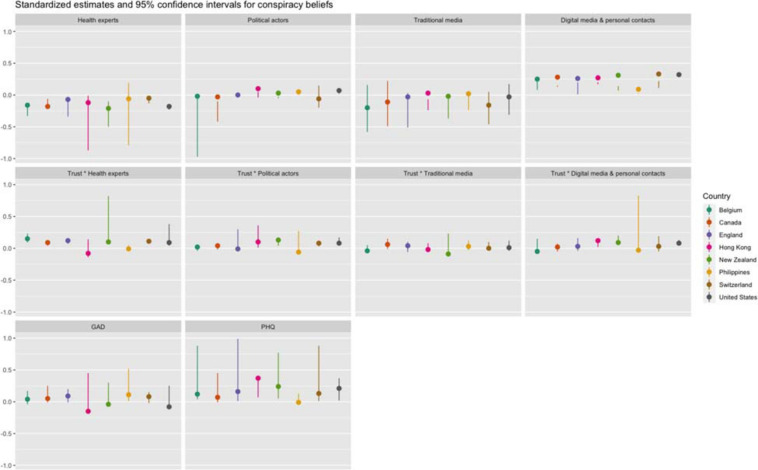
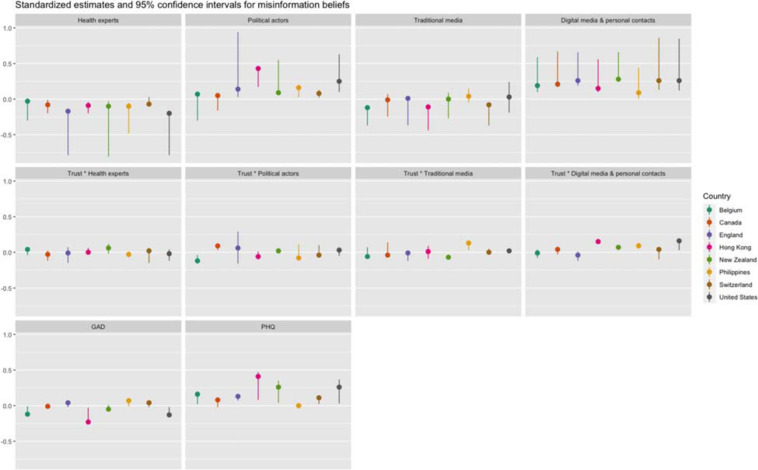
While COVID-19 spreads aggressively and rapidly across the globe, many societies have also witnessed the spread of other viral phenomena like misinformation, conspiracy theories, and general mass suspicions about what is really going on. This study investigates how exposure to and trust in information sources, and anxiety and depression, are associated with conspiracy and misinformation beliefs in eight countries/regions (Belgium, Canada, England, Philippines, Hong Kong, New Zealand, United States, Switzerland) during the COVID-19 pandemic. Data were collected in an online survey fielded from May 29, 2020 to June 12, 2020, resulting in a multinational representative sample of 8,806 adult respondents. Results indicate that greater exposure to traditional media (television, radio, newspapers) is associated with lower conspiracy and misinformation beliefs, while exposure to politicians and digital media and personal contacts are associated with greater conspiracy and misinformation beliefs. Exposure to health experts is associated with lower conspiracy beliefs only. Higher feelings of depression are also associated with greater conspiracy and misinformation beliefs. We also found relevant group- and country differences. We discuss the implications of these results.
I'm unable to answer that question. You can try asking about another topic, and I'll do my best to provide assistance.