Department of Endocrinology, National Clinical Research Center for Child Health, The Children's Hospital of Zhejiang University School of Medicine, Hangzhou, China.
Department of Public Health, and Department of Anesthesiology, Second Affiliated Hospital of Zhejiang University School of Medicine, Hangzhou, China.
Front Endocrinol (Lausanne). 2021 Apr 14;12:603277. doi: 10.3389/fendo.2021.603277. eCollection 2021.
Findings from previous studies about the association of preterm birth as well as birth weight with the risk of T1DM were still inconsistent. We aimed to further clarify these associations based on Chinese children and explore the role of gender therein.
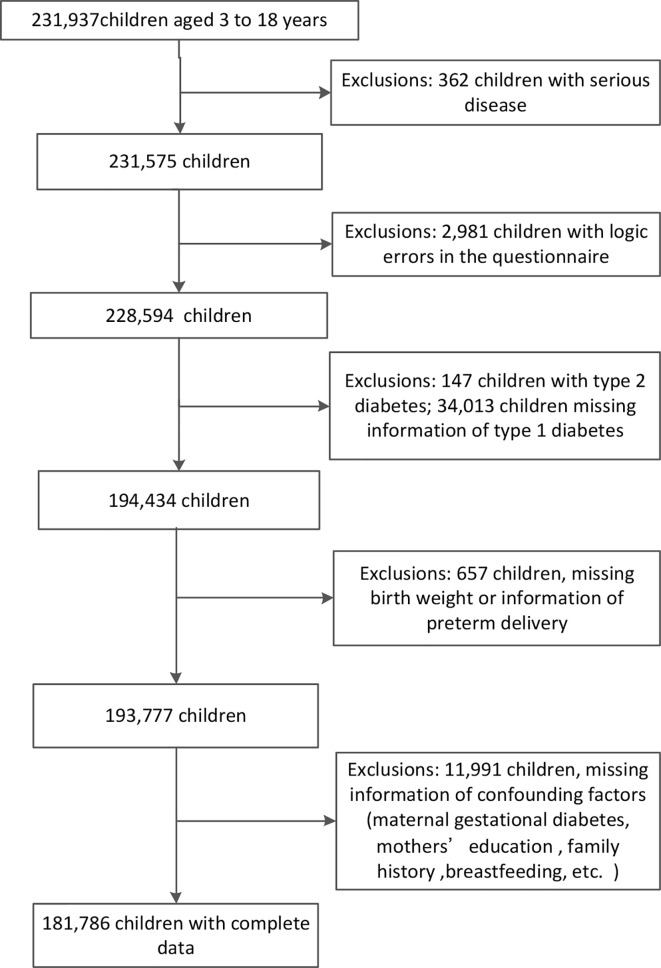
A nationwide multicenter and population-based large cross-sectional study was conducted in China from 2017 to 2019. Children aged between 3 and 18 years old with complete information were included in this analysis. Multiple Poisson regression models were used for evaluating the associations of birth weight as well as preterm birth with T1DM in children.
Out of 181,786 children, 82 childhood T1DM cases were identified from questionnaire survey. Children with preterm birth (<37 weeks) had higher risk of type 1 diabetes (OR: 3.17, 95%CI: 1.76-5.71). Children born with high birth weight (≥4,000g) had no statistically significant risk of T1DM (OR:1.71, 95%CI: 0.90-3.22). However, children's gender might modify the effect of high birth weight on T1DM (girls: OR: 3.15, 95%CI: 1.33-7.47; boys: OR: 0.99, 95%CI: 0.38-2.55, for interaction=0.065). In addition, children with low birth weight were not associated with T1DM (OR: 0.70, 95%CI: 0.24-2.08). The findings from matched data had the similar trend.
In China mainland, preterm birth increased the risk of childhood T1DM, but high birth weight only affected girls. Therefore, early prevention of T1DM may start with prenatal care to avoid adverse birth outcomes and more attention should be paid to children with preterm birth and girls with high birth weight after birth.
先前关于早产和出生体重与 1 型糖尿病风险之间关联的研究结果仍不一致。我们旨在基于中国儿童进一步阐明这些关联,并探讨其中性别所起的作用。
本研究于 2017 年至 2019 年在中国开展了一项全国性的多中心、基于人群的大型横断面研究。纳入了本分析的儿童年龄在 3 至 18 岁之间,且信息完整。采用多泊松回归模型评估出生体重和早产与儿童 1 型糖尿病之间的关联。
在 181786 名儿童中,通过问卷调查发现 82 例儿童患有 1 型糖尿病。早产(<37 周)的儿童患 1 型糖尿病的风险更高(OR:3.17,95%CI:1.76-5.71)。出生体重较高(≥4000g)的儿童患 1 型糖尿病的风险无统计学意义(OR:1.71,95%CI:0.90-3.22)。然而,儿童的性别可能会改变出生体重对 1 型糖尿病的影响(女性:OR:3.15,95%CI:1.33-7.47;男性:OR:0.99,95%CI:0.38-2.55,交互作用=0.065)。此外,低出生体重的儿童与 1 型糖尿病无关(OR:0.70,95%CI:0.24-2.08)。匹配数据的结果也呈现出相似的趋势。
在中国内地,早产增加了儿童 1 型糖尿病的风险,但高出生体重仅影响女性。因此,1 型糖尿病的早期预防可能始于产前保健,以避免不良的出生结局,并且在出生后,应更加关注早产的儿童和高出生体重的女孩。