Second Department of Cardiology, Faculty of Medical Sciences in Zabrze, Medical University of Silesia, M. C. Skłodowskiej 10 Street, 41-800 Zabrze, Poland.
Department of Biochemistry, Faculty of Medical Sciences in Zabrze, Medical University of Silesia, Jordana 19 Street, 41-808 Zabrze, Poland.
Oxid Med Cell Longev. 2021 Apr 15;2021:6693405. doi: 10.1155/2021/6693405. eCollection 2021.
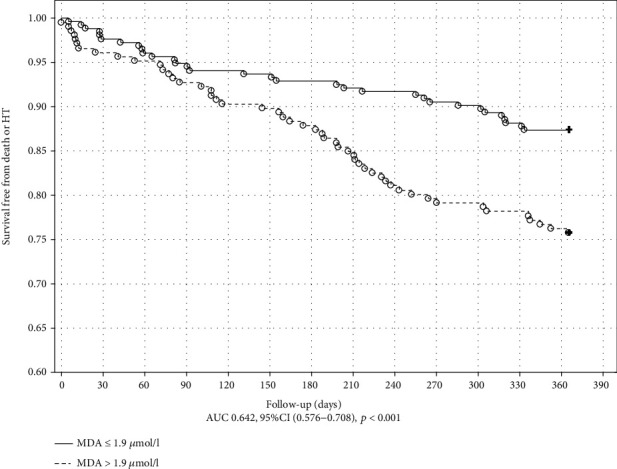
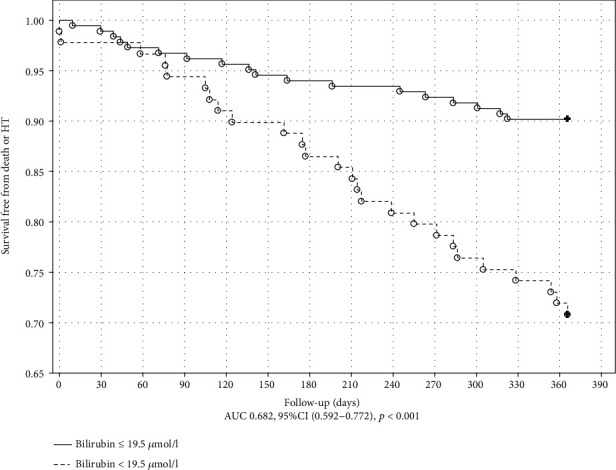
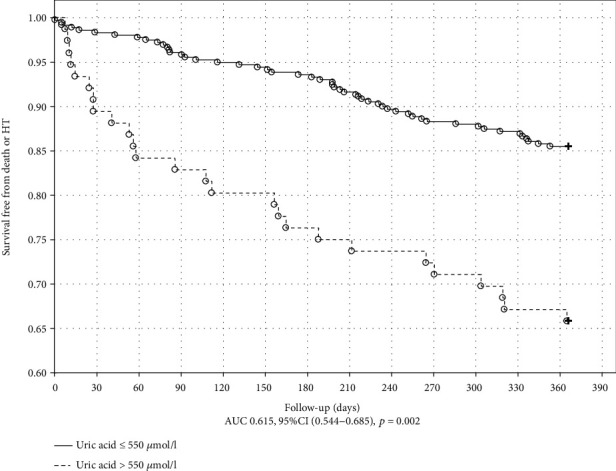
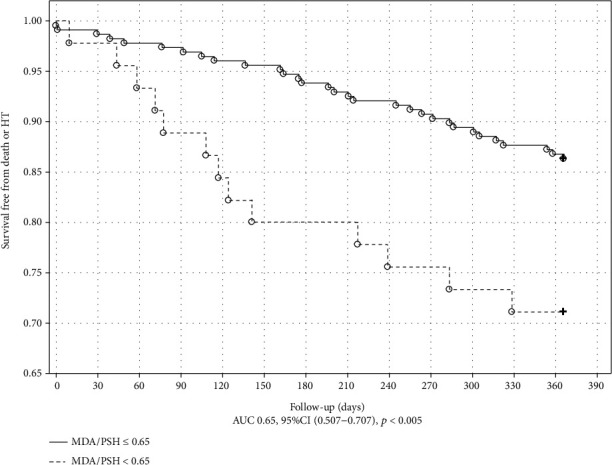
Oxidative stress plays a significant role in the pathogenesis of heart failure (HF). The aim of the study was to investigate the prognostic value of oxidation-reduction (redox) markers in patients with HF due to ischemic and nonischemic cardiomyopathy. The study included 707 patients of HF allocated into two groups depending on ethology: ischemic cardiomyopathy (ICM) ( = 435) and nonischemic cardiomyopathy (nICM) ( = 272), who were followed up for one year. The endpoint occurrence (mortality or heart transplantation) in a 1-year follow-up was similar in the ICM and nICM group. The predictive value of endpoint occurrence of oxidative stress biomarkers such as the serum protein sulfhydryl groups (PSH), malondialdehyde (MDA), uric acid (UA), bilirubin, and MDA/PSH ratio and other clinical and laboratory data were assessed in both groups (ICM and nICM) separately using univariate and multivariate Cox regression analyses. In multivariate analysis, the higher concentrations of UA ( = 0.015, HR = 1.024, 95% CI (1.005-1.044)) and MDA ( = 0.004, HR = 2.202, 95% CI (1.296-3.741)) were significantly associated with adverse prognosis in patients with ICM. Contrastingly, in patients with nICM, we observed that higher bilirubin concentration ( = 0.026, HR = 1.034, 95% CI (1.004-1.064)) and MDA/PSH ratio ( = 0.034, HR = 3.360, 95% CI (1.096-10.302)) were significantly associated with increased risk of death or HT. The results showed the association of different oxidative biomarkers on the unfavorable course of heart failure depending on etiology.
氧化应激在心力衰竭(HF)的发病机制中起重要作用。本研究旨在探讨氧化还原(redox)标志物在缺血性和非缺血性心肌病所致 HF 患者中的预后价值。该研究纳入了 707 例 HF 患者,根据病因分为两组:缺血性心肌病(ICM)(n=435)和非缺血性心肌病(nICM)(n=272),并进行了为期 1 年的随访。在 1 年的随访中,ICM 组和 nICM 组的终点事件(死亡率或心脏移植)发生率相似。使用单变量和多变量 Cox 回归分析分别评估两组(ICM 和 nICM)中氧化应激生物标志物(如血清蛋白巯基基团(PSH)、丙二醛(MDA)、尿酸(UA)、胆红素和 MDA/PSH 比值)以及其他临床和实验室数据的终点事件发生预测价值。在多变量分析中,UA( = 0.015,HR = 1.024,95%CI(1.005-1.044))和 MDA( = 0.004,HR = 2.202,95%CI(1.296-3.741))的浓度较高与 ICM 患者的不良预后显著相关。相比之下,在 nICM 患者中,我们观察到较高的胆红素浓度( = 0.026,HR = 1.034,95%CI(1.004-1.064))和 MDA/PSH 比值( = 0.034,HR = 3.360,95%CI(1.096-10.302))与死亡或 HT 的风险增加显著相关。结果表明,不同氧化生物标志物与病因相关的心力衰竭不良病程有关。