Yu Fangqin, Ma Runsheng, Liu Chenguang, Zhang Lele, Feng Kaixiang, Wang Meiqi, Yin Detao
Department of Thyroid Surgery, The First Affiliated Hospital of Zhengzhou University, Zhengzhou, China.
Front Oncol. 2021 Apr 15;11:638701. doi: 10.3389/fonc.2021.638701. eCollection 2021.
Thyroid cancer is one of the most common endocrine malignancies worldwide, and papillary thyroid cancer (PTC) is the most common pathologic type of thyroid cancer. SQSTM1/p62 activity mediates different biological functions. This study aimed to investigate the effect of SQSTM1/p62, a multifunctional receptor, on biological function and autophagy characteristics in the human PTC cell line TPC-1.
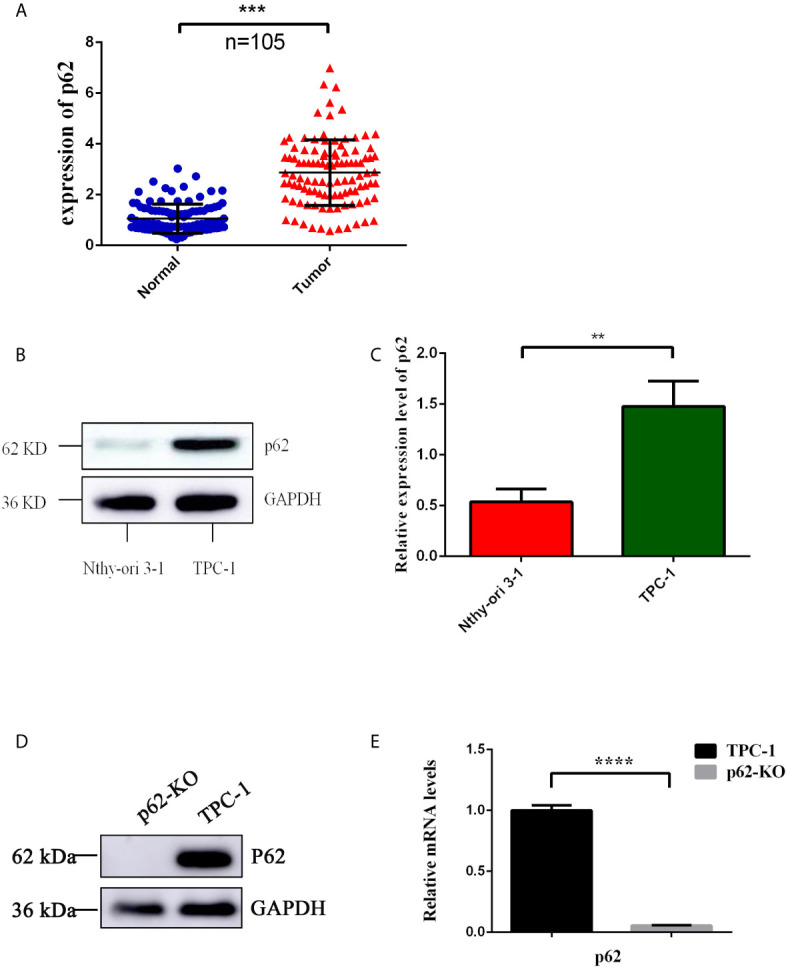
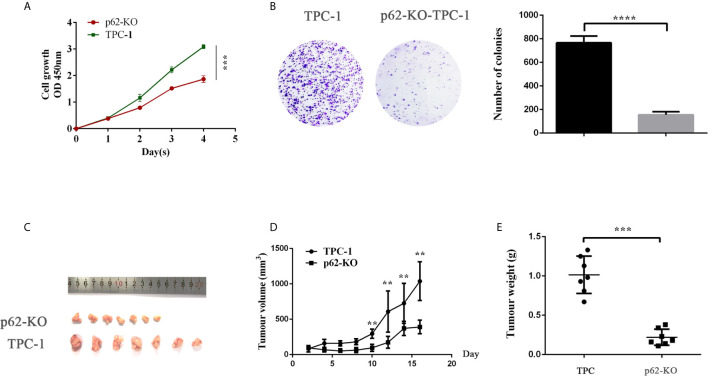
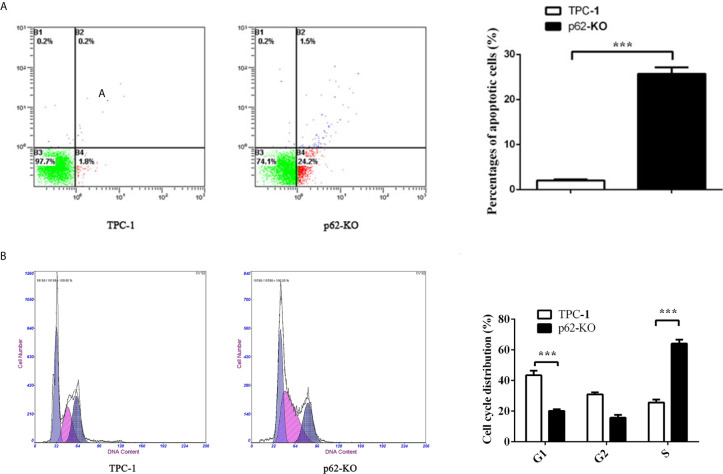
A total of 105 primary PTC samples and matched adjacent normal thyroid tissue samples were obtained to evaluate the expression of p62 in clinical patients. A similar p62 expression pattern was found in PTC cell lines and normal human thyroid follicular epithelial cells. To evaluate the effect of SQSTM1/p62 on TPC-1 cells, we constructed the p62 knockout cell line p62-KO-TPC-1. Cell proliferation, cell cycle, and cell apoptosis were analyzed by colony formation tests, Cell Counting Kit-8 (CCK-8) assays and flow cytometry . TPC-1 and p62-KO-TPC-1 human PTC cell lines in the logarithmic growth phase were subcutaneously implanted into BALB/c nude mice to verify their proliferation effect . Furthermore, western blotting and immunohistochemistry (IHC) were used to detect the expression of AKT/AMPK/mTOR signaling pathway-related proteins.
Overall, p62 expression was higher in tumor tissues than in normal tissues in 73 of 105 PTC patients (69.5%). The expression level of p62 in the PTC cell line was higher than that in the normal thyroid cell line. Our data indicated that , p62 deficiency could decrease the number of colonies, inhibit cell growth and the cell cycle, and induce apoptosis. Tumor xenograft experiments in BALB/c nude mice corroborated these findings. Moreover, the molecular mechanism was explored by western blotting, and we found that the AMPK/AKT/mTOR pathway was involved.
The results indicate that p62 might mediate cell autophagy and apoptosis in TPC-1 cells the AMPK/AKT/mTOR pathway and could be used as a potential therapeutic approach for PTC.
甲状腺癌是全球最常见的内分泌恶性肿瘤之一,而乳头状甲状腺癌(PTC)是甲状腺癌最常见的病理类型。SQSTM1/p62活性介导不同的生物学功能。本研究旨在探讨多功能受体SQSTM1/p62对人PTC细胞系TPC-1生物学功能和自噬特征的影响。
共获取105例原发性PTC样本及匹配的相邻正常甲状腺组织样本,以评估临床患者中p62的表达。在PTC细胞系和正常人甲状腺滤泡上皮细胞中发现了相似的p62表达模式。为评估SQSTM1/p62对TPC-1细胞的影响,我们构建了p62基因敲除细胞系p62-KO-TPC-1。通过集落形成试验、细胞计数试剂盒-8(CCK-8)检测和流式细胞术分析细胞增殖、细胞周期和细胞凋亡。将处于对数生长期的TPC-1和p62-KO-TPC-1人PTC细胞系皮下植入BALB/c裸鼠,以验证其增殖效果。此外,采用蛋白质印迹法和免疫组织化学(IHC)检测AKT/AMPK/mTOR信号通路相关蛋白的表达。
总体而言,105例PTC患者中有73例(69.5%)肿瘤组织中p62表达高于正常组织。PTC细胞系中p62的表达水平高于正常甲状腺细胞系。我们的数据表明,p62缺陷可减少集落数量,抑制细胞生长和细胞周期,并诱导凋亡。BALB/c裸鼠的肿瘤异种移植实验证实了这些发现。此外,通过蛋白质印迹法探索了分子机制,我们发现AMPK/AKT/mTOR通路参与其中。
结果表明,p62可能通过AMPK/AKT/mTOR通路介导TPC-1细胞的自噬和凋亡,可作为PTC的一种潜在治疗方法。