Loi Iliana, Stanev Dimitar, Moustakas Konstantinos
Department of Electrical and Computer Engineering, University of Patras, Patras, Greece.
School of Engineering, Institute of Bioengineering, École Polytechnique Fédérale de Lausanne, Lausanne, Switzerland.
Front Bioeng Biotechnol. 2021 Apr 16;9:648356. doi: 10.3389/fbioe.2021.648356. eCollection 2021.
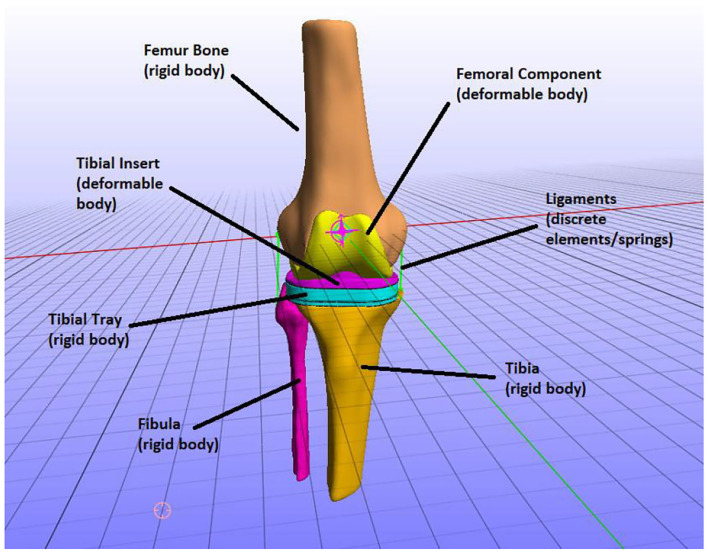
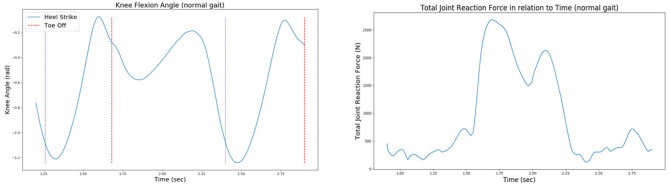
This study presents a semi-automatic framework to create subject-specific total knee replacement finite element models, which can be used to analyze locomotion patterns and evaluate knee dynamics. In recent years, much scientific attention was attracted to pre-clinical optimization of customized total knee replacement operations through computational modeling to minimize post-operational adverse effects. However, the time-consuming and laborious process of developing a subject-specific finite element model poses an obstacle to the latter. One of this work's main goals is to automate the finite element model development process, which speeds up the proposed framework and makes it viable for practical applications. This pipeline's reliability was ratified by developing and validating a subject-specific total knee replacement model based on the 6th SimTK Grand Challenge data set. The model was validated by analyzing contact pressures on the tibial insert in relation to the patient's gait and analysis of tibial contact forces, which were found to be in accordance with the ones provided by the Grand Challenge data set. Subsequently, a sensitivity analysis was carried out to assess the influence of modeling choices on tibial insert's contact pressures and determine possible uncertainties on the models produced by the framework. Parameters, such as the position of ligament origin points, ligament stiffness, reference strain, and implant-bone alignment were used for the sensitivity study. Notably, it was found that changes in the alignment of the femoral component in reference to the knee bones significantly affect the load distribution at the tibiofemoral joint, with an increase of 206.48% to be observed at contact pressures during 5° internal rotation. Overall, the models produced by this pipeline can be further used to optimize and personalize surgery by evaluating the best surgical parameters in a simulated manner before the actual surgery.
本研究提出了一种半自动框架,用于创建特定于个体的全膝关节置换有限元模型,该模型可用于分析运动模式和评估膝关节动力学。近年来,通过计算建模对定制全膝关节置换手术进行临床前优化以尽量减少术后不良反应吸引了大量科学关注。然而,开发特定于个体的有限元模型耗时费力,这对后者构成了障碍。这项工作的主要目标之一是使有限元模型开发过程自动化,这加快了所提出的框架并使其在实际应用中可行。通过基于第六届SimTK大挑战数据集开发并验证一个特定于个体的全膝关节置换模型,验证了该流程的可靠性。通过分析胫骨假体上与患者步态相关的接触压力以及胫骨接触力来验证该模型,发现其与大挑战数据集提供的数据一致。随后,进行了敏感性分析,以评估建模选择对胫骨假体接触压力的影响,并确定该框架生成的模型可能存在的不确定性。韧带起始点位置、韧带刚度、参考应变和植入物与骨骼的对齐等参数用于敏感性研究。值得注意的是,发现股骨组件相对于膝关节骨骼的对齐变化会显著影响胫股关节处的载荷分布,在5°内旋时接触压力会增加206.48%。总体而言,该流程生成的模型可进一步用于通过在实际手术前以模拟方式评估最佳手术参数来优化手术并实现个性化。