Lackner Angelika, Bosch Philipp, Zenz Sabine, Horwath-Winter Jutta, Rabensteiner Dieter Franz, Hermann Josef, Graninger Winfried, Stradner Martin Helmut
Department of Rheumatology and Immunology, Medical University of Graz, Graz, Austria.
Department of Ophtalmology, Medical University of Graz, Graz, Austria.
Front Med (Lausanne). 2021 Apr 15;8:660580. doi: 10.3389/fmed.2021.660580. eCollection 2021.
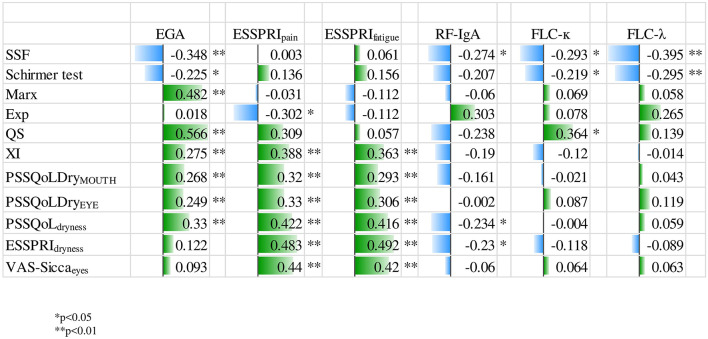
The patient perspective is an essential outcome parameter in the quest for effective therapy in primary Sjögren's Syndrome (PSS). The EULAR Sjögren's Syndrome Patient Reported Index (ESSPRI) is recommended by EULAR to quantify patient's symptom burden and has been used in several clinical trials. Surprisingly, the patient's perception of dryness quantified with ESSPRI does not correlate with objective measures of salivary or lacrimal flow. Thus, we evaluated a newly developed assessment tool-the Primary Sjögren's Syndrome Quality of Life Questionnaire (PSS-QoL)-for quantifying symptoms of dryness in comparison with the ESSPRI and objective measurements of salivary and lacrimal flow. Data of patients from the PSS registry of the Medical University of Graz fulfilling the 2016 ACR/EULAR classification criteria for PSS were analyzed. The patient perspective was analyzed by PSS-QoL, ESSPRI, Xerostomia Inventory (XI) and Ocular Surface Disease Index (OSDI). Sicca signs were measured with Schirmer's test, unstimulated salivary flow test (USF) and stimulated salivary flow test (SSF). ESSDAI (EULAR Sjögren's Syndrome Disease Activity Index) and EGA (Evaluator Global Assessment, numeric rating scale from 0 to 10) were obtained. In addition, free light chains (FLC) κ and λ, rheumatoid factor (RF) IgM and IgA were determined. Data from 123 PSS patients were analyzed; 91.9% ( = 113) were female, with a mean disease duration of 6.2 (±5.3) years and mean age of 60.1 (±12.4) years. PSS-QoL-dryness revealed significant negative correlations with Schirmer's test ( = -0.31, < 0.05) and SSF-test ( = -0.390, < 0.01). In contrast, we found no significant correlation between ESSPRI-dryness and any objective dryness test. Lower perceived dryness was associated with higher immunological activity determined by increased levels of IgG, FLC and RF-IgA. Whereas patients with only subjective signs of dryness had lower immunological activity. Patients' perception of dryness assessed by PSS-QoL correlates with objective measurements of salivary gland function while ESSPRI-dryness did not. Based on the PSS-QoL and objective measures of dryness two distinct groups of PSS patients could be distinguished, which may have implications in daily practice and future clinical studies.
患者视角是寻求原发性干燥综合征(PSS)有效治疗方法时的一项重要结果参数。欧洲抗风湿病联盟(EULAR)推荐使用EULAR干燥综合征患者报告指数(ESSPRI)来量化患者的症状负担,该指数已在多项临床试验中使用。令人惊讶的是,用ESSPRI量化的患者干燥感与唾液或泪液分泌的客观测量结果并无关联。因此,我们评估了一种新开发的评估工具——原发性干燥综合征生活质量问卷(PSS-QoL),以与ESSPRI以及唾液和泪液分泌的客观测量结果相比较,来量化干燥症状。分析了来自格拉茨医科大学PSS登记处、符合2016年美国风湿病学会(ACR)/EULAR PSS分类标准的患者数据。通过PSS-QoL、ESSPRI、口干症量表(XI)和眼表疾病指数(OSDI)分析患者视角。用施密特试验、非刺激性唾液流量试验(USF)和刺激性唾液流量试验(SSF)测量干燥体征。获取欧洲抗风湿病联盟干燥综合征疾病活动指数(ESSDAI)和评估者整体评估(EGA,数字评分量表,范围为0至10)。此外,还测定了游离轻链(FLC)κ和λ、类风湿因子(RF)IgM和IgA。分析了123例PSS患者的数据;91.9%(n = 113)为女性,平均病程为6.2(±5.3)年,平均年龄为60.1(±12.4)岁。PSS-QoL-干燥感与施密特试验(r = -0.31,P < 0.05)和SSF试验(r = -0.390,P < 0.01)呈显著负相关。相比之下,我们发现ESSPRI-干燥感与任何客观干燥试验之间均无显著相关性。较低的主观干燥感与通过IgG、FLC和RF-IgA水平升高所确定的较高免疫活性相关。而仅有主观干燥体征的患者免疫活性较低。通过PSS-QoL评估的患者干燥感与唾液腺功能的客观测量结果相关,而ESSPRI-干燥感则不然。基于PSS-QoL和干燥感的客观测量结果,可以区分出两组不同的PSS患者,这可能对日常实践和未来临床研究具有启示意义。