Wu Dongmei, Yang Qiuju, Su Baohua, Hao Jia, Ma Huirong, Yuan Weilan, Gao Junhui, Ding Feifei, Xu Yue, Wang Huifeng, Zhao Jiangman, Li Bingqiang
Department of Cardiovascular Medicine, General Hospital of Tisco, Sixth Hospital of Shanxi Medical University, Shanxi, China.
Department of Cardiovascular Medicine, The First People's Hospital of Pingdingshan, Pingdingshan, China.
Front Cardiovasc Med. 2021 Apr 16;8:619386. doi: 10.3389/fcvm.2021.619386. eCollection 2021.
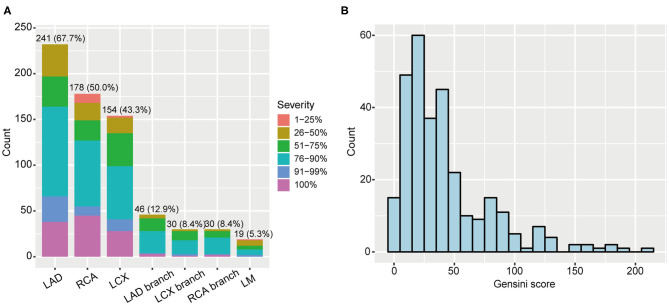
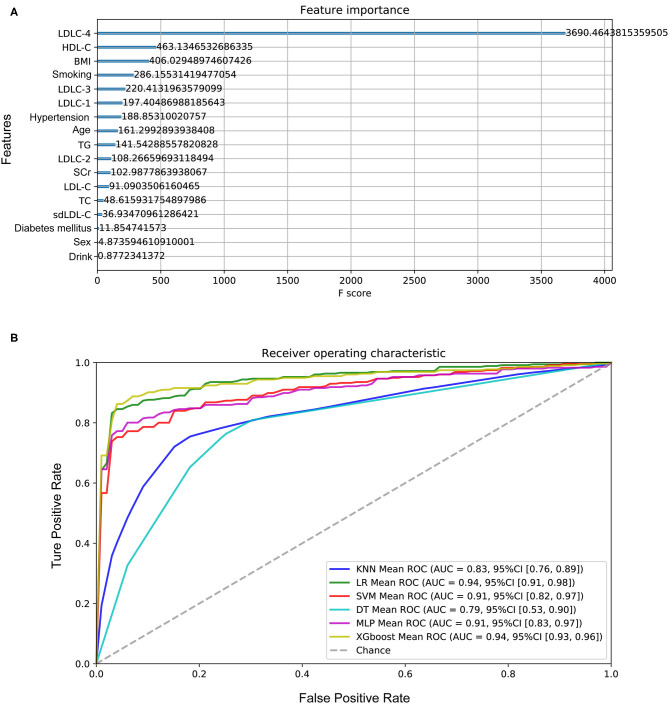
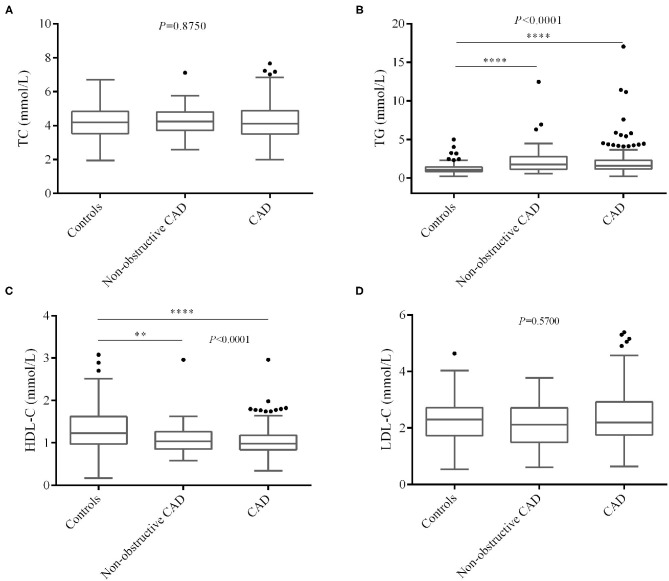
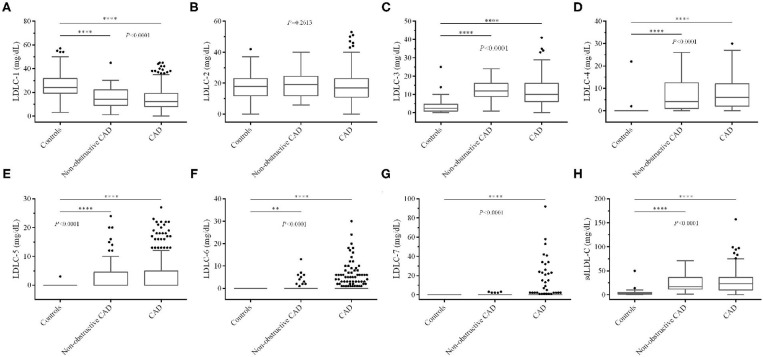
Coronary artery disease (CAD) is the leading cause of death worldwide, which has a long asymptomatic period of atherosclerosis. Thus, it is crucial to develop efficient strategies or biomarkers to assess the risk of CAD in asymptomatic individuals. A total of 356 consecutive CAD patients and 164 non-CAD controls diagnosed using coronary angiography were recruited. Blood lipids, other baseline characteristics, and clinical information were investigated in this study. In addition, low-density lipoprotein cholesterol (LDL-C) subfractions were classified and quantified using the Lipoprint system. Based on these data, we performed comprehensive analyses to investigate the risk factors for CAD development and to predict CAD risk. Triglyceride, LDLC-3, LDLC-4, LDLC-5, LDLC-6, and total small and dense LDL-C were significantly higher in the CAD patients than those in the controls, whereas LDLC-1 and high-density lipoprotein cholesterol (HDL-C) had significantly lower levels in the CAD patients. Logistic regression analysis identified male [odds ratio (OR) = 2.875, < 0.001], older age (OR = 1.018, = 0.025), BMI (OR = 1.157, < 0.001), smoking (OR = 4.554, < 0.001), drinking (OR = 2.128, < 0.016), hypertension (OR = 4.453, < 0.001), and diabetes mellitus (OR = 8.776, < 0.001) as clinical risk factors for CAD development. Among blood lipids, LDLC-3 (OR = 1.565, < 0.001), LDLC-4 (OR = 3.566, < 0.001), and LDLC-5 (OR = 6.866, < 0.001) were identified as risk factors. To predict CAD risk, six machine learning models were constructed. The XGboost model showed the highest AUC score (0.945121), which could distinguish CAD patients from the controls with a high accuracy. LDLC-4 played the most important role in model construction. The established models showed good performance for CAD risk prediction, which can help screen high-risk CAD patients in asymptomatic population, so that further examination and prevention treatment might be taken before any sudden or serious event.
冠状动脉疾病(CAD)是全球范围内主要的死亡原因,其动脉粥样硬化有很长的无症状期。因此,制定有效的策略或生物标志物以评估无症状个体患CAD的风险至关重要。本研究共招募了356例经冠状动脉造影诊断的连续性CAD患者和164例非CAD对照。研究了血脂、其他基线特征和临床信息。此外,使用Lipoprint系统对低密度脂蛋白胆固醇(LDL-C)亚组分进行分类和定量。基于这些数据,我们进行了综合分析,以研究CAD发生的危险因素并预测CAD风险。CAD患者的甘油三酯、LDLC-3、LDLC-4、LDLC-5、LDLC-6以及总的小而密LDL-C显著高于对照组,而CAD患者的LDLC-1和高密度脂蛋白胆固醇(HDL-C)水平显著较低。逻辑回归分析确定男性[比值比(OR)=2.875,<0.001]、年龄较大(OR=1.018,=0.025)、体重指数(BMI)(OR=1.157,<0.001)、吸烟(OR=4.554,<0.001)、饮酒(OR=2.128,<0.016)、高血压(OR=4.453,<0.001)和糖尿病(OR=8.776,<0.001)是CAD发生的临床危险因素。在血脂中,LDLC-3(OR=1.565,<0.001)、LDLC-4(OR=3.566,<0.001)和LDLC-5(OR=6.866,<0.001)被确定为危险因素。为了预测CAD风险,构建了六个机器学习模型。XGboost模型显示出最高的AUC分数(0.945121),能够高精度地区分CAD患者和对照组。LDLC-4在模型构建中起最重要的作用。所建立的模型在CAD风险预测方面表现良好,有助于在无症状人群中筛查高危CAD患者,以便在任何突发或严重事件发生之前采取进一步的检查和预防治疗措施。