Department of Neurology, Leiden University Medical Center, Leiden, The Netherlands.
Department of Internal Medicine, Erasmus University Medical Center, Rotterdam, The Netherlands.
Cephalalgia. 2021 Oct;41(11-12):1161-1171. doi: 10.1177/03331024211010306. Epub 2021 May 2.
To determine whether our E-diary can be used to diagnose migraine and provide more reliable migraine-related frequency numbers compared to patients' self-reported estimates.
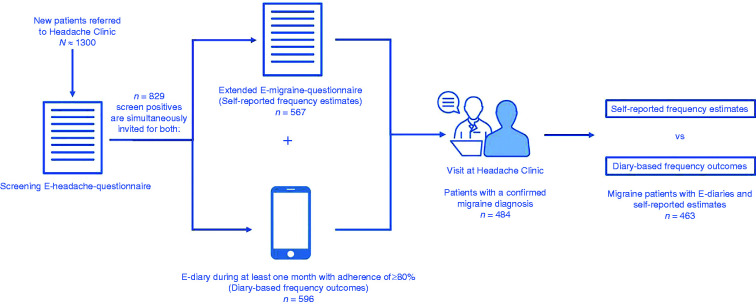
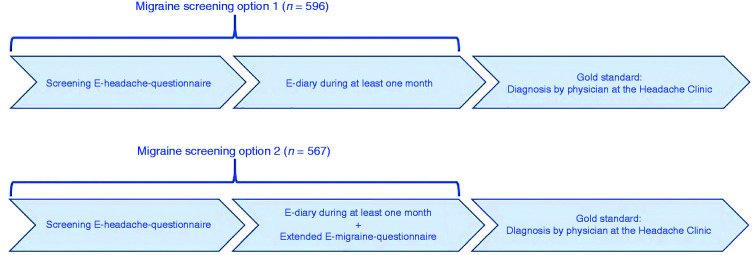
We introduced a self-developed E-diary including automated algorithms differentiating headache and migraine days, indicating whether a patient has migraine. Reliability of the E-diary diagnosis in combination with two previously validated E-questionnaires was compared to a physician's diagnosis as gold standard in headache patients referred to the Leiden Headache Clinic (n = 596). In a subset of patients with migraine (n = 484), self-estimated migraine-related frequencies were compared to diary-based results.
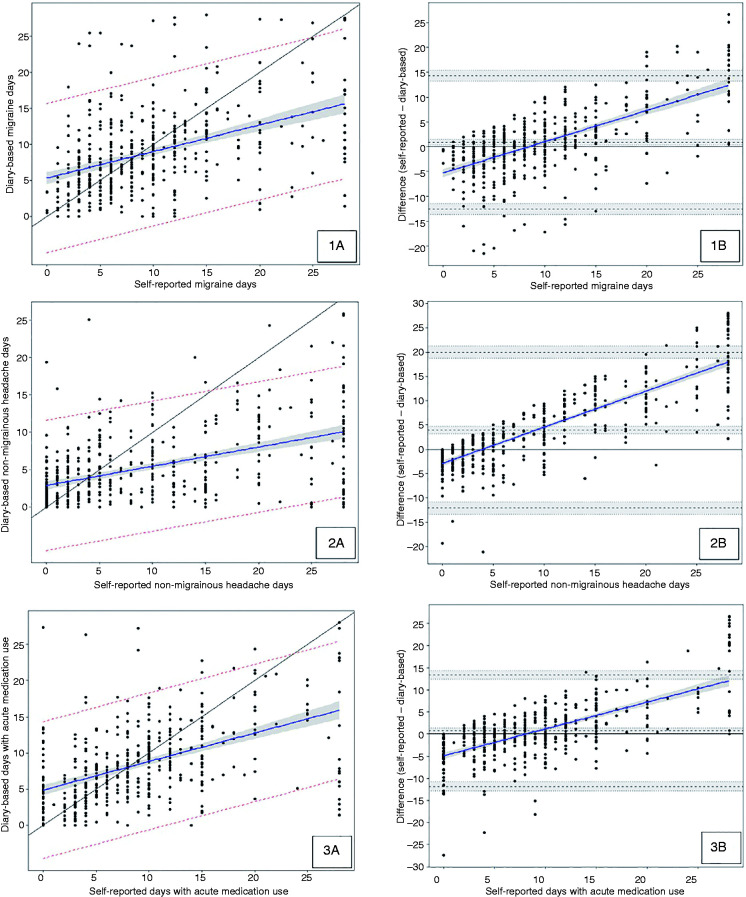
The first migraine screening approach including an E-headache questionnaire, and the E-diary revealed a sensitivity of 98% and specificity of 17%. In the second approach, an E-migraine questionnaire was added, resulting in a sensitivity of 79% and specificity of 69%. Mean self-estimated monthly migraine days, non-migrainous headache days and days with acute medication use were different from E-diary-based results (absolute mean difference ± standard deviation respectively 4.7 ± 5.0, 6.2 ± 6.6 and 4.3 ± 4.8).
The E-diary including algorithms differentiating headache and migraine days showed usefulness in diagnosing migraine. The use emphasised the need for E-diaries to obtain reliable information, as patients do not reliably recall numbers of migraine days and acute medication intake. Adding E-diaries will be helpful in future headache telemedicine.
确定我们的电子日记是否可用于诊断偏头痛,并与患者自我报告的估计相比提供更可靠的偏头痛相关频率数据。
我们引入了一种自我开发的电子日记,其中包括自动算法来区分头痛和偏头痛日,并指示患者是否患有偏头痛。将电子日记诊断的可靠性与两个先前经过验证的电子问卷相结合,与作为头痛患者就诊莱顿头痛诊所(n=596)的金标准的医生诊断进行比较。在偏头痛患者的亚组中(n=484),将自我估计的偏头痛相关频率与日记结果进行比较。
第一个偏头痛筛查方法包括电子头痛问卷和电子日记,其敏感性为 98%,特异性为 17%。在第二种方法中,添加了电子偏头痛问卷,其敏感性为 79%,特异性为 69%。每月自我估计的偏头痛天数、非偏头痛性头痛天数和使用急性药物的天数与电子日记的结果不同(绝对平均差异±标准差分别为 4.7±5.0、6.2±6.6 和 4.3±4.8)。
包括区分头痛和偏头痛日的算法的电子日记在诊断偏头痛方面具有实用性。该用途强调了使用电子日记获取可靠信息的必要性,因为患者不能可靠地回忆偏头痛天数和急性药物摄入的次数。在未来的头痛远程医疗中使用电子日记将有所帮助。