Chen Zhufeng, Xu Wanju, Ma Wanshan, Shi Xiaohong, Li Shuomin, Hao Mingju, Fang Yuanxun, Zhang Li
Department of Clinical Laboratory Medicine, The First Affiliated Hospital of Shandong First Medical University & Shandong Provincial Qianfoshan Hospital, Shandong Medicine and Health Key Laboratory of Laboratory Medicine, Jinan, PR China.
Rural Vitalization Research Institute of Qilu, Shandong Agriculture and Engineering University, Jinan, PR China.
Clin Chim Acta. 2021 Aug;519:172-182. doi: 10.1016/j.cca.2021.04.022. Epub 2021 Apr 30.
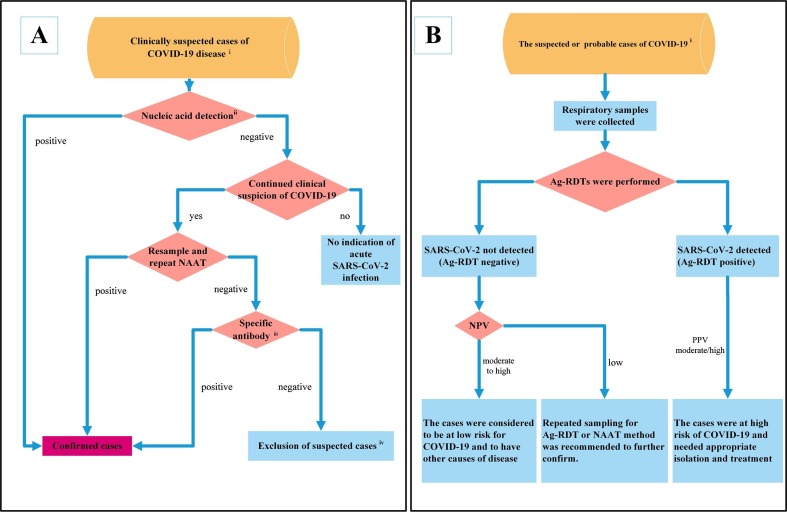
COVID-19, caused by SARS-CoV-2, is a highly infectious disease, and clinical laboratory detection has played important roles in its diagnosis and in evaluating progression of the disease. Nucleic acid amplification testing or gene sequencing can serve as pathogenic evidence of COVID-19 diagnosing for clinically suspected cases, and dynamic monitoring of specific antibodies (IgM, IgA, and IgG) is an effective complement for false-negative detection of SARS-CoV-2 nucleic acid. Antigen tests to identify SARS-CoV-2 are recommended in the first week of infection, which is associated with high viral loads. Additionally, many clinical laboratory indicators are abnormal as the disease evolves. For example, from moderate to severe and critical cases, leukocytes, neutrophils, and the neutrophil-lymphocyte ratio increase; conversely, lymphocytes decrease progressively but are over activated. LDH, AST, ALT, CK, high-sensitivity troponin I, and urea also increase progressively, and increased D-dimer is an indicator of severe disease and an independent risk factor for death. Severe infection leads to aggravation of inflammation. Inflammatory biomarkers and cytokines, such as CRP, SAA, ferritin, IL-6, and TNF-α, increase gradually. High-risk COVID-19 patients with severe disease, such as the elderly and those with underlying diseases (cardiovascular disease, diabetes, chronic respiratory disease, hypertension, obesity, and cancer), should be monitored dynamically, which will be helpful as an early warning of serious diseases.
由严重急性呼吸综合征冠状病毒2(SARS-CoV-2)引起的2019冠状病毒病(COVID-19)是一种高传染性疾病,临床实验室检测在其诊断及病情进展评估中发挥了重要作用。核酸扩增检测或基因测序可作为临床疑似病例COVID-19诊断的病原学依据,对特异性抗体(IgM、IgA和IgG)的动态监测是对SARS-CoV-2核酸检测假阴性的有效补充。在感染的第一周推荐进行SARS-CoV-2抗原检测,此时病毒载量较高。此外,随着病情进展,许多临床实验室指标会出现异常。例如,从中度到重度及危重症病例,白细胞、中性粒细胞及中性粒细胞与淋巴细胞比值升高;相反,淋巴细胞逐渐减少但处于过度激活状态。乳酸脱氢酶(LDH)、天门冬氨酸氨基转移酶(AST)、丙氨酸氨基转移酶(ALT)、肌酸激酶(CK)、高敏肌钙蛋白I及尿素也逐渐升高,D-二聚体升高是重症疾病的指标及死亡的独立危险因素。严重感染会导致炎症加重。炎症生物标志物及细胞因子,如C反应蛋白(CRP)、血清淀粉样蛋白A(SAA)、铁蛋白、白细胞介素-6(IL-6)及肿瘤坏死因子-α(TNF-α)会逐渐升高。对患有重症的COVID-19高危患者,如老年人及患有基础疾病(心血管疾病、糖尿病、慢性呼吸系统疾病、高血压、肥胖症及癌症)的患者,应进行动态监测,这将有助于对严重疾病进行早期预警。