Department of Biochemistry and Molecular Biology, VCU School of Medicine, Richmond, VA, USA.
Department of Biochemistry and Molecular Biology, VCU School of Medicine, Richmond, VA, USA.
J Lipid Res. 2021;62:100082. doi: 10.1016/j.jlr.2021.100082. Epub 2021 Apr 30.
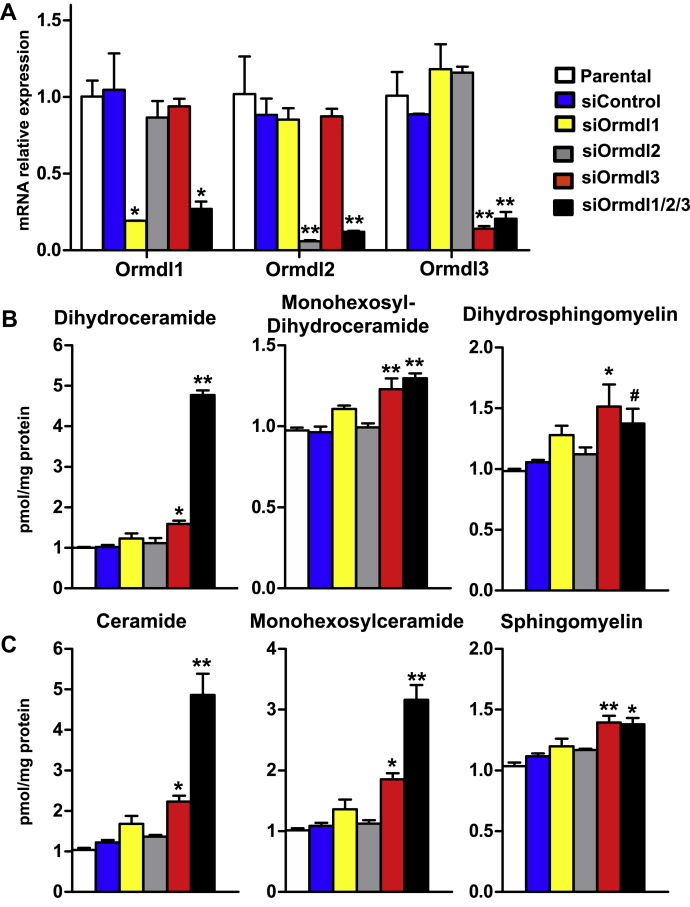
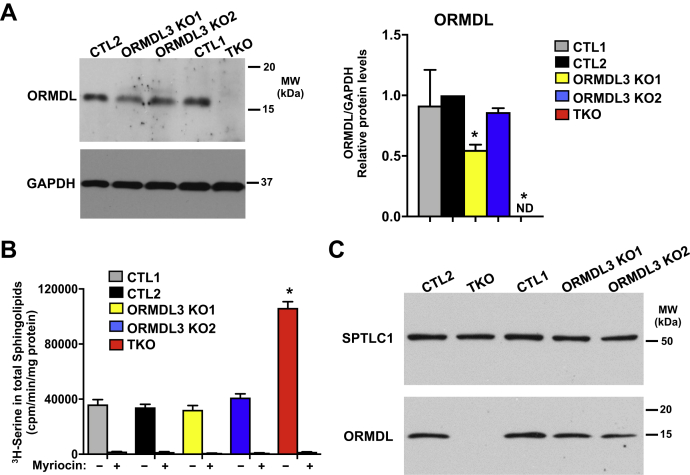
The serine palmitoyltransferase (SPT) complex catalyzes the rate-limiting step in the de novo biosynthesis of ceramides, the precursors of sphingolipids. The mammalian ORMDL isoforms (ORMDL1-3) are negative regulators of SPT. However, the roles of individual ORMDL isoforms are unclear. Using siRNA against individual ORMDLs, only single siORMDL3 had modest effects on dihydroceramide and ceramide levels, whereas downregulation of all three ORMDLs induced more pronounced increases. With the CRISPR/Cas9-based genome-editing strategy, we established stable single ORMDL3 KO (ORMDL3-KO) and ORMDL1/2/3 triple-KO (ORMDL-TKO) cell lines to further understand the roles of ORMDL proteins in sphingolipid biosynthesis. While ORMDL3-KO modestly increased dihydroceramide and ceramide levels, ORMDL-TKO cells had dramatic increases in the accumulation of these sphingolipid precursors. SPT activity was increased only in ORMDL-TKO cells. In addition, ORMDL-TKO but not ORMDL3-KO dramatically increased levels of galactosylceramides, glucosylceramides, and lactosylceramides, the elevated N-acyl chain distributions of which broadly correlated with the increases in ceramide species. Surprisingly, although C16:0 is the major sphingomyelin species, it was only increased in ORMDL3-KO, whereas all other N-acyl chain sphingomyelin species were significantly increased in ORMDL-TKO cells. Analysis of sphingoid bases revealed that although sphingosine was only increased 2-fold in ORMDL-TKO cells, levels of dihydrosphingosine, dihydrosphingosine-1-phosphate, and sphingosine-1-phosphate were hugely increased in ORMDL-TKO cells and not in ORMDL3-KO cells. Thus, ORMDL proteins may have a complex, multifaceted role in the biosynthesis and regulation of cellular sphingolipids.
丝氨酸棕榈酰转移酶(SPT)复合物催化神经酰胺从头生物合成的限速步骤,神经酰胺是鞘脂的前体。哺乳动物 ORMDL 同工型(ORMDL1-3)是 SPT 的负调节剂。然而,个别 ORMDL 同工型的作用尚不清楚。使用针对单个 ORMDLs 的 siRNA,只有单 siORMDL3 对二氢神经酰胺和神经酰胺水平有适度影响,而下调所有三种 ORMDLs 则诱导更明显的增加。使用基于 CRISPR/Cas9 的基因组编辑策略,我们建立了稳定的单个 ORMDL3 KO(ORMDL3-KO)和 ORMDL1/2/3 三重 KO(ORMDL-TKO)细胞系,以进一步了解 ORMDL 蛋白在鞘脂生物合成中的作用。虽然 ORMDL3-KO 适度增加了二氢神经酰胺和神经酰胺水平,但 ORMDL-TKO 细胞中这些鞘脂前体的积累则显著增加。仅在 ORMDL-TKO 细胞中 SPT 活性增加。此外,ORMDL-TKO 但不是 ORMDL3-KO 显著增加了半乳糖神经酰胺、葡萄糖神经酰胺和乳糖神经酰胺的水平,其升高的 N-酰基链分布与神经酰胺种类的增加广泛相关。令人惊讶的是,尽管 C16:0 是主要的神经鞘氨醇种类,但它仅在 ORMDL3-KO 中增加,而所有其他 N-酰基链神经鞘氨醇种类在 ORMDL-TKO 细胞中均显著增加。鞘氨醇碱基分析表明,尽管 ORMDL-TKO 细胞中二氢鞘氨醇仅增加了 2 倍,但在 ORMDL-TKO 细胞中,二氢鞘氨醇-1-磷酸、鞘氨醇-1-磷酸的水平均显著增加,而在 ORMDL3-KO 细胞中则没有。因此,ORMDL 蛋白在细胞鞘脂的生物合成和调节中可能具有复杂的、多方面的作用。