Department of Sociology, Faculty of Social Sciences, the University of Victoria, Victoria, BC, V8W 3P5, Canada.
Department of Social Work and Social Policy, School of Social and Behavioral Sciences, Nanjing University, Jiangsu Province, 210023, P. R. China; The Centre for Asia-Pacific Development Studies, Nanjing University, Jiangsu Province, 210023, P. R. China.
J Affect Disord. 2021 Jun 15;289:46-54. doi: 10.1016/j.jad.2021.04.026. Epub 2021 Apr 20.
The COVID-19 pandemic generates negative psychological effects such as distress. Social influences on subjective distress associated with COVID-19 remain understudied in the Chinese context. Wuhan with its surrounding areas in Hubei province was not only the locale where first COVID-19 cases were detected in the world but was also the hardest hit across China. Data from Hubei provide a unique opportunity to investigate COVID-19-related subjective distress and its social correlates.
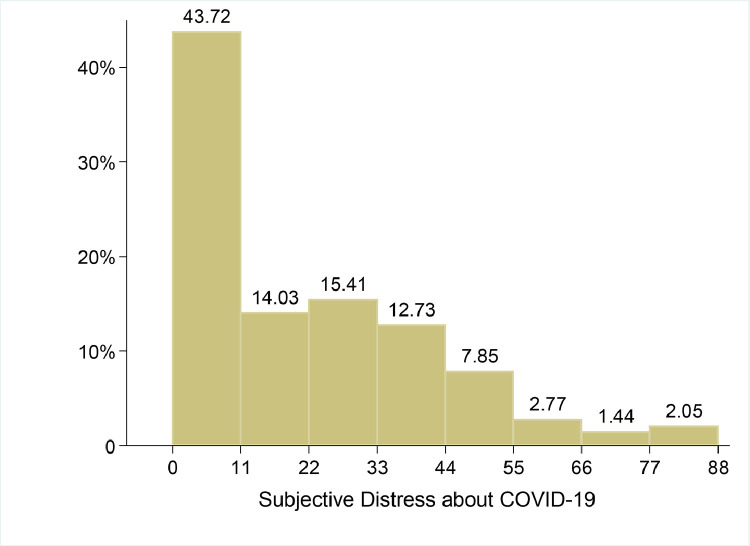
We use original data (N=3,465) from the General Social Survey on COVID-19 in Hubei, China, conducted in August 2020. Regression analysis is employed to examine the impact of socioeconomic status, family structure, and social policies on COVID-19-related subjective distress measured by the Impact of Event-Scale-Revised (IES-R).
First, individuals with higher socioeconomic status are not more immune to distress, and actually it is those better-educated ones who are more distressed. Second, family structure influences distress. Divorced and widowed individuals are more prone to distress than those who are married or single. Those living with COVID-19-infected family members or living with a larger family are particularly more distressed. Third, stricter lockdown measures promote real and perceived protection and also increase individuals' psychological distance from the disease, thereby reducing subjective distress.
The sample is not totally random so we should use caution when generalizing the findings to the general population.
The findings contribute to our understanding of mental health disparity during the COVID-19 pandemic. Certain social groups are at a higher risk of distress than others.
COVID-19 大流行会产生痛苦等负面心理影响。在中国背景下,与 COVID-19 相关的社会影响对主观痛苦的研究还不够充分。武汉及其周边的湖北省不仅是世界上首次发现 COVID-19 病例的地方,也是中国受灾最严重的地区。湖北省的数据为研究 COVID-19 相关主观痛苦及其社会关联提供了独特的机会。
我们使用了 2020 年 8 月在中国湖北省进行的 COVID-19 一般社会调查的原始数据(N=3465)。回归分析用于检验社会经济地位、家庭结构和社会政策对修订后的事件影响量表(IES-R)衡量的 COVID-19 相关主观痛苦的影响。
首先,社会经济地位较高的个体并非对痛苦有更强的免疫力,实际上是受教育程度较高的个体更痛苦。其次,家庭结构会影响痛苦。与已婚或单身者相比,离婚和丧偶者更容易感到痛苦。与 COVID-19 感染者同住或与大家庭同住的人特别痛苦。第三,更严格的封锁措施促进了实际和感知的保护,也增加了个体与疾病的心理距离,从而降低了主观痛苦。
样本并非完全随机,因此在将研究结果推广到一般人群时应谨慎。
研究结果有助于我们了解 COVID-19 大流行期间的心理健康差距。某些社会群体比其他群体更容易感到痛苦。