WG Environmental Health, Department of Biomedical Sciences, University of Veterinary Medicine Vienna, Veterinärplatz 1, A-1210, Vienna, Austria.
Environ Pollut. 2021 Sep 1;284:117153. doi: 10.1016/j.envpol.2021.117153. Epub 2021 Apr 15.
Lockdowns amid the COVID-19 pandemic have offered a real-world opportunity to better understand air quality responses to previously unseen anthropogenic emission reductions.
This work examines the impact of Vienna's first lockdown on ground-level concentrations of nitrogen dioxide (NO), ozone (O) and total oxidant (O). The analysis runs over January to September 2020 and considers business as usual scenarios created with machine learning models to provide a baseline for robustly diagnosing lockdown-related air quality changes. Models were also developed to normalise the air pollutant time series, enabling facilitated intervention assessment.
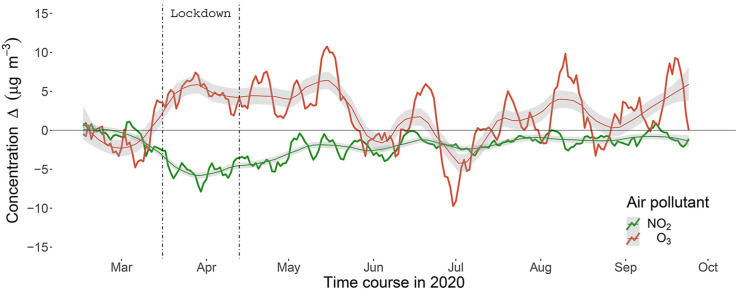
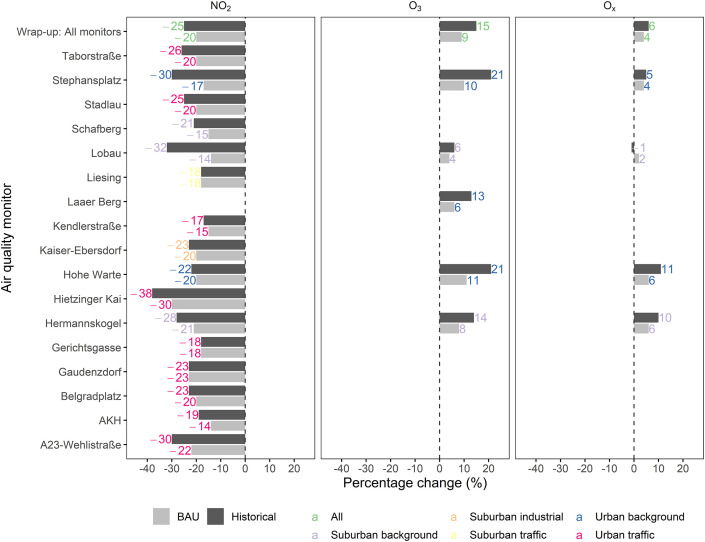
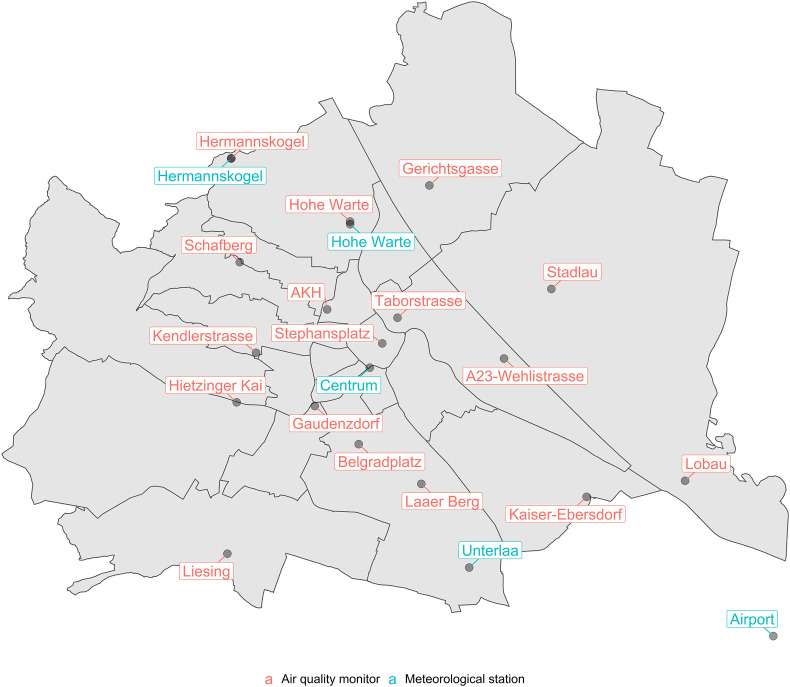
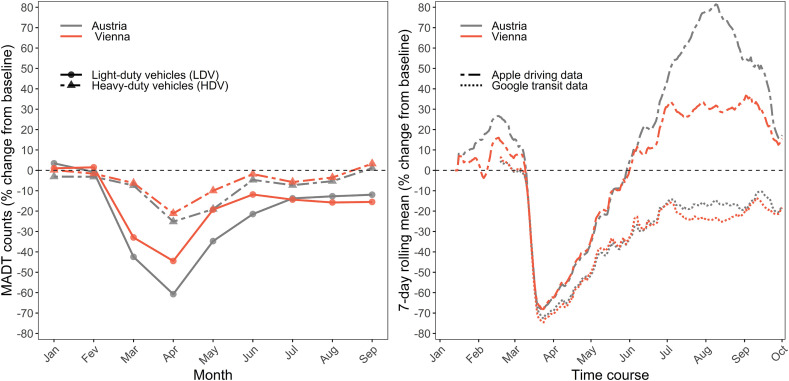
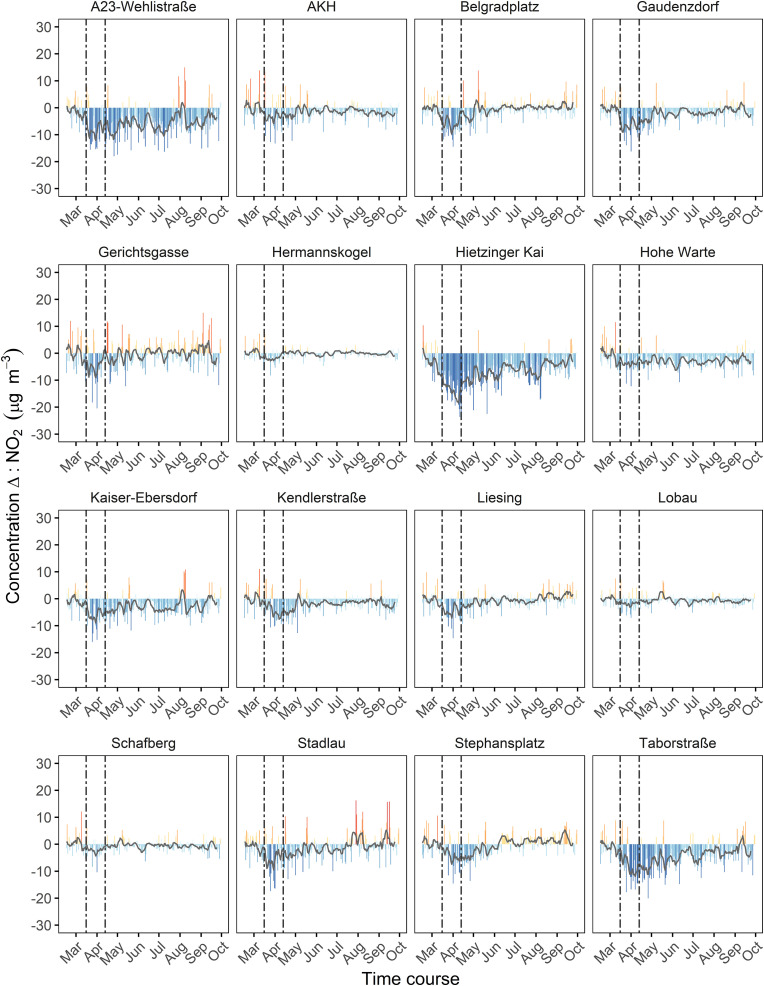
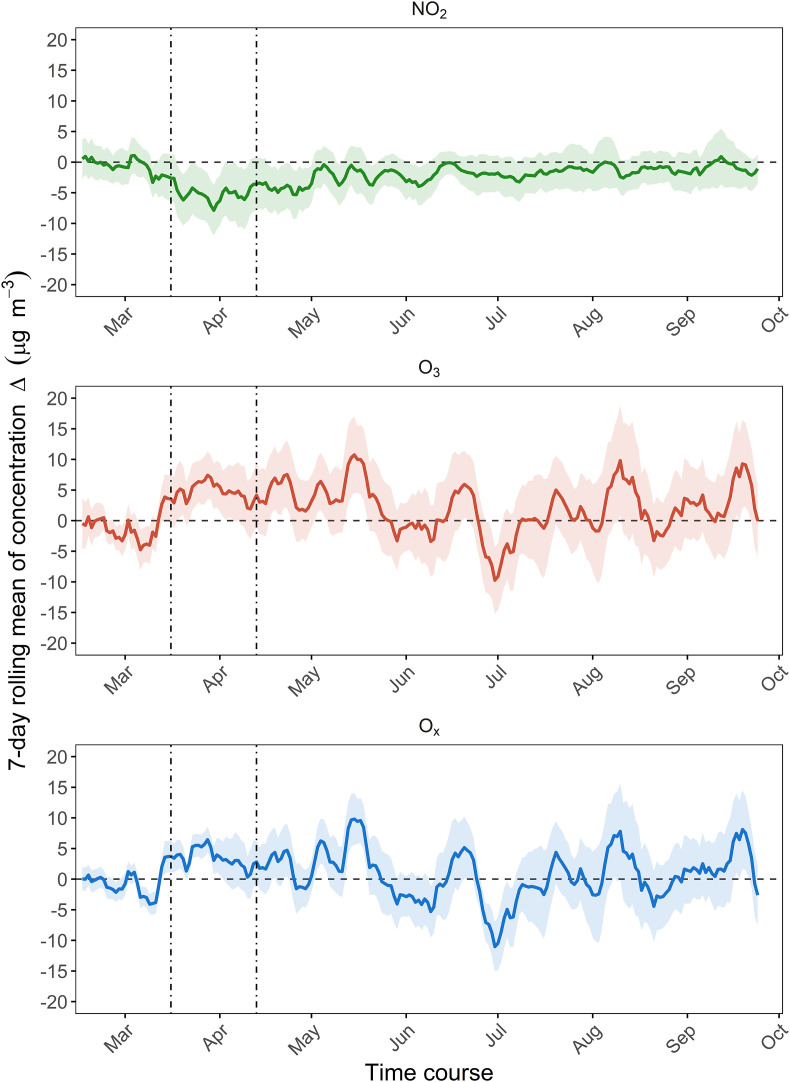
NO concentrations were on average -20.1% [13.7-30.4%] lower during the lockdown. However, this benefit was offset by amplified O pollution of +8.5% [3.7-11.0%] in the same period. The consistency in the direction of change indicates that the NO reductions and O increases were ubiquitous over Vienna. O concentrations increased slightly by +4.3% [1.8-6.4%], suggesting that a significant part of the drops in NO was compensated by gains in O. Accordingly, 82% of lockdown days with lowered NO were accompanied by 81% of days with amplified O. The recovery shapes of the pollutant concentrations were depicted and discussed. The business as usual-related outcomes were broadly consistent with the patterns outlined by the normalised time series. These findings allowed to argue further that the detected changes in air quality were of anthropogenic and not of meteorological reason. Pollutant changes on the machine learning baseline revealed that the impact of the lockdown on urban air quality were lower than the raw measurements show. Besides, measured traffic drops in major Austrian roads were more significant for light-duty than for heavy-duty vehicles. It was also noted that the use of mobility reports based on cell phone movement as activity data can overestimate the reduction of emissions for the road transport sector, particularly for heavy-duty vehicles. As heavy-duty vehicles can make up a large fraction of the fleet emissions of nitrogen oxides, the change in the volume of these vehicles on the roads may be the main driver to explain the change in NO concentrations.
A probable future with emissions of volatile organic compounds (VOCs) dropping slower than emissions of nitrogen oxides could risk worsened urban O pollution under a VOC-limited photochemical regime. More holistic policies will be needed to achieve improved air quality levels across different regions and criteria pollutants.
在 COVID-19 大流行期间实施的封锁为更好地了解空气质量对以前从未见过的人为排放减少的响应提供了一个真实世界的机会。
这项工作研究了维也纳首次封锁对地面二氧化氮(NO)、臭氧(O)和总氧化剂(O)浓度的影响。分析时间为 2020 年 1 月至 9 月,并考虑了使用机器学习模型创建的常规情景,为稳健诊断与封锁相关的空气质量变化提供基线。还开发了模型来归一化空气污染物时间序列,从而便于进行干预评估。
封锁期间,NO 浓度平均降低了 20.1%[13.7-30.4%]。然而,在此期间,O 污染的放大抵消了这一好处,增加了 8.5%[3.7-11.0%]。变化方向的一致性表明,NO 的减少和 O 的增加在维也纳普遍存在。O 浓度略有增加,增加了 4.3%[1.8-6.4%],这表明 NO 的大部分减少被 O 的增加所补偿。因此,82%的 NO 浓度降低的封锁日伴随着 81%的 O 浓度增加日。污染物浓度的恢复形状被描绘并讨论。与正常化时间序列相关的常规情景结果基本一致。这些发现进一步表明,空气质量的变化是人为的,而不是气象原因。在机器学习基线相关的污染物变化揭示了封锁对城市空气质量的影响低于原始测量结果所显示的影响。此外,在奥地利主要道路上测量到的交通流量下降对轻型车辆的影响比对重型车辆的影响更为显著。还注意到,使用基于手机移动的移动性报告作为活动数据可能会高估道路交通部门的排放量减少,尤其是对重型车辆而言。由于重型车辆可能占氮氧化物车队排放量的很大一部分,因此道路上这些车辆数量的变化可能是解释 NO 浓度变化的主要驱动因素。
如果挥发性有机化合物(VOC)的排放量下降速度慢于氮氧化物的排放量,那么在 VOC 受限的光化学机制下,城市 O 污染可能会恶化。需要采取更全面的政策,才能在不同地区和不同污染物标准下实现空气质量水平的提高。