D'Isidoro Massimo, D'Elia Ilaria, Vitali Lina, Briganti Gino, Cappelletti Andrea, Piersanti Antonio, Finardi Sandro, Calori Giuseppe, Pepe Nicola, Di Giosa Alessandro, Bolignano Andrea, Zanini Gabriele
ENEA - Italian Agency for New Technologies, Energy and Sustainable Economic Development, Bologna, Italy.
Arianet s.r.l., Milano, Italy.
Atmos Pollut Res. 2022 Dec;13(12):101620. doi: 10.1016/j.apr.2022.101620. Epub 2022 Dec 2.
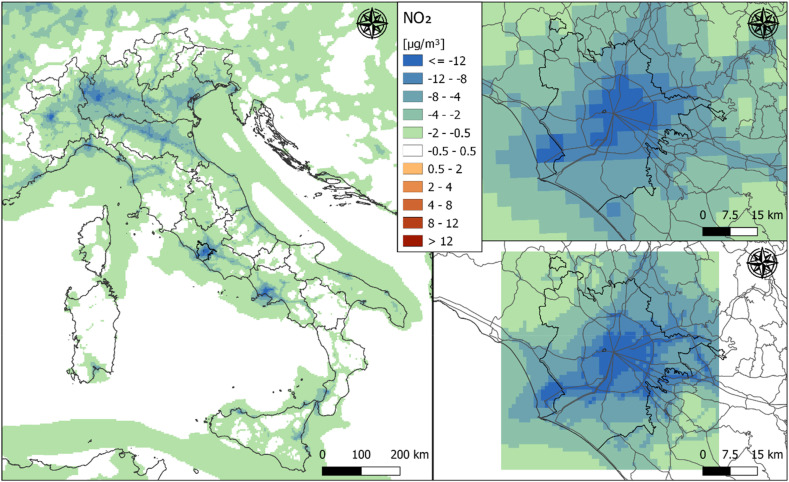
Policies to improve air quality need to be based on effective plans for reducing anthropogenic emissions. In 2020, the outbreak of COVID-19 pandemic resulted in significant reductions of anthropogenic pollutant emissions, offering an unexpected opportunity to observe their consequences on ambient concentrations. Taking the national lockdown occurred in Italy between March and May 2020 as a case study, this work tries to infer if and what lessons may be learnt concerning the impact of emission reduction policies on air quality. Variations of NO, O, PM and PM concentrations were calculated from numerical model simulations obtained with business as usual and lockdown specific emissions. Both simulations were performed at national level with a horizontal resolution of 4 km, and at local level on the capital city Rome at 1 km resolution. Simulated concentrations showed a good agreement with in-situ observations, confirming the modelling systems capability to reproduce the effects of emission reductions on ambient concentration variations, which differ according to the individual air pollutant. We found a general reduction of pollutant concentrations except for ozone, that experienced an increase in Rome and in the other urban areas, and a decrease elsewhere. The obtained results suggest that acting on precursor emissions, even with sharp reductions like those experienced during the lockdown, may lead to significant, albeit complex, reduction patterns for secondary pollutant concentrations. Therefore, to be more effective, reduction measures should be carefully selected, involving more sectors than those related to mobility, such as residential and agriculture, and integrated on different scales.
改善空气质量的政策需要基于减少人为排放的有效计划。2020年,新冠疫情的爆发导致人为污染物排放量大幅减少,为观察其对环境浓度的影响提供了一个意外的机会。以2020年3月至5月意大利实施的全国封锁为例,这项工作试图推断是否以及可以从减排政策对空气质量的影响中学到什么经验教训。通过使用照常营业和封锁期间特定排放获得的数值模型模拟,计算了一氧化氮、臭氧、细颗粒物和可吸入颗粒物浓度的变化。这两种模拟都是在国家层面以4公里的水平分辨率进行的,在地方层面以1公里的分辨率在首都罗马进行的。模拟浓度与现场观测结果吻合良好,证实了建模系统能够再现减排对环境浓度变化的影响,而这种影响因个别空气污染物而异。我们发现除了臭氧外,污染物浓度普遍下降,臭氧在罗马和其他城市地区有所增加,在其他地方有所下降。所得结果表明,即使像封锁期间那样大幅减少前体排放,也可能导致二次污染物浓度显著降低,尽管模式复杂。因此,为了更有效,减排措施应谨慎选择,涉及比与交通相关的部门更多的部门,如住宅和农业,并在不同规模上进行整合。