Department of Translational Molecular Pathology, University of Texas MD Anderson Cancer Center, Houston, TX 77030.
Department of Genomic Medicine, University of Texas MD Anderson Cancer Center, Houston, TX 77030.
Proc Natl Acad Sci U S A. 2021 May 11;118(19). doi: 10.1073/pnas.2102050118.
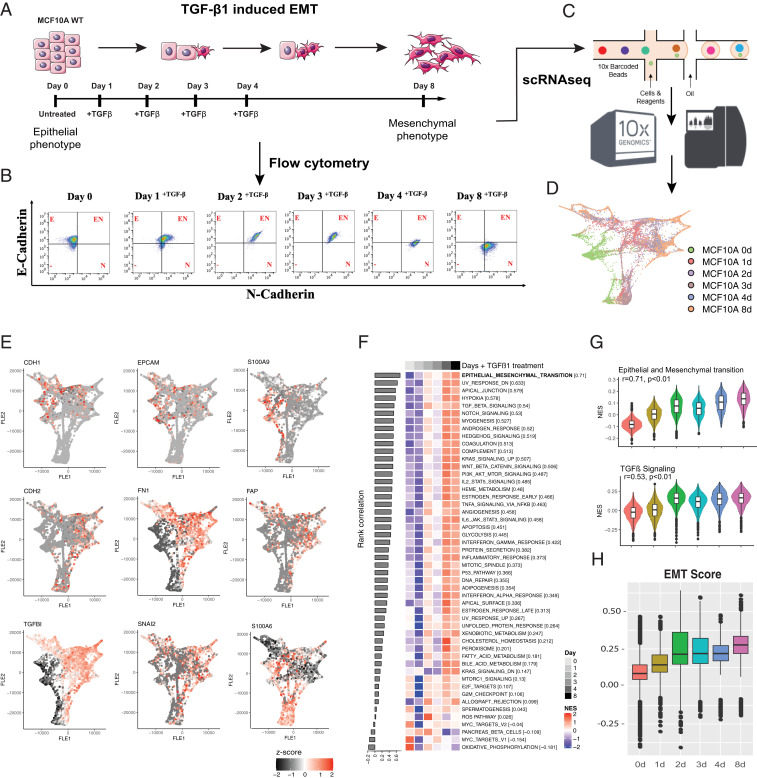
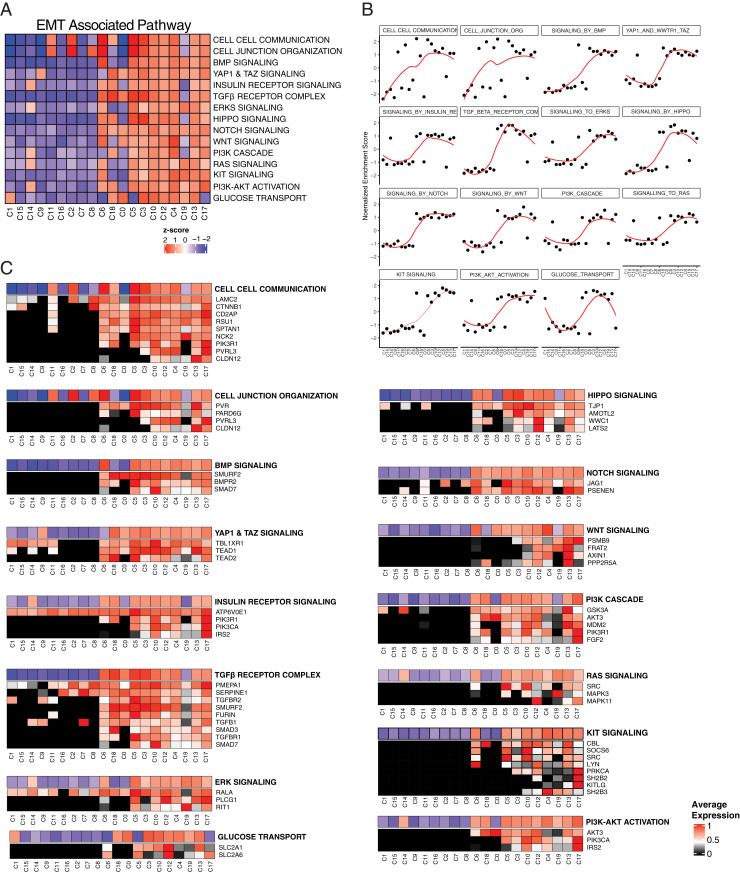
The epithelial-to-mesenchymal transition (EMT) plays a critical role during normal development and in cancer progression. EMT is induced by various signaling pathways, including TGF-β, BMP, Wnt-β-catenin, NOTCH, Shh, and receptor tyrosine kinases. In this study, we performed single-cell RNA sequencing on MCF10A cells undergoing EMT by TGF-β1 stimulation. Our comprehensive analysis revealed that cells progress through EMT at different paces. Using pseudotime clustering reconstruction of gene-expression profiles during EMT, we found sequential and parallel activation of EMT signaling pathways. We also observed various transitional cellular states during EMT. We identified regulatory signaling nodes that drive EMT with the expression of important microRNAs and transcription factors. Using a random circuit perturbation methodology, we demonstrate that the NOTCH signaling pathway acts as a key driver of TGF-β-induced EMT. Furthermore, we demonstrate that the gene signatures of pseudotime clusters corresponding to the intermediate hybrid EMT state are associated with poor patient outcome. Overall, this study provides insight into context-specific drivers of cancer progression and highlights the complexities of the EMT process.
上皮-间充质转化 (EMT) 在正常发育和癌症进展中起着关键作用。EMT 由多种信号通路诱导,包括 TGF-β、BMP、Wnt-β-catenin、NOTCH、Shh 和受体酪氨酸激酶。在这项研究中,我们对 MCF10A 细胞在 TGF-β1 刺激下发生 EMT 进行了单细胞 RNA 测序。我们的综合分析表明,细胞以不同的速度经历 EMT。通过 EMT 过程中基因表达谱的伪时间聚类重建,我们发现 EMT 信号通路的顺序和并行激活。我们还观察到 EMT 过程中的各种过渡细胞状态。我们确定了调控信号节点,这些节点通过表达重要的 microRNA 和转录因子来驱动 EMT。我们使用随机电路干扰方法证明,NOTCH 信号通路是 TGF-β 诱导 EMT 的关键驱动因素。此外,我们还证明了对应于中间混合 EMT 状态的伪时间聚类的基因特征与患者预后不良相关。总的来说,这项研究深入了解了癌症进展的特定于背景的驱动因素,并强调了 EMT 过程的复杂性。