Rady Faculty of Health Sciences, University of Manitoba, Winnipeg, MB, Canada.
George & Faye Yee Centre for Healthcare Innovation, Winnipeg, MB, Canada.
Health Expect. 2021 Aug;24(4):1220-1229. doi: 10.1111/hex.13252. Epub 2021 May 4.
Disclosure of human immunodeficiency virus (HIV)-positive status in a workplace can be a complex social decision for a person living with HIV.
To design a Decision Guide to support people living with HIV in assessing contexts, risks and benefits of workplace disclosure in choosing whether or not, or to what extent, to disclose. In this report, we review the participatory design of a Decision Guide prototype and focus on its evaluation.
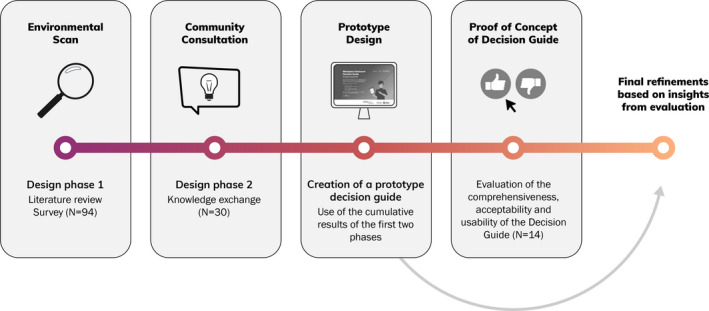
We began with stakeholder input through an environmental scan and community consultation that informed the development of an online Decision Guide prototype. To evaluate the comprehensiveness, acceptability and usability of the prototype, we used qualitative methodology involving individual interviews and the think-aloud technique. Interviews were transcribed and analysed qualitatively.
Fourteen people, including people living with HIV and service providers, participated. We identified benefits of the Decision Guide related to comprehensiveness, acceptability and usability. Additional interview themes focused on disclosure concerns, mitigating risks associated with disclosure and additional considerations for the Decision Guide.
The Decision Guide was perceived to be acceptable, comprehensive and useful. The findings endorse the application of a socio-ecological perspective when designing decision support aids for complex social decisions.
People with lived experience of HIV were involved in the prototype design phases as research team members. They, along with community leaders and service providers, also participated in a community forum and were key informants for the evaluation of the Workplace Disclosure Decision Guide prototype.
对于 HIV 感染者来说,在工作场所披露 HIV 阳性状态可能是一个复杂的社会决策。
设计一个决策指南,以支持 HIV 感染者评估工作场所披露的背景、风险和收益,从而决定是否以及在何种程度上披露。在本报告中,我们回顾了决策指南原型的参与式设计,并重点关注其评估。
我们首先通过环境扫描和社区咨询获得利益相关者的投入,这些投入为在线决策指南原型的开发提供了信息。为了评估原型的全面性、可接受性和可用性,我们使用了定性方法,包括个人访谈和出声思维技术。访谈记录进行了定性分析。
共有 14 人参与,包括 HIV 感染者和服务提供者。我们确定了决策指南的一些益处,包括其全面性、可接受性和可用性。其他访谈主题则侧重于披露的担忧、减轻与披露相关的风险以及决策指南的其他考虑因素。
决策指南被认为是可接受的、全面的和有用的。研究结果支持在设计复杂社会决策的决策支持辅助工具时应用社会生态观点。
有 HIV 感染经历的人作为研究小组成员参与了原型设计阶段。他们以及社区领袖和服务提供者还参加了一个社区论坛,并成为工作场所披露决策指南原型评估的主要信息来源。