Molecular Medicine Program, The University of Utah, Salt Lake City, UT.
Oregon Health and Science University, Portland, OR; and.
Blood Adv. 2021 May 11;5(9):2362-2374. doi: 10.1182/bloodadvances.2020004112.
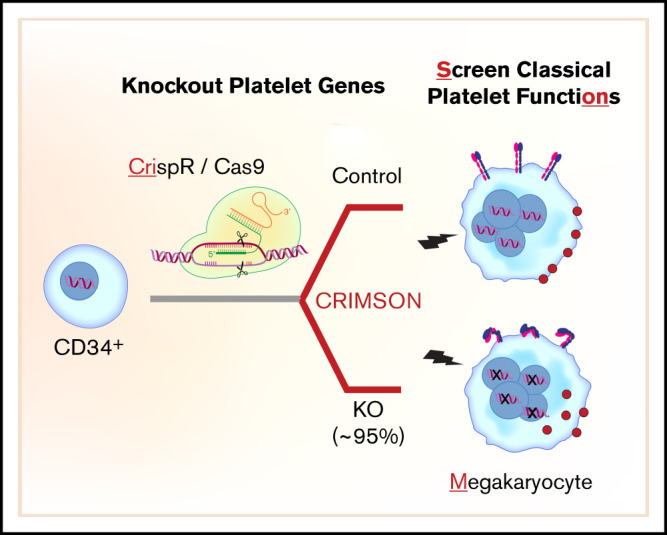
Human anucleate platelets cannot be directly modified using traditional genetic approaches. Instead, studies of platelet gene function depend on alternative models. Megakaryocytes (the nucleated precursor to platelets) are the nearest cell to platelets in origin, structure, and function. However, achieving consistent genetic modifications in primary megakaryocytes has been challenging, and the functional effects of induced gene deletions on human megakaryocytes for even well-characterized platelet genes (eg, ITGA2B) are unknown. Here we present a rapid and systematic approach to screen genes for platelet functions in CD34+ cell-derived megakaryocytes called CRIMSON (CRISPR-edited megakaryocytes for rapid screening of platelet gene functions). By using CRISPR/Cas9, we achieved efficient nonviral gene editing of a panel of platelet genes in megakaryocytes without compromising megakaryopoiesis. Gene editing induced loss of protein in up to 95% of cells for platelet function genes GP6, RASGRP2, and ITGA2B; for the immune receptor component B2M; and for COMMD7, which was previously associated with cardiovascular disease and platelet function. Gene deletions affected several select responses to platelet agonists in megakaryocytes in a manner largely consistent with those expected for platelets. Deletion of B2M did not significantly affect platelet-like responses, whereas deletion of ITGA2B abolished agonist-induced integrin activation and spreading on fibrinogen without affecting the translocation of P-selectin. Deletion of GP6 abrogated responses to collagen receptor agonists but not thrombin. Deletion of RASGRP2 impaired functional responses to adenosine 5'-diphosphate (ADP), thrombin, and collagen receptor agonists. Deletion of COMMD7 significantly impaired multiple responses to platelet agonists. Together, our data recommend CRIMSON for rapid evaluation of platelet gene phenotype associations.
人无核血小板不能直接用传统的遗传方法进行修饰。相反,血小板基因功能的研究依赖于替代模型。巨核细胞(血小板的有核前体)在起源、结构和功能上与血小板最为接近。然而,在原代巨核细胞中实现一致的基因修饰一直具有挑战性,并且即使对于特征明确的血小板基因(如 ITGA2B),诱导基因缺失对人巨核细胞的功能影响也是未知的。在这里,我们提出了一种快速而系统的方法来筛选 CD34+细胞衍生的巨核细胞中血小板功能的基因,称为 CRIMSON(用于快速筛选血小板基因功能的 CRISPR 编辑巨核细胞)。通过使用 CRISPR/Cas9,我们在不影响巨核细胞生成的情况下,在巨核细胞中高效地进行了血小板功能基因 GP6、RASGRP2 和 ITGA2B、免疫受体成分 B2M 和先前与心血管疾病和血小板功能相关的 COMMD7 的非病毒基因编辑。基因编辑诱导多达 95%的细胞中血小板功能基因 GP6、RASGRP2 和 ITGA2B、免疫受体成分 B2M 和 COMMD7 的蛋白丢失;而对于 COMMD7,则与心血管疾病和血小板功能相关。基因缺失以与血小板预期基本一致的方式影响巨核细胞中几种对血小板激动剂的选择反应。B2M 的缺失并不显著影响血小板样反应,而 ITGA2B 的缺失则消除了纤维蛋白原上激动剂诱导的整合素激活和扩展,而不影响 P-选择素的易位。GP6 的缺失阻断了对胶原受体激动剂的反应,但不阻断对凝血酶的反应。RASGRP2 的缺失损害了对 ADP、凝血酶和胶原受体激动剂的功能反应。COMMD7 的缺失显著损害了对多种血小板激动剂的反应。总的来说,我们的数据推荐 CRIMSON 用于快速评估血小板基因表型相关性。