Department of Medical Biochemistry, Oslo University Hospital-Radiumhospitalet, Box 4953 Nydalen, 0424, Oslo, Norway.
Faculty of Medicine, University of Oslo, Oslo, Norway.
Rheumatol Int. 2021 Sep;41(9):1657-1665. doi: 10.1007/s00296-021-04865-9. Epub 2021 May 4.
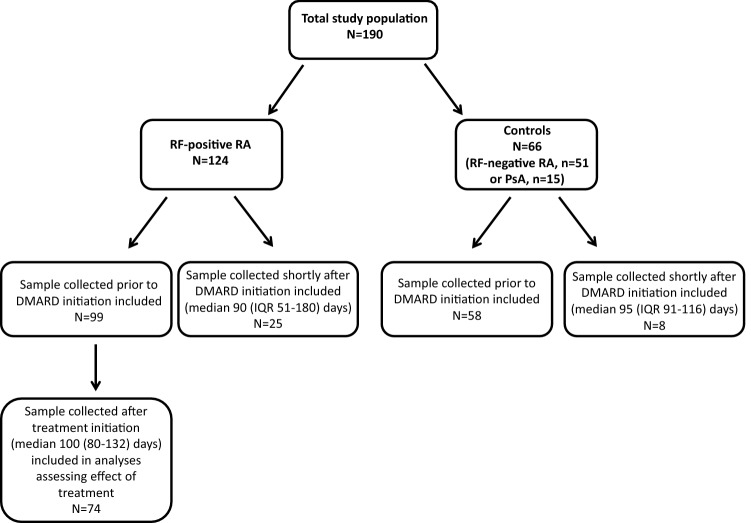
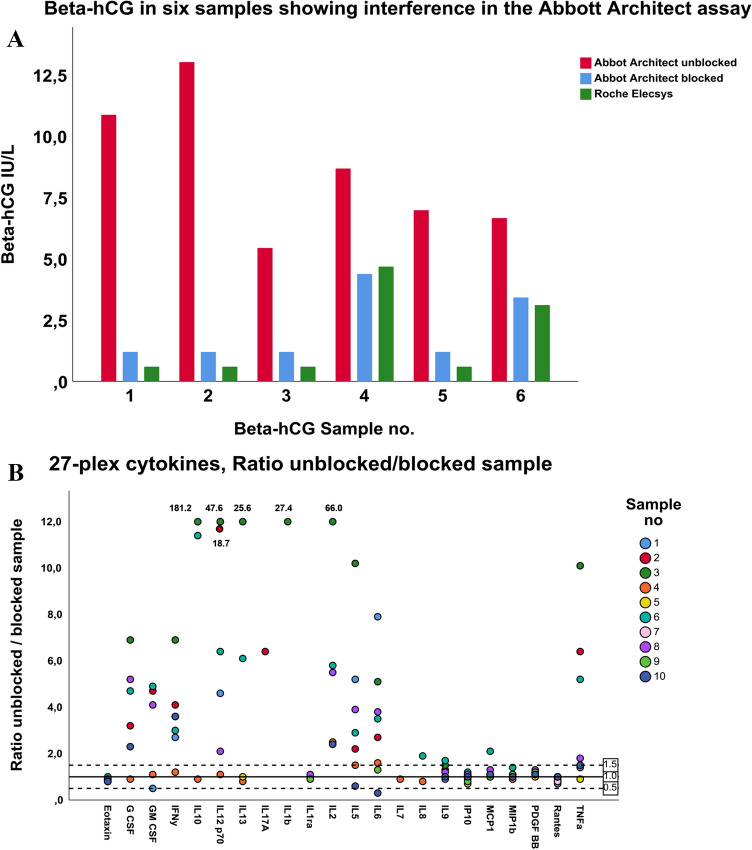
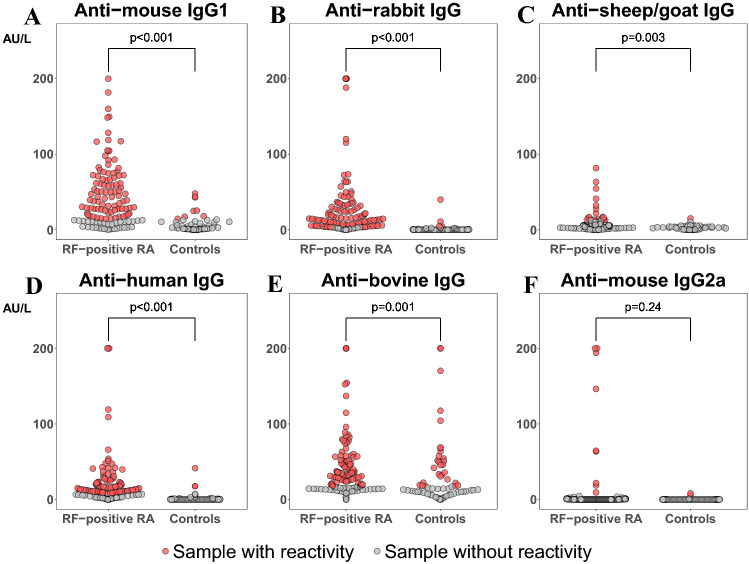
The aim of the study was to assess RF cross-reactivity to animal antibodies used in immunoassays, and to test if selected commercial immunoassays are vulnerable to interference from RF, causing false test results. Our study included samples from patients with RF-positive rheumatoid arthritis (RA) and controls (patients with RF-negative RA and psoriatic arthritis), included in an early arthritis-cohort. Reactivity to mouse IgG1, mouse IgG2a, rabbit IgG, bovine IgG, sheep/goat IgG and human IgG was analysed using in-house interference assays. RF-positive sera with strong reactivity to mouse IgG1 were analysed in three commercial immunoassays. To reveal interference, results before and after addition of blocking aggregated murine IgG1 were compared. Samples from 124 RF-positive RA patients and 66 controls were tested. We found considerably stronger reactivity toward animal antibodies, particularly mouse IgG1 (73% vs. 12%) and rabbit IgG (81% vs. 6%), in sera from RF-positive RA-patients compared to controls (p < 0.001). After selecting samples for testing in commercial assays, interference was revealed in 6/30 sera in the Architect β-hCG assay, 7/10 sera in the 27-plex cytokine assays, and in 2/33 samples in the Elecsys Soluble Transferrin Receptor assay. Our study revealed considerable RF reactivity to animal antibodies used in immunoassays and RF was associated with falsely elevated results in immunoassays used in clinical care and research. Clinicians, laboratorians, researchers and assay manufacturers must be alert to the risk of falsely elevated test results in RF-positive RA patients.
本研究旨在评估免疫分析中使用的动物抗体对 RF 的交叉反应性,并检测是否某些商业免疫分析方法易受 RF 的干扰,从而导致假阳性结果。我们的研究纳入了来自 RF 阳性类风湿关节炎(RA)患者和对照(RF 阴性 RA 和银屑病关节炎患者)的样本,这些样本均来自一个早期关节炎队列。使用内部干扰检测方法分析了对鼠 IgG1、鼠 IgG2a、兔 IgG、牛 IgG、羊/山羊 IgG 和人 IgG 的反应性。对强反应性鼠 IgG1 的 RF 阳性血清进行了三种商业免疫分析检测。为了揭示干扰,比较了添加阻断聚集鼠 IgG1 前后的结果。对 124 例 RF 阳性 RA 患者和 66 例对照的样本进行了检测。与对照相比,我们发现 RF 阳性 RA 患者的血清对动物抗体,尤其是鼠 IgG1(73% vs. 12%)和兔 IgG(81% vs. 6%)的反应性明显更强(p<0.001)。在选择用于商业检测的样本后,在 Architect β-hCG 检测中发现 6/30 份血清、27 个细胞因子检测中发现 7/10 份血清、Elecsys 可溶性转铁蛋白受体检测中发现 2/33 份血清存在干扰。本研究揭示了免疫分析中使用的动物抗体对 RF 具有明显的反应性,并且 RF 与临床护理和研究中使用的免疫分析方法出现假阳性结果有关。临床医生、实验室人员、研究人员和检测制造商必须警惕 RF 阳性 RA 患者的假阳性检测结果的风险。