Division of Pulmonary and Critical Care Medicine, Department of Internal Medicine, Tongji Hospital, Tongji Medical College, Huazhong University of Science and Technology, Wuhan, China.
Key Laboratory of Respiratory Diseases, National Health Commission of People's Republic of China, and National Clinical Research Center for Respiratory Diseases, Wuhan, China.
JCI Insight. 2021 Jun 8;6(11):148103. doi: 10.1172/jci.insight.148103.
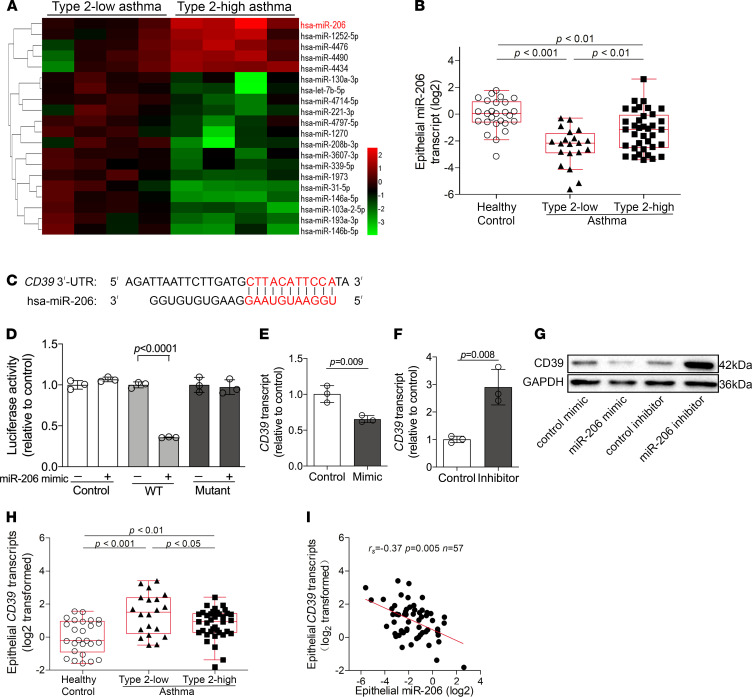
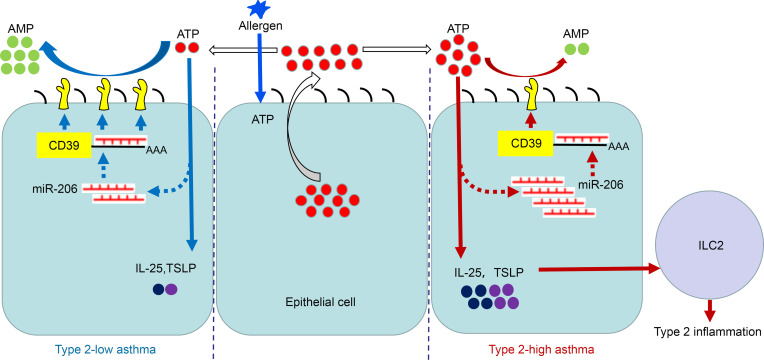
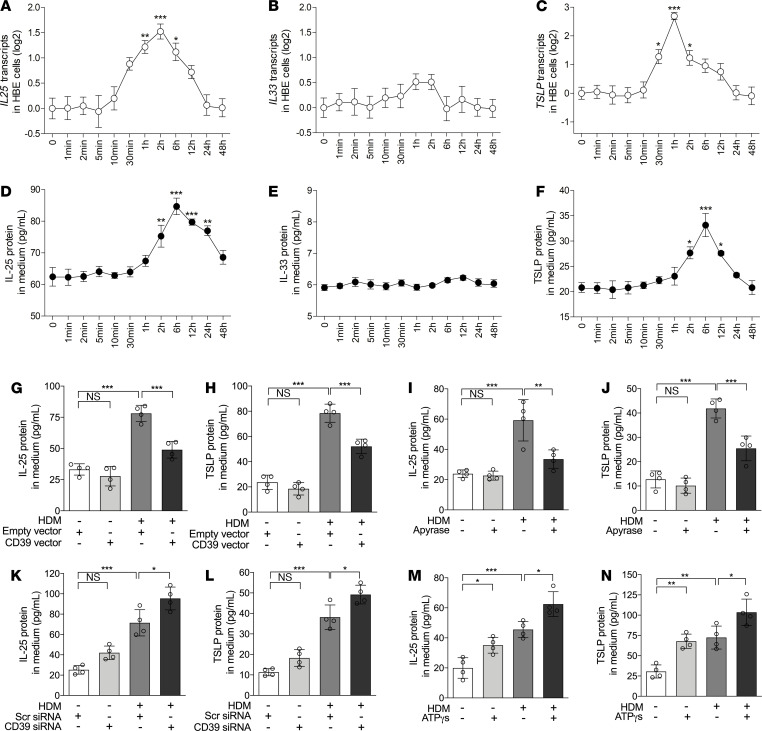
The epithelial cell-derived cytokines IL-25, IL-33, and thymic stromal lymphopoietin (TSLP) initiate type 2 inflammation in allergic diseases, including asthma. However, the signaling pathway regulating these cytokines expression remains elusive. Since microRNAs are pivotal regulators of gene expression, we profiled microRNA expression in bronchial epithelial brushings from type 2-low and type 2-high asthma patients. miR-206 was the most highly expressed epithelial microRNA in type 2-high asthma relative to type 2-low asthma but was downregulated in both subsets compared with healthy controls. CD39, an ectonucleotidase degrading ATP, was a target of miR-206 and upregulated in asthma. Allergen-induced acute extracellular ATP accumulation led to miR-206 downregulation and CD39 upregulation in human bronchial epithelial cells, forming a feedback loop to eliminate excessive ATP. Airway ATP levels were markedly elevated and strongly correlated with IL-25 and TSLP expression in asthma patients. Intriguingly, airway miR-206 antagonism increased Cd39 expression; reduced ATP accumulation; suppressed IL-25, IL-33, and Tslp expression and group 2 innate lymphoid cell expansion; and alleviated type 2 inflammation in a mouse model of allergic airway inflammation. In contrast, airway miR-206 overexpression had opposite effects. Overall, epithelial miR-206 upregulates airway IL-25 and TSLP expression by targeting the CD39-extracellular ATP axis, which represents a potentially novel therapeutic target in type 2-high asthma.
上皮细胞衍生的细胞因子白细胞介素 25(IL-25)、白细胞介素 33(IL-33)和胸腺基质淋巴细胞生成素(TSLP)启动了包括哮喘在内的过敏疾病的 2 型炎症。然而,调节这些细胞因子表达的信号通路仍然难以捉摸。由于 microRNA 是基因表达的关键调节因子,我们对 2 型低和 2 型高哮喘患者的支气管上皮刷取物中的 microRNA 表达进行了分析。与 2 型低哮喘患者相比,miR-206 是 2 型高哮喘患者中表达最高的上皮 microRNA,但与健康对照组相比,这两个亚组的 miR-206 表达均下调。CD39 是一种降解 ATP 的细胞外核苷酸酶,是 miR-206 的靶标,在哮喘中上调。过敏原诱导的急性细胞外 ATP 积累导致 miR-206 在人支气管上皮细胞中下调和 CD39 上调,形成一个反馈回路以消除过多的 ATP。在哮喘患者中,气道 ATP 水平显著升高,与 IL-25 和 TSLP 表达呈强相关性。有趣的是,气道 miR-206 拮抗作用增加了 Cd39 表达;减少 ATP 积累;抑制 IL-25、IL-33 和 Tslp 表达和 2 型固有淋巴细胞扩增;并减轻了过敏性气道炎症的小鼠模型中的 2 型炎症。相反,气道 miR-206 过表达则有相反的效果。总的来说,上皮细胞 miR-206 通过靶向 CD39-细胞外 ATP 轴上调气道中的 IL-25 和 TSLP 表达,这代表了 2 型高哮喘的一个潜在的新型治疗靶点。