Department of Veterinary Public Health, Faculty of Veterinary Sciences, Chulalongkorn University, Bangkok, Thailand.
Functional Proteomics Technology Laboratory, Functional Ingredients and Food Innovation Research Group, National Center for Genetic Engineering and Biotechnology, National Science and Technology for Development Agency, Pathum Thani, Thailand.
PLoS One. 2021 May 4;16(5):e0249682. doi: 10.1371/journal.pone.0249682. eCollection 2021.
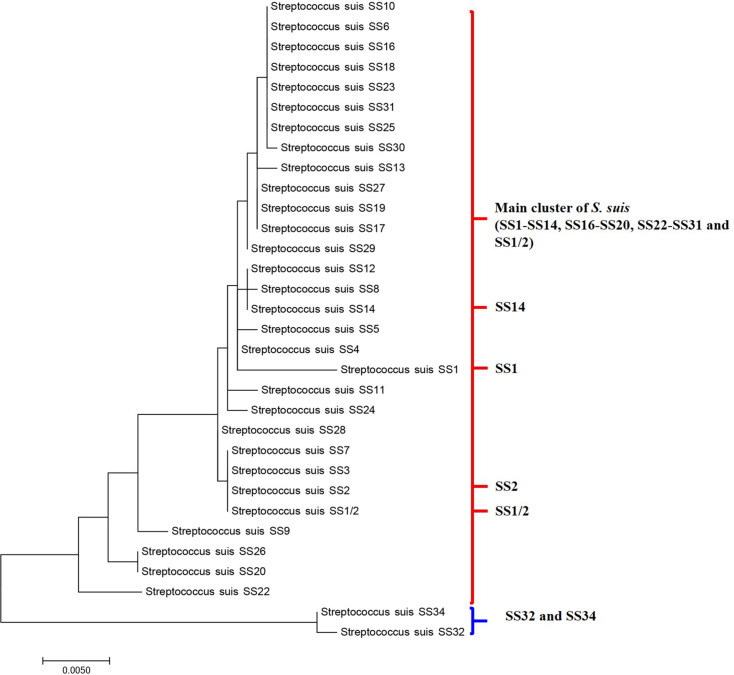
Streptococcus suis, particularly S. suis serotype 2 (SS2), is an important zoonotic pathogen causing meningitis in humans worldwide. Although the proper classification of the causative and pathogenic serotype is salutary for the clinical diagnosis, cross-reactions leading to the indistinguishability of serotypes by the current serotyping methods are significant limitations. In the present study, matrix-assisted laser desorption/ionization time-of-flight mass spectrometry (MALDI-TOF-MS) analysis of extracted peptides was developed to improve the classification of serotype of S. suis. The peptide mass fingerprint (PMFs) database of S. suis was generated from the whole-cell peptides of 32 reference strains of S. suis isolates obtained from pigs. Thirty-two human S. suis isolates from clinical cases in Thailand were used to validate this alternative serotyping method in direct comparison to the multiplex (m)PCR approach. All reference strains, representing 32 serotypes of S. suis, exhibited their individual PMFs patterns, thus allowing differentiation from one another. Highly pathogenic SS2 and SS14 were clearly differentiated from the otherwise serologically closely related SS1/2 and SS1, respectively. The developed MALDI-TOF-MS serotyping method correctly classified the serotype in 68.8% (22/32) of the same serotype isolates generated from the PMFs database; while the validity for the clinical human isolates was 62.5% (20/32). The agreement between the MALDI-TOF-MS and mPCR serotyping was moderate with a Kappa score of 0.522, considering that mPCR could correctly serotype up to 75%. The present study demonstrated that PMFs from the developed MALDI-TOF-MS-based method could successfully discriminate the previously indistinguishable highly pathogenic SS2 and SS14 from SS1/2 and SS1, respectively. Moreover, this serotyping method distinguished pathogenic SS6, and so is an alternative approach of choice to rapidly and reliably serotype clinically pathogenic S. suis isolates.
猪链球菌,特别是血清 2 型(SS2),是一种重要的人畜共患病病原体,可导致全球人类脑膜炎。虽然正确分类致病血清型对于临床诊断有益,但当前血清分型方法导致的交叉反应使得血清型难以区分是一个显著的局限性。在本研究中,开发了基质辅助激光解吸/电离飞行时间质谱(MALDI-TOF-MS)分析提取肽的方法,以提高猪链球菌血清型的分类。从 32 株猪源猪链球菌参考菌株的全细胞肽中生成猪链球菌肽质量指纹(PMF)数据库。用该替代血清分型方法与多重(m)PCR 方法直接比较,对来自泰国临床病例的 32 株人源猪链球菌进行验证。所有参考菌株代表 32 种血清型的猪链球菌,表现出各自的 PMF 模式,从而能够彼此区分。高致病性 SS2 和 SS14 与其他血清学上密切相关的 SS1/2 和 SS1 分别清楚地分开。开发的 MALDI-TOF-MS 血清分型方法正确分类了从 PMF 数据库生成的相同血清型分离株中的 68.8%(22/32);而对于临床人源分离株的有效性为 62.5%(20/32)。考虑到 mPCR 可正确血清型鉴定高达 75%,MALDI-TOF-MS 和 mPCR 血清分型之间的一致性为中度,Kappa 评分为 0.522。本研究表明,从开发的基于 MALDI-TOF-MS 的方法获得的 PMF 可成功区分高致病性 SS2 和 SS14 与 SS1/2 和 SS1,分别。此外,这种血清分型方法可区分致病性 SS6,因此是一种快速可靠地鉴定临床致病性猪链球菌分离株的替代方法。