Department of Sexual Health, Infectious Diseases, and Environmental Health, South Limburg Public Health Service, PO-Box 33, 6400 AA, Heerlen, The Netherlands.
Department of Social Medicine, Care and Public Health Research Institute (CAPHRI), Faculty of Health, Medicine and Life Sciences, Maastricht University, PO-Box 616, 6200 MD, Maastricht, The Netherlands.
BMC Infect Dis. 2021 May 4;21(1):418. doi: 10.1186/s12879-021-06093-9.
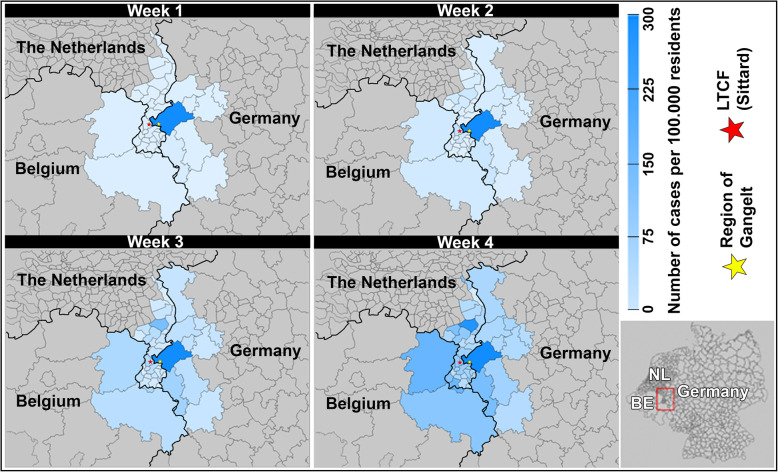
The Dutch province of Limburg borders the German district of Heinsberg, which had a large cluster of COVID-19 cases linked to local carnival activities before any cases were reported in the Netherlands. However, Heinsberg was not included as an area reporting local or community transmission per the national case definition at the time. In early March, two residents from a long-term care facility (LTCF) in Sittard, a Dutch town located in close vicinity to the district of Heinsberg, tested positive for COVID-19. In this study we aimed to determine whether cross-border introduction of the virus took place by analysing the LTCF outbreak in Sittard, both epidemiologically and microbiologically.
Surveys and semi-structured oral interviews were conducted with all present LTCF residents by health care workers during regular points of care for information on new or unusual signs and symptoms of disease. Both throat and nasopharyngeal swabs were taken from residents suspect of COVID-19, based on regional criteria, for the detection of SARS-CoV-2 by Real-time Polymerase Chain Reaction. Additionally, whole genome sequencing was performed using a SARS-CoV-2 specific amplicon-based Nanopore sequencing approach. Moreover, twelve random residents were sampled for possible asymptomatic infections.
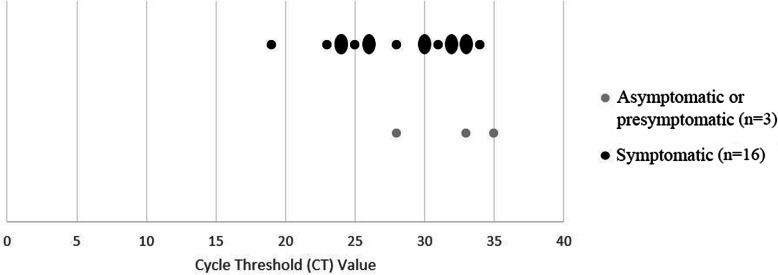
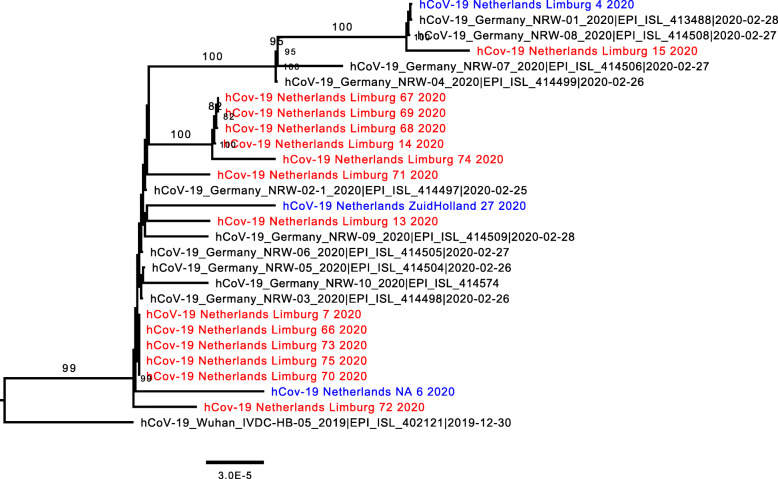
Out of 99 residents, 46 got tested for COVID-19. Out of the 46 tested residents, nineteen (41%) tested positive for COVID-19, including 3 asymptomatic residents. CT-values for asymptomatic residents seemed higher compared to symptomatic residents. Eleven samples were sequenced, along with three random samples from COVID-19 patients hospitalized in the regional hospital at the time of the LTCF outbreak. All samples were linked to COVID-19 cases from the cross-border region of Heinsberg, Germany.
Sequencing combined with epidemiological data was able to virtually prove cross-border transmission at the start of the Dutch COVID-19 epidemic. Our results highlight the need for cross-border collaboration and adjustment of national policy to emerging region-specific needs along borders in order to establish coordinated implementation of infection control measures to limit the spread of COVID-19.
荷兰林堡省与德国海因斯贝格地区接壤,在荷兰报告首例病例之前,该地区的狂欢节活动与大量 COVID-19 病例有关。然而,当时按照国家病例定义,海因斯贝格并未被列为报告本地或社区传播的地区。3 月初,来自荷兰锡塔德市的一家长期护理机构(LTCF)的两名居民新冠病毒检测呈阳性,该荷兰城镇与海因斯贝格地区相邻。在这项研究中,我们旨在通过分析锡塔德 LTCF 的疫情,从流行病学和微生物学角度确定病毒是否通过跨境传播。
医护人员对所有在场的 LTCF 居民进行了调查和半结构化的口头访谈,以了解新的或不寻常的疾病症状和体征的信息。根据区域标准,对有 COVID-19 嫌疑的居民进行了咽喉和鼻咽拭子采集,通过实时聚合酶链反应检测 SARS-CoV-2。此外,使用基于 SARS-CoV-2 特定扩增子的 Nanopore 测序方法进行全基因组测序。此外,还对 12 名随机居民进行了可能无症状感染的采样。
在 99 名居民中,有 46 名接受了 COVID-19 检测。在接受检测的 46 名居民中,有 19 名(41%)检测出 COVID-19 阳性,其中 3 名无症状居民。无症状居民的 CT 值似乎高于有症状居民。对 11 个样本进行了测序,同时对 LTCF 疫情期间在地区医院住院的 COVID-19 患者的三个随机样本进行了测序。所有样本均与德国边境海因斯贝格地区的 COVID-19 病例有关。
测序与流行病学数据相结合,实际上证明了荷兰 COVID-19 疫情开始时的跨境传播。我们的研究结果强调了跨境合作以及调整国家政策的必要性,以满足边境地区的新出现的特定需求,从而建立协调实施感染控制措施以限制 COVID-19 传播。