Gorgels Koen M F, Dukers-Muijrers Nicole H T M, Evers Ymke J, Hackert Volker H, Savelkoul Paul H M, Hoebe Christian J P A
Department of Sexual Health, Infectious Diseases and Environmental Health, Living Lab Public Health, South Limburg Public Health Service, PO Box 33, 6400 AA Heerlen, the Netherlands.
Department of Social Medicine, Care and Public Health Research Institute (CAPHRI), Maastricht University, PO Box 616, 6200 MD Maastricht, the Netherlands.
Public Health Pract (Oxf). 2024 Jun 27;8:100523. doi: 10.1016/j.puhip.2024.100523. eCollection 2024 Dec.
The COVID-19 pandemic highlights the importance of understanding facilitators for disease transmission. Events such as Carnival, characterized by large gatherings and extensive social interactions, have the potential to become 'super spreading events' for respiratory infections. This paper aims to assess the impact of large gatherings on virus transmission, providing crucial insights for the development of effective public health strategies.
An ecological study was performed.
The age-standardized number of COVID-19 cases reported in 2022, stratified by age (under 60 and 60+ years) was compared countrywide for Dutch provinces where Carnival was celebrated versus those where it was not. Additionally, we compared standardized hospitalization rates in 2022 and 2023 for both areas.
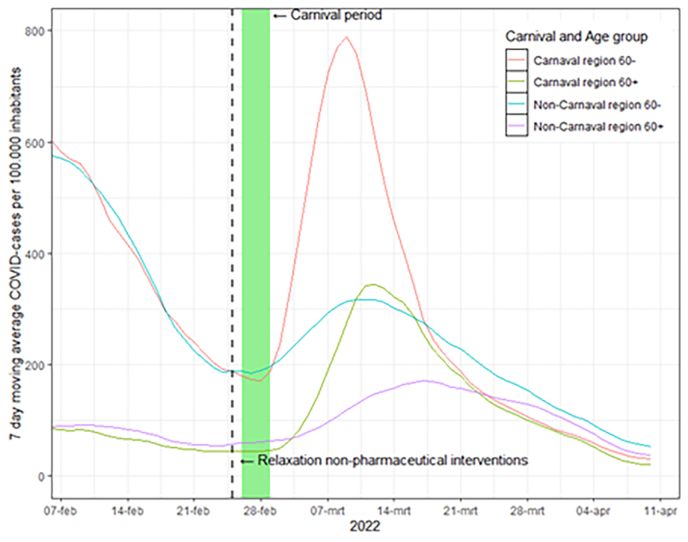
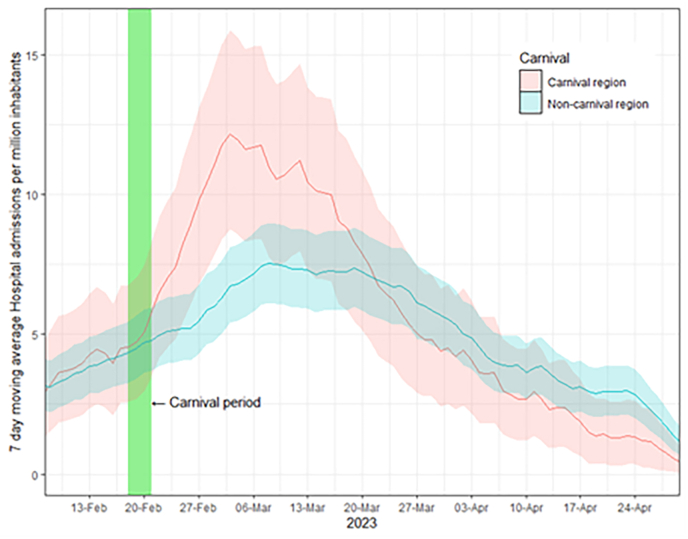
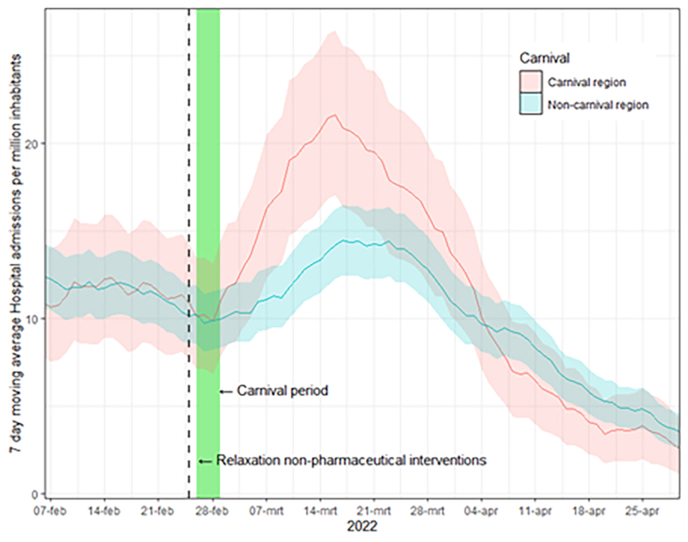
Countrywide, 2,278,431 COVID-19 cases were reported between 06-02-2022 and 10-04-2022. Daily incidence increased after Carnival, peaking at 803 per 100,000 inhabitants for under 60s in carnival provinces and 368 in non-carnival provinces. For individuals 60+ daily incidence peaked at 396 in carnival provinces and 247 in non-carnival provinces. Over the 10 weeks following the start of Carnival, the carnival provinces demonstrated a 15 % (2022) 17 % (2023) higher hospitalization rate compared to non-carnival provinces.
The peak in cases and hospitalizations in regions actively celebrating Carnival compared to the rest of the Netherlands qualifies Carnival as a 'super-spreading' event. Our findings underscore the elevated risk of respiratory infections associated with large gatherings, advocating guided policies, including transparent risk communication and healthcare preparedness.
新冠疫情凸显了了解疾病传播促进因素的重要性。诸如狂欢节这类以大型集会和广泛社交互动为特征的活动,有可能成为呼吸道感染的“超级传播事件”。本文旨在评估大型集会对病毒传播的影响,为制定有效的公共卫生策略提供关键见解。
进行了一项生态学研究。
比较了2022年荷兰全国按年龄(60岁以下和60岁及以上)分层报告的新冠病例的年龄标准化数量,其中包括举办狂欢节的省份和未举办狂欢节的省份。此外,我们还比较了这两个地区2022年和2023年的标准化住院率。
在全国范围内,2022年2月6日至2022年4月10日期间报告了2,278,431例新冠病例。狂欢节后每日发病率上升,在举办狂欢节的省份,60岁以下人群发病率峰值为每10万居民803例,在未举办狂欢节的省份为368例。对于60岁及以上的人群,举办狂欢节省份的发病率峰值为396例,未举办狂欢节省份为247例。在狂欢节开始后的10周内,举办狂欢节的省份的住院率比未举办狂欢节的省份高15%(2022年)至17%(2023年)。
与荷兰其他地区相比,积极举办狂欢节的地区病例和住院人数的峰值表明狂欢节是一个“超级传播”事件。我们的研究结果强调了与大型集会相关的呼吸道感染风险升高,并倡导制定有指导作用的政策, 包括透明风险沟通和医疗准备。